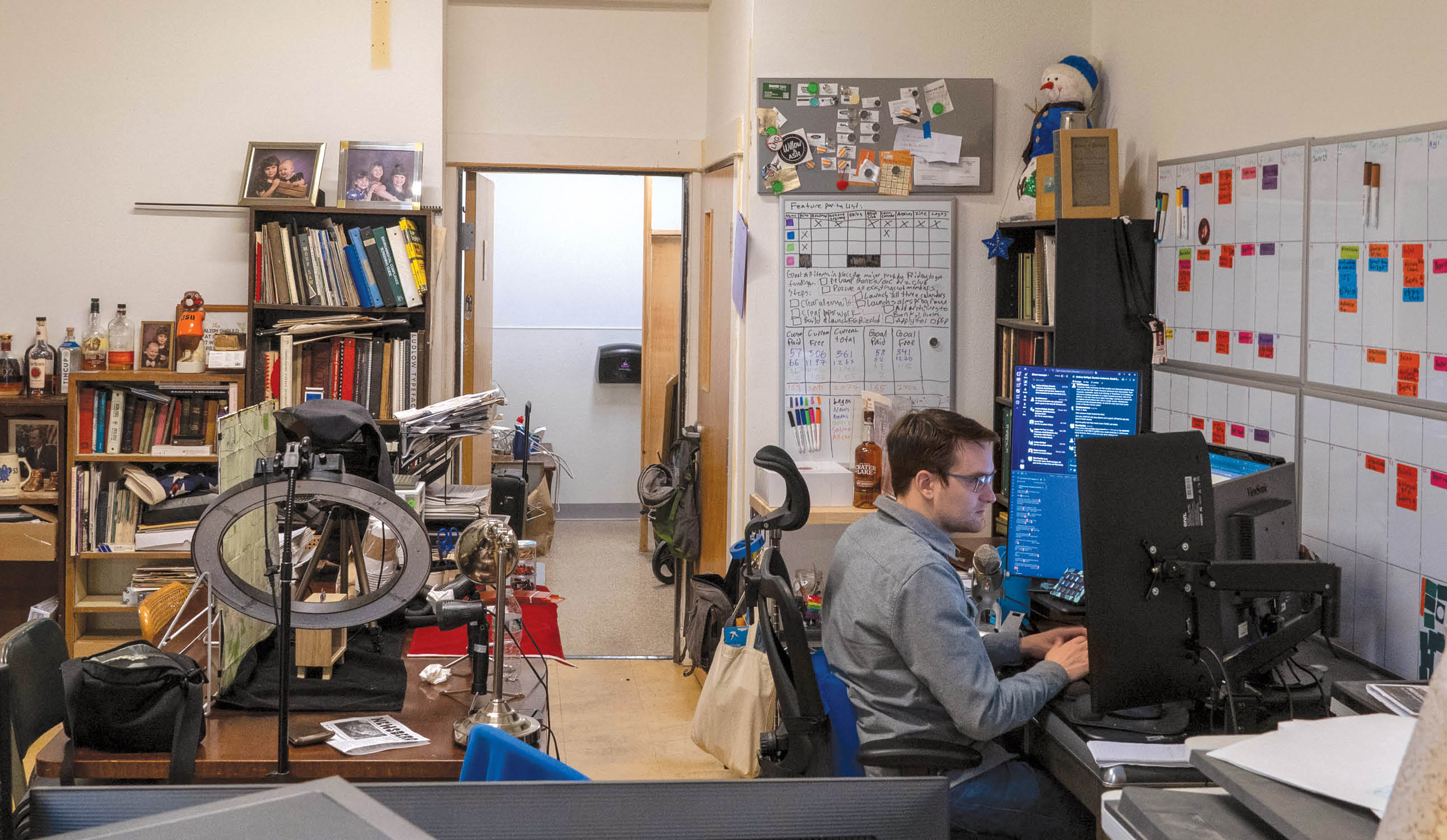
Near downtown Philomath, in a newer housing development, Brad Fuqua’s commute is the length of a hallway. His office is a small room in his home, the walls lined with various awards and memorabilia, a desk holding a Mac computer, a worn-out keyboard, and a Nebraska Cornhuskers coffee mug. A nameplate on the room’s door reads Philomath News. It’s the only dedicated news outlet in town, and Fuqua is its sole employee.
“I just redid a lot of it,” he said, sitting next to his new standing desk. “I spend a lot of time in here. But because of that, I don’t exercise enough, and my watch tells me all the time that I need to stand up.”
Philomath News is one of dozens of independent newsrooms in Oregon that have sprung up in response to recent tidal shifts in the local news ecosystem. Over the past twenty years, local news outlets across the country have experienced closures and corporate consolidation, which have significantly reduced or even obliterated smaller communities’ access to local reporting and information. Newsrooms like the Philomath News are largely owner-operated, meaning one person is filling the role of an entire newsroom: They research, report, write, edit, photograph, design, and publish, while also managing the business side, handling sales, marketing, IT, and finance.
“I don’t really make enough money to hire anybody to help me out,” Fuqua said. “I do have a freelance photographer that I pay mostly to cover sports. Some of those nights get late, and that’s before I’m able to get to the administrative stuff. I usually save that for the weekend.”
Most grassroots news outlet owners, or at least the ones profiled in this story, said they’d be happy working as a journalist in a traditional newsroom, covering their beat and clocking off after a good day’s work. They’re not working this way because they want to, but because they have to.
If they didn’t, who would?
The decline in local media has been well documented, and the story has several villains—the rise of social media, online classifieds and obituaries, the consolidation of media corporations, search engine advertising, consumers’ general unwillingness to pay for digital content. But it all boils down to harrowing statistics: According to Northwestern University’s 2025 State of Local News report, nearly 40 percent of all newsrooms in the country—roughly 3,500—have closed in the past twenty years. In 2025 alone, 148 newsrooms closed, averaging two per week.
The result is that around fifty million Americans do not have access to reliable local news about their community. Hundreds of thousands of local stories and happenings are unpreserved or poorly preserved in social media posts and comments that have not been factually verified.
In Oregon, the problem is increasingly framed as a civic health crisis. Research from the University of Oregon’s Agora Journalism Center shows that since 2022, nearly twenty local news outlets in the state have closed or merged with larger publishing groups. This represents an additional 13 percent loss in the number of community-focused news outlets from earlier declines, going back to the early 2000s.
But closures are just one way that the loss is felt. In 2024, the Alabama-based company Carpenter Media Group (CMG) purchased thirty-four local news outlets previously owned by Oregon-based publishers Pamplin Media Group and EO Media Group, ballooning the conglomerate’s total property number to 252 outlets in North America. Shortly after CMG’s purchase of the local outlets in Oregon, reductions in the number of newsrooms, journalists, and staff followed.
“The fact that there are no journalists in a town, a county, or a region does create challenges for the people who live there,” said Andrew DeVigal, director of the Agora Journalism Center. “Because there’s just not a trusted news source that they can rely on.”
DeVigal has been leading research into the state of local news in Oregon since Agora opened in 2014, examining and recording trend lines, researching Oregon’s news ecosystem, and reporting findings and case studies. In recent years, his students have traveled to rural communities to learn about the challenges faced by micro newsrooms—generally, newsrooms run by one or two people.
DeVigal has found that metro areas like Portland, Eugene, Bend, and Salem have ample, if understaffed, news outlets operating within their boundaries. However, the number of news deserts—defined as communities with no daily or nondaily news outlet—is increasing. These communities have no journalists working locally, or they’re covered by a weekly “ghost” paper filled with consolidated regional reporting and limited local reporting. Or, in the worst case, they have a “zombie” paper, like the one that took over the Ashland Daily Tidings in 2023 and published plagiarized and AI-generated articles under fake bylines before being unmasked by former OPB reporter Ryan Haas a year later.
“If there is a journalist in the area,” DeVigal said, “they’re pretty undersourced and can’t deliver news in a timely fashion. So [the community] would learn about news and events that are a week old and can’t participate because it’s already passed. That’s a huge problem.”
While the problem has been persistent since the wide adoption of the internet in the early 2000s, it’s increased in severity over the past decade, especially in small communities that only receive news coverage during controversies. In an ecosystem now driven by clicks and impressions instead of circulation numbers, the grabbiest headlines win. And the grabbiest headlines, otherwise known as “clickbait,” are the ones that elicit an emotional reaction.
However, those stories erode trust, not only between the community and the news media, but between members of the community itself. This is why some locals have decided to roll up their sleeves and combat the influx of clickbait and misinformation themselves.
For Chas Hundley, publisher of News in the Grove and The Banks Post, the decline in local news coverage was something he’d observed for years. The Forest Grove newspaper, he said, had withdrawn coverage of smaller neighboring communities “because they’re really tiny markets. There’s no real viable business to sustain a newsroom out there, but it doesn’t change that [the people in these towns] need verified local news to understand what’s happening. It’s a public right, even if the business isn’t behind it right now.”
In 2013, while working a separate job, Hundley started casually covering the news for the small, unincorporated community of Gales Creek. Without any prior journalism experience, he began contacting government agencies and gathering information about road closures and wildfires in the rural area. Initially, he published everything on Facebook; later, he transitioned to a printed product and website before launching a publication covering the neighboring community of Banks in 2017. A few years after that, Hundley noticed a drop-off in local reporting by the paper of record in his hometown of Forest Grove, and in 2024, he added a third area to his coverage.
“I do this because I truly believe it will help my community,” Hundley said. “I’m fighting social media platforms all the time. But my pitch to my community is, ‘I’m in town, and I’m accountable.’ I’m trying to do it in a responsible way that brings people together and provides vital information and increases the livability of this town.”
Working in a back room at Gann Bros. print shop, where he also prints a news mailer for paid subscribers of The Banks Post, Hundley publishes three to six stories per week across his publications, focused on civic reporting. They’re all available free of charge to the reader, at least digitally. Nearly every independent publisher in Oregon provides news, stories, and event calendars at no cost.
“Local information is important,” said Quinton Smith, publisher of the Lincoln Chronicle. “I believe it’s so important that it should be free.”
Smith had a long and storied career in journalism before starting Yachats News, now called the Lincoln Chronicle, in 2019. His first job was at United Press International in the early 1970s; then he worked at Oregon’s Albany Democrat-Herald before becoming editor of its sister paper, the Gresham Outlook. In 1984, he joined The Oregonian, where he rose through the editing ranks.
Eventually, he and his wife moved to Yachats on Oregon’s central coast. After nearly a decade in retirement, Smith said he looked around his community and saw a growing news desert.
“My MO has always been to be involved in the community,” he explained, “so I just decided to do what I know best—start a local news site and make sure people here still know what’s going on.”
That means doing baseline civic reporting: going to city council, school board, county commission, and parks district meetings to report what’s happening. Part of the job is to remind the community what local news should be: a record of what happened the previous day. This record serves as the first draft of history, as well as a way for the public to hold elected officials to account and ensure decisions about their community are not made in darkness.
Anne Scheck said that the work of a reporter—raising public accountability, documenting community life, and explaining local decisions—is a big reason why she started Trammart News ten years ago. Now, the company represents a collection of publications that cover Independence and its surrounding communities, including a monthly print newspaper called The Independent and weekly online stories.
“I see it as a vital service to the community,” Scheck said. “The watchdog role is important, but so is routine news-gathering—profiles, features, events—to keep the public informed.”
Scheck worked for thirty years as a journalist in the Los Angeles area before finding her way out due to what she described as a career “dying a slow death.” She then started her own freelance business, which thrived for a time, but eventually the work dried up. After retiring at sixty-two, she moved to Monmouth with her husband, who had taken a job there. Several neighbors heard about her experience as a journalist and asked her to take a look at what was happening at city hall.
“I went to a few city council meetings, then sent out some emails about what had transpired,” Scheck said. “There was a fair amount of interest, so I persisted. The rest, as they say, is history.”
Reporting a beat can be a grind even with the support of a full newsroom, but it can be especially taxing for a solo publisher. It demands a consistent presence, a robust Rolodex, and contextual understanding to ensure the reader knows the full story. Then the other work starts, as solo newsroom publishers must also be salespeople and marketers, ensuring their stories are easily found and, ideally, paid for.
The work is hard, but necessary, Scheck said.
“I cannot speak for others who have chosen to go a solo route … but I’d characterize it as a very worthwhile struggle against time and the adversity that comes with the job.”
The main question for these journalists is that of burnout—one of the many downstream effects of financial constraints. What at one time occupied an entire staff now depends on one person’s capacity. The money behind local news outlets sometimes comes from traditional sources like advertising, but is largely based on reader contributions and grant programs, not subscriptions (remember, most of these outlets are free to read).
Some micro newsrooms, like the Lincoln Chronicle, have found success by becoming nonprofits, which allows them to raise money from organizations or wealthy community members. Another common thread is spousal support or the use of personal finances to prop up a publication until it reaches profitability.
Most of the publishers in this story said they have gone or currently go without a consistent paycheck. Hundley, for example, bartended during a slow time at The Banks Post to keep money coming in. But that’s not stopping them. Everyone shared a number of factors that motivate them—civic obligation leading the way—and in some cases, they are finding that working without editors or publishers actually suits them.
“I don’t want to work for anybody else,” said Fuqua, the publisher of the Philomath News. “After all these years, I’m at the age where I don’t want to jump through those hoops anymore. And I love Philomath. I like community journalism enough to keep doing it because I feel like I’m contributing to this town.”
But these independent publishers also hold a somewhat troubling sentiment in common: We do it because we have to. Without financial support or other rewards, there is a real danger of these news outlets closing entirely. And the work itself can begin to feel like an obligation rather than a noble cause.
Still, there’s something they’re all betting on: That their communities are stronger and more connected because of reliable local news, and that this will lead to stronger financial support down the road.
Their models serve as a reminder of what news is and should be. Even with the challenges and endless hours, it’s work these publishers love doing.
“Every person in this industry is doing this work because they want to,” Hundley said. “We can all make better money somewhere else, easier, with less risk to ourselves, with less exhaustion, in ways that give us time with our families. I do this because I truly believe it will help my community—it’s the glue that binds our communities together.”
Comments
1 comments have been posted.
Great article highlighting the difficulties in providing local news. As a Philomath resident, I'm so proud to see my kids and their friends' accomplishments captured in the news. This fills them with pride and confidence like nothing else. Brad Fuqua is the life blood of our little community, and we would not be the same without him.
Chris Workman | April 2026 | Philomath, Oregon
Add a Comment