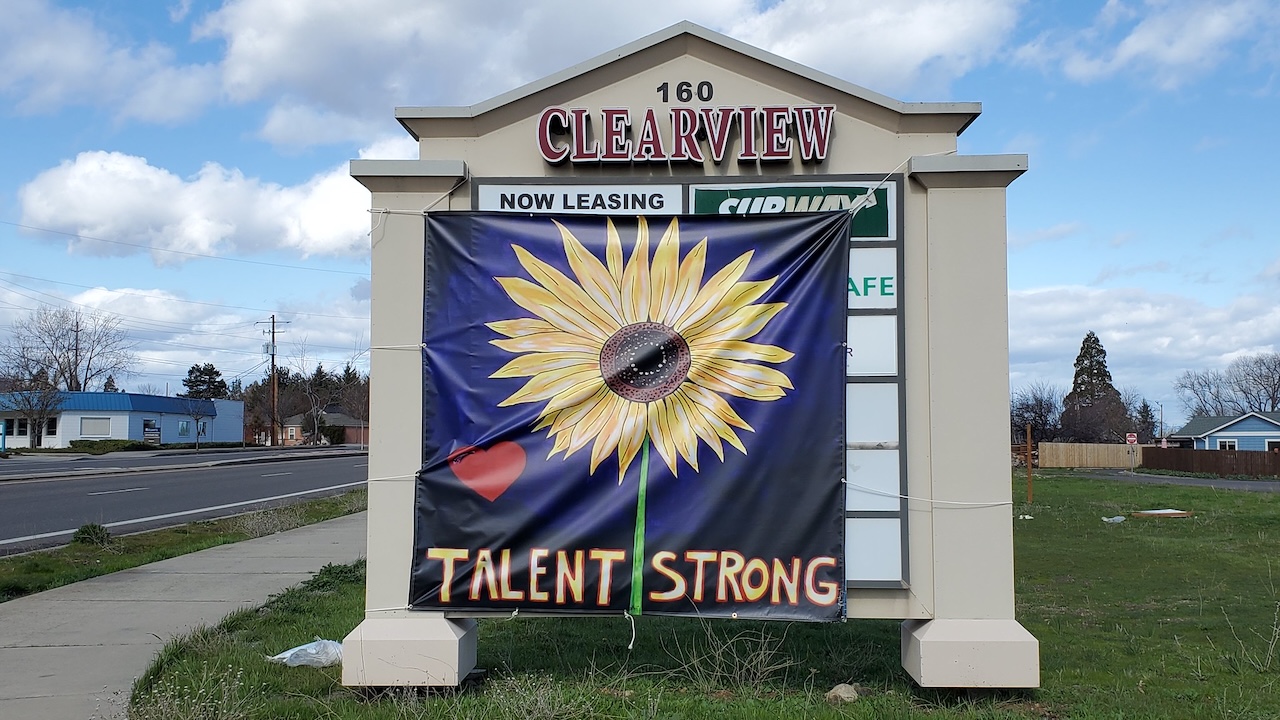
An emergency alert text from Southern Oregon University sounded the alarm bells for Jocksana Corona the morning of September 8, 2020. A fire was burning in Ashland and was out of control. She knew she needed to leave before it made its way north to her community in Talent.
“I just went with my gut feeling,” Corona said. “I was not told by a fire department or anyone to evacuate, it was just me saying, ‘This is not safe.’” So she started going door to door in her neighborhood, and posted to Facebook about the approaching fire.
“Many of the kids were home alone because their parents were working, so we were knocking on people's doors telling the kids, ‘Hey, call your mom, call your dad, call whoever you need to call, but you need to have someone pick you up because there's a fire coming down our way,’” Corona said.
Her family lost their home in the Almeda fire, like many people in Talent and the surrounding area in Southern Oregon. They lived in a shelter for 101 days before they were able to buy a house in another town. Corona’s neighbors in Talent and in nearby towns banded together to support each other in the aftermath.
“We fed each other. We came up with our own recovery,” Corona said. “The El Tapatio in Ashland had its own emergency station where people went and donated. . . . There were people taking care of each other. People who lost their homes were there helping others who lost their homes.”
Corona’s predominantly Latino community relied on neighborly support; many Spanish speakers struggled to navigate the assistance applications from the Federal Emergency Management Agency. People who spoke English and Spanish tried to help each other. Today, Corona works with Coalicion Fortaleza, a nonprofit that’s helping Rogue Valley communities recover from the fire and helping individuals to be more prepared in the event of another disaster.
People in Portland were also building community support to withstand the fires and smoke. During that time, Betty Brown ran a food pantry out of the Portland Open Bible Church through the nonprofit she leads, Nourish Oregon. Even as the dangerous air quality warning went out, the food pantry still operated for several hours every morning.
“Even during the fires when it's like thick smoke and nobody's supposed to be outside, we had lines of people outside,” Brown said.
The food pantry was already established in the community prior to the fires and burgeoning COVID pandemic and worked with partners like the Oregon Health Authority. This position meant they were able to create a hub for information on how to stay safe during the pandemic as well.
The trust that Brown and the pantry had built with the community also helped to dispel misinformation about the virus and the subsequent vaccine, which was widespread across media. Their preexisting relationships with neighbors made their outreach efforts effective in ways that direct outreach from government agencies may not have been.
“I'm very proud that the church made a decision that we're not going to turn our back on a community that's crying out,” Brown said.
During the 2020 fires across the state, many rural communities burned to the ground. The process of rebuilding has been extensive—but with community and state support, many of these small towns have been able to recover.
Valerie Rapp’s community, McKenzie Bridge, and the surrounding unincorporated small towns along the McKenzie River, had to figure out how to completely rebuild infrastructure after the Holiday Farm fire tore through their area. While the area began the years-long process of rebuilding, people had to find ways to protect what little they had left.
Rapp talked about a community-run project called Sheds of Hope. A group of local veterans volunteered to build simple wooden sheds to help people protect whatever belongings they had left on their property from theft and the elements.
“People who had lost expensive homes wept with joy and relief when they just got these storage [areas] they could put a few things in after the fire,” Rapp said.
Melanie Stanley is the owner of Meyer’s General Store, a fixture of Blue River—just downriver from McKenzie Bridge—since 1943. The store burned down in the Holiday Farm Fire, and Stanley, who also lost her home in the fire, struggled to find funding to rebuild until help came from her community.
“If you are underinsured or don't have hundreds and hundreds of thousands of dollars in savings, you probably will not be able to recover your business if it burns down,” Stanley said. “It took me two and a half years to find a private funding source, which literally is a person who believed in me, to help fund the finishing of the rebuild of this business.”
The building is still unfinished—Stanley says the building is 60 percent complete—and people who live along the river are stepping up, buying engraved bricks for the parking lot to support the project. “It really is a store for this community,” Stanley said. “We thought that the bricks were a good idea because then they can be part of the legacy of the building.
Forty miles north of Blue River, another mountain community was nearly lost in the Lionshead fire, which burned over 200,000 acres in September 2020. Nearly half of the buildings at Breitenbush Hot Springs Retreat and Conference Center, a worker-owned co-op just east of Detroit, were destroyed in the blaze. Peter Moore, a cofounder of Breitenbush, says the business likely would have closed were it not for the strength of the community.
“Social capital can sometimes produce miracles where financial capital just doesn't cut it,” Moore said, “and we've had a lot of social capital of people who care about this place and who care about this community and who care about our ideals.” Thanks to donations from visitors and the labor of Breitenbush’s worker-owners, the resort was able to reopen less than a year after the fire.
Back in Southern Oregon, businesses banded together to help a colleague whose facility burned in the Almeda fire. After Simple Machine Winery lost thirty barrels and twenty thousand bottles of wine to the flames, Medford winemaker Brian Gruber organized other winemakers to help them rebuild.
“He lost his barrels. He lost his racks. He lost his grapes. He lost his wine,” Gruber said. “What can we do to help? I donated some of my personal grapes, along with getting a lot of my friends to donate grapes—a full harvest’s worth, as many as he was going to buy, donated from all over the place, including grapes from as far away as Walla Walla. Our distributors donated barrels, got the glass company to donate glass. The custom-crush wineries donated all the winemaking services, so we effectively got him an entire harvest. And I called him and told them, 'Hey, we got everything for you.'” The business survived, reopening a year later.
In the small rural communities of Eastern Oregon, communities must be even more self-reliant when facing natural hazards.
Patrick Farrell is a former mayor of Mitchell, a town of fewer than 150 people in Wheeler County. In addition to running a hostel and a barbershop and driving the school bus, he volunteers with Wheeler County Fire & Rescue.
“There’s a lot of land in Wheeler County that’s not really protected by professional firefighters,” he said. “Every time there’s a fire, it’s a community event. . . . In some ways we have a stronger community because of recent fires: we all talk to each other, we’re trusting each other, and we’re starting to work together with other agencies more frequently.”
Curtis Martin is a rancher in North Powder, a Union County town not much larger than Mitchell. He says ranchers have to work together to protect an immense area from fire.
“Generally, we're the very first ones to arrive on scene because we have a lot of skin in the game,” Martin said. “It kinda goes with our culture. We are neighbors. We care for people that are in our community.”
On the other side of the state, Ian Keene, the planning director for the Confederated Tribes of Siletz Indians, echoes that idea of community care: “It's really all the communities together, the network of communities, and looking out for your neighbors,” he said.
Though only thirteen miles from Newport, Siletz is an isolated community, connected to the rest of the Oregon coast by a winding two-lane highway. In December 2025, a massive landslide destroyed the road north from Siletz to Lincoln City, where the tribe has a casino and medical clinic.
“That landslide has cut off the economic lifeline,” Keene said. “Folks are having to adjust to way longer commutes to work back and forth.” And yet people have adapted, helping one another deal with the much longer travel time. “Witnessing the tribal community respond to things and the endless togetherness that they exhibit, it’s a miracle,” Keene said.
While community connections are vital during and after natural disasters, they can also help people prepare for future hazards. Ariel Cowan, a regional wildland fire specialist with the Oregon State University Extension Service office in Deschutes County, says she’s seen people who have the time and resources to prepare for wildfires help those who do not.
“I see the community members who are really prepared also working with their neighbors, and it's really beautiful to see that community approach,” Cowan said. “Instead of it being every person for themselves, they're looking all around them and saying, ‘Oh, you know, I do know this neighbor here. They have some challenges—how can I support them?’ Or even just being able to know everybody's phone numbers and call to make sure that everybody got out if there was an evacuation. Or saying, ‘Hey, I have a trailer and you have horses. Let me try to help you get your horses out.’”
Anna Gahley works with the High Desert Partnership in Harney County. She says she’s proud of how her community comes together to deal with natural disasters. “That could look like a meal train. That could look like filling sandbags. That can look like, you know, taking meals out to a fire. They really come together, and everyone is a neighbor. Every single person is fighting for that one cow, that one ranch, that one trail that we all like to go on. I think that's just truly amazing to see people come together at the table and say, ‘What do we need to do to help one another, no matter who it is?’”
“The amazing thing about any disaster is that you survive it, and then you see what people are made of,” said Peter Moore, the Breitenbush cofounder. “The positive side of the shock and the pain of loss is . . . in the aftermath, you know, okay, we’re survivors of this. What are we going to do well? We’re going to survive, and we’re going to thrive again.”
Comments
No comments yet.
Add a Comment