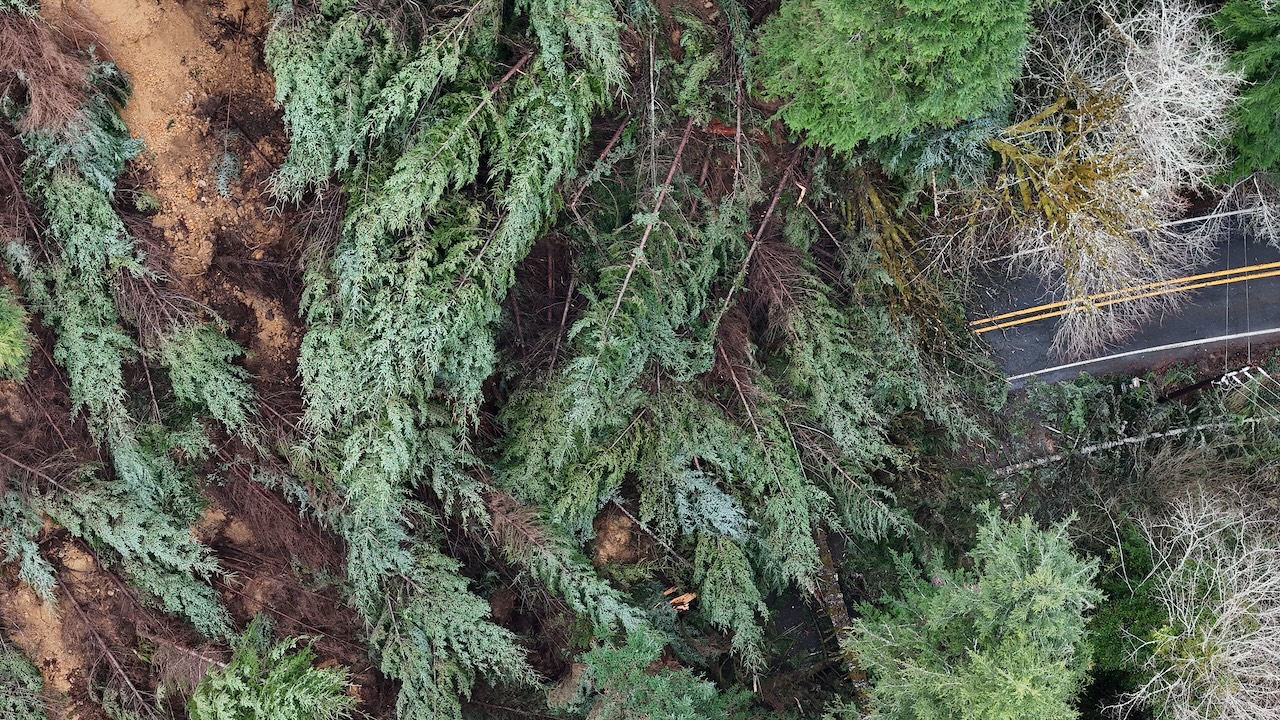
Each year, it seems, Oregon keeps breaking terrible records for the number of acres burned, power lines downed by ice, or homes destroyed by ecological disaster. This year has been no exception. After an unusually mild winter, Southern and Eastern Oregon yet again faced historically devastating fires. This past winter, mudslides shut down a major highway that connected the north coast with the rest of the state, and nearly half the population of Burns was forced to evacuate by flooding. On the horizon looms the threat of the Big One, the Cascadia Subduction Zone that shakes the Northwest every 500 years.
Rural communities often bear the brunt of natural disasters. The same expanses of forest and rangeland that draw people to these communities puts them at risk from wildfire. Isolation means state resources can be slow to arrive in the event of a disaster.
Lisa Norton, the chief administrative officer for the Confederated Tribes of Siletz Indians, experienced this firsthand in December 2025, when a huge landslide shut down Oregon Route 229, cutting off Siletz from Lincoln City and other towns to the north. The highway remains closed, with no date for reopening announced.
“I think rural folks are used to not having an immediate response,” Norton said. “If that road had been I-5, it likely would've been fixed or [had] an alternative right now.”
In the absence of certain kinds of government support, the Confederated Tribes of Siletz has had to rely on the resources available within their own community.
“That’s what's so indicative of rural communities and tribal communities, is you make do with what you've got,” Norton said. “You find out who has a bulldozer or an excavator. You find out who can haul a trailer. You know those things ahead of time, and then you practice with each disaster.”
Many residents of rural communities who spoke with us for This Place shared similar experiences: Government resources, when they exist, often can’t swoop in fast enough to head off the initial impact of a fire, a landslide, or a flood. It’s up to communities to endure.
When people talk about how local governments could respond better to disasters, they focus on what happens in the aftermath.
Jeff Kincaid is a senior operational analyst with the government of Lane County—a job that involved a lot of emergency response during the ice storms that hit Western Oregon in January 2024. While the county tried its best to keep up consistent communication with the community, this task was made more challenging by the power and telecommunications outages caused by the storm.
“During the event you saw towns that really banded together really well and took action and took care of folks, and then you saw towns that maybe weren't as ready for that,” Kinkaid said. He emphasizes that it’s important to seize the urgency after a disaster, once the community has returned to a relative baseline, to make changes to prepare for what many agree will inevitably be the next disaster.
“Within those first few months, there's a lot more motivation to do it, and then afterwards we as humans tend to just be like, ‘Oh, it's not going to happen again,’” Kincaid said. “On the emergency management side, it's really good to get folks to act during that timeframe to build that resilience when they're most motivated to do so.”
The more that people with greater resources prepare, Kincaid said, the more local governments can put their limited resources toward people who need them: “Resilience looks like being prepared so that you can endure the most difficult part of a disaster within your small community, whether that's within your household or your neighbors,” Kincaid said. “Resilience to me just means that you can hold out and you can make it through those shorter periods of higher intensity disasters, and not need outside resources to get there.”
Chris Goldfinger, a retired professor of geology at Oregon State University, says local governments should be looking at what works elsewhere to plan for major disasters like a Cascadia Subduction Zone earthquake. In 2011, Goldfinger was at an international meeting of seismologists in Japan when the magnitude 9.1 Tohoku quake hit. Although it was the most powerful seismic event ever recorded in Japan, he recalls seeing that people were very well-prepared to deal with the event.
“Japan has become a very safety-oriented culture,” Goldfinger said. Buildings large and small are built to withstand shaking, including pedestrian bridges, so that people can walk home when trains are automatically shut off during a quake. People are informed about what to do in the event of a quake. But Japan has a top-down government that makes imposing such safety measures easier than it is in the US.
“State and local government is sort of on their own to figure these things out,” Goldfinger said. “If we want to be resilient to earthquakes, we have to think forward the way the Japanese do. . . . It’s actually a pretty tractable problem that just costs money. We can afford to do it.”
Building resources within communities prior to or in the aftermath of disaster, with government support, can make a huge difference in the future.
“ State and local governments have their hands full when it comes to natural disasters,” said Patrick Farrell, a former mayor of Mitchell, a town of fewer than 150 residents in Wheeler County. Mitchell is surrounded by public lands that are prone to wildfire. Farrell says he’d like to see the state and local governments devote more resources to planned burns and removing juniper and other fuels. “We need to be better about burning things on a frequent basis,” he says.
Public-private partnerships like the Rangeland Fire Protection Association of Eastern Oregon, which trains landowners to respond to fires in their earliest stages to prevent more damage, utilize government support to increase community resilience.
Aaron Johnston, who works with the Harney County Wildfire and Forest Restoration Collaboratives in Eastern Oregon, said, “When a fire starts in a very far off place that might be hours away from any agency suppression resources, these guys are out there on the spot within a short period of time to put out those initial flames.”
Johnston said these partnerships between the local government and landowners have reduced tension between the two groups, by increasing communication and cooperation between them.
Managing the various interests within communities as part of emergency preparedness is crucial to creating sustainable plans that have buy-in from all communities involved.
Mark Mulvihill lives in Pendleton and experienced the 2019 and 2020 floods of McKay Creek and the Umatilla River that resulted in millions of dollars of damage. Now, he sits on the board of the Lower McKay Creek Water Control District.
In the aftermath of the floods, when considering ongoing management of the McKay Dam and downstream waterways, the community had meetings to try to reconcile the different interests of landowners who had property damaged in the flood, people who relied on the dam for irrigation, and local tribes who benefited from the fish runs for salmon.
“The first thing was to accept where each audience is coming from, and that the only way that creek is going to be meeting the needs of all three entities is a win-win-win project,” Mulvihill said. “The idea that it'll never flood again is not realistic, so what are we going to do about that and learn and support one another?”
Building resilient communities requires learning from many stakeholders and from past disasters to better plan for the future.
Anna Lindquist, the City of La Grande’s urban forester, says local governments have to look both forward and backward. A healthy canopy brings many benefits, including mitigating heat islands and slowing stormwater, but the trees have to be healthy—and many of the fast-growing species are vulnerable to pests and disease. So governments have to look not only at what trees can survive in the unnatural urban environment now, but at what will be able to survive twenty or fifty years in the future.
“When you think about resilience in an urban forest and resilience in general, it’s not about going back to what was,” Lindquist said. “It really is just about experimenting, trying to think about, What can we learn from the past? And how do we use that to inform the future?”
Comments
No comments yet.
Add a Comment