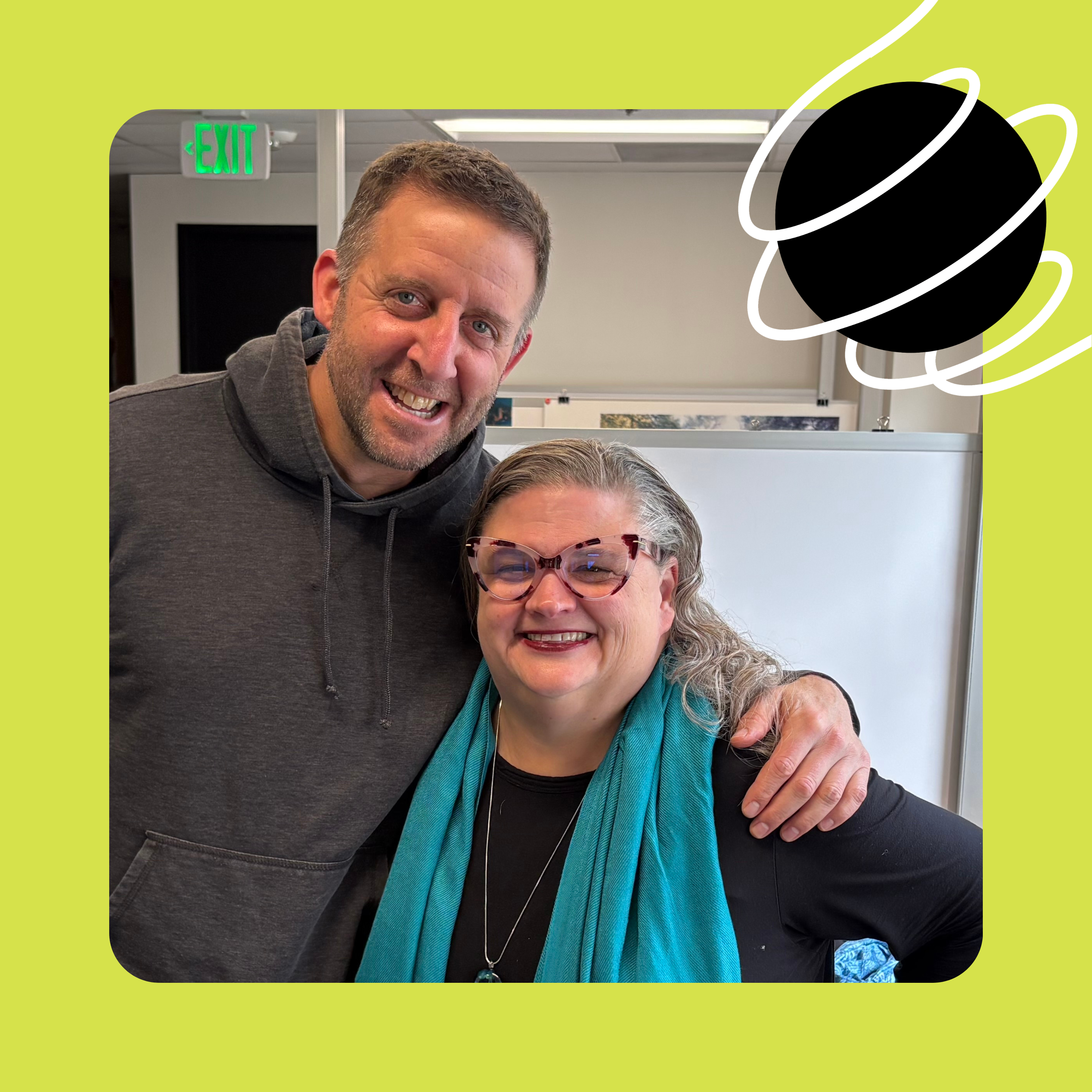
If we are a nation committed to the idea of self-rule of government by the people, for the people, and of the people, one of the biggest questions facing us is, Who actually governs? Who steps forward and engages in the representative part of representative government? One very specific answer to this question is CM Hall. CM has been a city councilor in Newport, Oregon for several years, as well as chair of that city council. CM also runs Emerge, an organization that identifies, trains, and inspires women to run for office. This conversation explores CM's journey toward and in public office, especially local office. And though this is just one person's journey involving everything from identity and belonging to plastic bags and trash, we hope that it pushes all of us to think about the prospect and experience of public service.
Show Notes
About our guest
CM Hall is a proud lifelong Oregonian and serves on the Newport City Council. Professionally, CM’s extensive experience includes teaching, political strategy, and advocacy work. She is currently executive director of Emerge Oregon. Linguistic access, equity, and inclusion are CM's passions, and she works to inform progressive organizations on the importance of diverse and representative engagement. CM hosts and produces the Her Own Wings podcast featuring Oregon women in leadership with the goal to encourage more women who might pursue elected or staff positions in government. CM has been a member of the Oregon Humanities board of directors since 2021.
Further detours
More stories about serving in public office from Oregon Humanities:
- "Public Servant: A cab driver whos an elected official by day has his work cut out for him" by David Bragdon, former president of Metro
- "A Remedy for Disruption" by Chelsea King, West Linn-Wilsonville School Board member, on mask mandates, meetings, and the importance of presence
- "An Honor and a Duty" Eddie Melendrez on what he learned running for and serving on the Ontario, Oregon City Council
More episodes about democracy and public service from The Detour:
- An America as Good as Its Promise with Desmond Meade, Danielle Allen, and Jesse Beason
- Reinventing American Democracy with Danielle Allen
- The Lands We Live On with Chuck Sams, former director of the National Park Service
- Participation and Power with Hahrie Han, Bruce Poinsette, Marcus LeGrand, Joy Alise Davis, and Keith Jenkins
Transcript
Adam Davis: Hello and welcome to The Detour. Here in March 2026, as we move further into the 250th anniversary of the Declaration of Independence, Oregon Humanities continues to explore foundational questions about our nation and government. If we are, as we seem to like to say, a nation committed to the idea of self, rule of government by the people, for the people, and of the people, one of the biggest questions facing us is who actually governs?
Who steps forward and engages in the representative part of representative government. One very specific answer to this question is CM Hall. CM has been a city councilor in Newport, Oregon for several years, as well as chair of that City Council and CM also runs Emerge, an organization that identifies, trains and inspires women to run for office.
It happens that Emerge works with women who run as Democrats. CM has to this point been affiliated with theDemocratic party, but what we aim to explore here is not party affiliation so much as public service and public office. CM, as you'll hear, knew fairly early on that public service and even public office would be part of their life, and CM has also worked to help other people think about stepping forward and filling these roles that our communities depend on.
I should also note that CM is on the Oregon Humanities Board of Directors. This conversation explores CM's journey toward and in public office, especially local office. And though this is just one person's journey involving everything from identity and belonging to plastic bags and trash, we hope that it pushes all of us to think about the prospect and experience of public service, whether we head that way or not.
CM joined us in Oregon Humanities’ downtown Portland office in December, 2025, and our conversation began with how and when CM recognized that public service and elected office would be part of their life. CM. Thanks for joining us here on The Detour. I want to start by asking you when you started to realize that politics might matter to you?
CM Hall: So I'm an Oregonian lifelong, and in the early 1990s, Oregon was working to defeat some pretty corrosive anti LGBTQ ballot initiatives. Ballot Measure nine and Ballot Measure 13 in 1992 and 1994, respectively, and that was in my early college days. I was kind of coming out right at that same time, questioning my own sexual identity and watching those campaigns.
And the first one I was starting to voice how this is wrong that people want to discriminate and legislate that. And then by 1994 I had come out and I was actually actively organizing on my college campus. It just felt like the personal is political. My identity, my friend's identities are being put on the ballot.
Everyone's getting to have an opinion on something that is so personal and private that people shouldn't get to have a vote on. You wouldn't vote on whether or not someone has freckles, you know? So why would we say like, you get to vote on whether or not someone's sexual orientation is valid, and that they should get to work or not work because of that.
So that just really was gasoline on an internal fire. And then I just kind of went from there and started doing more campaign organizing, specifically as a queer person. They were doing, uh, more organizing to get young, queer people trained up to work on political campaigns, and a national organization pulled me in to get involved with that work.
Adam Davis: Mm-hmm. So you're in college?
CM Hall: Mm-hmm.
Adam Davis: You're coming out. You have a sense that what's going on in national politics is harmful or….
CM Hall: It was really more Oregon-based at that time 'cause it was so palpable. There was a toxicity and an emboldened toxicity, I would say, for people who are anti LGBTQ at that time.
And then I think it went underground for a couple of decades and now it's coming back. But that really was where it was centered for me. So it was, so much of those early days, um, were very much about LGBTQ equity and liberation and justice, and then recognizing that there was a political party. That was saying, you're a part of us, we're fighting for your issues.
And there was another party that was like, we're not with you. And so that for me felt very clear. Like I had already made some determinations about some other key values that I had, and it really did feel like it crystallized around one political party. Like, if these people are gonna fight for me and these people are gonna see my identity is valid and be inclusive of me and my friends and hire staff that feels like a representative group of people, that again, reflects my values. That's the party I can align with. That's the party I can fight for. You know, those are the values that I stand for.
Adam Davis: So I think in a bit, maybe we can get more into what followed college and what greater involvement with politics looked like and looks like.
But I wanna go earlier, like, did you grow up in a political or, uh, an engaged home? What was going on there?
CM Hall: Yeah, I did not grow up in a politically engaged home other than I grew up with Republican parents. I think a formative figure that I learned about young that really did kind of incinerate that spark of recognizing injustice was studying and learning about Harriet Tubman and just realizing how many trips she took along the Underground Railroad and that just felt so, um, personally moving to me even as a young child. And I've always really seen her work as heroic and I don't feel like she’s certainly ever been given the due she deserves.
For me, that was so formative.
Adam Davis: Hmm. How did you know your parents were Republican and when did you come to know that?
CM Hall: Mm, I don't know if there was a particular moment. We grew up Catholic and while there weren't conversations that I remember around political issues, my parents separated when I was seven and my bio mom, and that's how I will refer to her, um, was very mentally unwell.
And so there was a lot of vitriol and hate and judgment for anyone that was not Catholic, Frankly, if she knew they were not Republican, um, it did, like, there was just a very, very narrow way in which they could be perceived as Right in her mind.
Adam Davis: And even as a kid, that was very clear to you,
CM Hall: Very clear. She talked about it openly, like we couldn't associate with neighbors, even people within our Catholic church. And I had, I did go to Catholic school, grades one through eight, and, um, she would even judge and assess whether or not they were the right kind of Catholic. It was real harsh.
Adam Davis: Hmm, wow.
CM Hall: So, um, it was hard to kind of adjust. Like, if I'm talking to this person or I'm trying to play with this person, I feel like I'm gonna be in trouble, that kind of thing. And when I had friends in high school, um, my two closest friends, my first two years of high school happened to be people of color and I knew very clearly I was not allowed to bring them home.
Never. Our home wasn't a safe home. So that was probably a wise choice anyway, but I wasn't really supposed to be hanging out with them, so I had to do all those things and it felt very secretive. It's kind of like I am already very accustomed to a closeted kind of existence. Like everything I was doing outside of the house, I was really trying to keep that on lock down because I couldn't share that everything was gonna be up for judgment and scrutiny in a real hyper intense way.
Adam Davis: Mm-hmm. Now you're living in Newport?
CM Hall: Mm-hmm.
Adam Davis: You're a city councilor?
CM Hall: Yes.
Adam Davis: And maybe even president of the city council?
CM Hall: Uh, I have been twice, not this year. Mm-hmm.
Adam Davis: And have been doing political work for, is it fair to say? Decades.
CM Hall: Yeah.
Adam Davis: What you were just saying about the sense of judgment, how does that show up for you in the political work you have been doing?
CM Hall: Hmm. I think the more I get into it, the more I have to be open to multiple perspectives. Coming at things with a sense of like, they understand it differently than me and there's not one right way. And I did not grow up like that. Because I grew up as this is the one right way. And so, so much of that is the unlearning that I've had to do and kind of parent myself.
Or have my friends help parent me, uh, to really undo so much of that damage that I got growing up, trying to release some of that judgment. It just is so hardwired, unfortunately, into how I've kind of come along, but I hope that in my work as an elected official, I am more open. Like we've had to hear issues that it's like, oh, I have a real clear idea of how I want this to go or how I think about this.
But I am often the person who will sit back on the dais and wait for others to share remarks and really kind of take it all in. And then maybe make some comments because I just wanna hear it all. I don't wanna be knee-jerk. I wanna take it all in. And also, when we have so many people giving public comment…
Adam Davis: Can you think of an example of one that comes to mind?
CM Hall: I mean, two examples that come to mind in our community. One was right after I got on city council. I feel naive now in that I really led with this because I probably should have waited a little bit, but I was like, we're gonna ban plastic bags. Right. This was right before the state legislature had done it and ooh, that was controversial. And good people on all the sides of this came forward. Hmm. And it was like, ah, maybe we need to have a more measured or slowed approach to this. Right? So instead of just like, let's do it, you know, immediately, like overnight thinking about like, okay, well let's think about like, how is this gonna impact grocers?
How is this gonna impact their bottom line when, if we shift this overnight and they've bought all of these, you know, plastic bags, how are they gonna adjust to the cost? And we have some small businesses that are grocers in our community. And so like thinking about that, like I wouldn't have thought of that.
Like I was just thinking like, no, we're gonna get rid of them. You know? I need to think about this. I need to not judge the situation so harshly. And another one, and I think it's still one of these areas where there are so many different layers to this, is around short term rentals.
You know, in Newport we're a vacation destination. Mm-hmm. And a lot of these rentals are really fit for people who are like families or friends who wanna get together for like a retreat kind of weekend or girls weekend or something like that. And like individual hotel rooms just really not the right fit for them.
So short-term rentals make sense. At the same time, when you have so many short term rentals, it really crowds out housing supply. And we are desperate for housing stock in our community as many communities are. And so hearing lots of those perspectives of people who are like, this house has been in our family for 50 years and this is how we make our income and to have this rental property.
And it's like, well, that's a compelling perspective. At the same time. We don't have housing stock. Yeah. At the same time, there's parties all the time and we just can't get any peace. You know, when all these vacationers come and you know, they don't respect the community and they throw their garbage all around and they park all their cars.
And so just hearing all these perspectives and being like there isn't one right way. And that's the one thing I'm grateful for as a councilor. I have been able to kind of really become more open to so many different ways to kind of come at things and recognize they're really great people who just care about their community, even if we may not see eye to eye on one particular issue.
Adam Davis: So I'll just say that sounds actually quite difficult to move towards an increasing recognition that there's a range of respectable and maybe credible opinions, and that that's where you're doing a lot of your daily work. Do you find that, and you just said you were grateful for it, it all sounds hard?
CM Hall: I am grateful because I feel like I learn from it. I feel like it makes me a more open-hearted person to learn about other people's perspectives and where they're coming from. I think because I did grow up with such a harsh, kind of everyone else's wrong and bad because of this, this, this, and um, I really had to still continue to unlearn that. So trying to be open to gratitude for, I know you're impassioned on something and maybe if we completely do not see eye to eye on this, you're impassioned about that. I will say, admittedly, it gets real hard when it is personal on a level where it's people who still wanna come forward and legislate my identity. That's an area where I'm like, I really have a hard time seeing their like, just impassioned, you know? Like I, I, I really struggle with that still. Because it feels like we're talking about me. You're talking about me. Like you just have an issue with me and like I still have to work on that part.
Adam Davis: So plastic bags or even short term rentals are out there a little, but when it's the person….
CM Hall: Yeah. Right, because I can't disconnect sexual identity, from race, from disability, from other identity groups that feel all intersected in different ways. Right? Like if you have issues with people, for example, based on their gender identity, what's to say tomorrow you're not gonna come forward and say like, you know what, we don't want people with disabilities to come here. And so I just feel very sensitive to why we are legislating about people's identities. Feels like an area that is just beyond what our conversations and our legislation should be about.
Adam Davis: Mm-hmm. And that makes me want to ask about two other areas of work you do. One is with women.
CM Hall: Mm-hmm.
Adam Davis: Through Emerge.
CM Hall: Right.
Adam Davis: To help women get ready for serving in office.
CM Hall: Yeah.
Adam Davis: And the other is in education specifically around people with disabilities and sign language and other ways to communicate.
CM Hall: Right. When I was a college student and when ballot measures, no one nine and no one 13 were going along.
I was in college to study to become a sign language interpreter and I had a teacher who made us all watch this really great series that was on PBS called Eyes on the Prize, and it was really looking at the civil rights movement and paralleling the civil rights movement with the struggle for deaf visibility and the oppression that deaf people have experienced for so long, simply based on audism.
And I'm gonna always spell that because people don't necessarily hear it.
Ben Waterhouse: Mm-hmm.
CM Hall: But A-U-D-I-S-M, the belief that people who cannot hear are somewhat lesser. So it's kind of that, you know, it's an, it's an ableism related term, but she was able to really put those parallels together in a way that was so clear that we're really just talking about struggles for justice.
Adam Davis: Mm-hmm.
CM Hall: And quests for equality, quests for visibility, and for me that just felt completely obvious. Of course, this makes sense. Of course, we would be fighting for justice, for racial equality. Of course, we should be fighting for justice, for equality and visibility for deaf people. And I worked really hard for the last, you know, several decades to be an ally and an accomplice.
Right. To lift up and elevate people who are deaf and particularly deafblind. Mm-hmm. Um, I've worked with my colleagues as interpreters to make sure that there was training for sign language interpreters, to work with people who are deafblind because it is a niche, smaller community and there is a lot of prejudice.
And people who don't necessarily want to actually touch other people to communicate. And you have to do that when you're talking to deafblind people. It's a tactile-based communication, and so making sure that people understood how to do that. And so working with a lot of deafblind leaders nationally to work to get that education out there. Um, 'cause there is a new language in the deafblind community that people don't necessarily all know yet. And so making sure deafblind people and interpreters both have access to that. So that has been so much of my work and the last couple of decades. And now you're right.
Getting to do other passion work, which is inspiring training, recruiting women to run for office and to lead with their values and trust that they can do it. And I say that because so often imposter syndrome is real. So many other things are on our plates. And just recognizing like sometimes women need to be told and in fact on average, women need to be told seven times to run for office. Like encouraged, um, hey, you know, you'd be great as a local leader, like you should think about running for office. But the real number, if we're actually looking at the subset for women of color, you know, like encourage and tell and plant the seed with women of color 21 times, you know, and you think about so much of the cost of what it means and to take into account.
They have to think about when you're considering running for office, domestic priorities, work priorities, community priorities, but actually that is what leaders are doing already. So, um, just trying to get more people to see themselves as leaders and get themselves elected.
Adam Davis: So first I want to note that you're doing lots of hopeful and difficult work in the….
CM Hall: world
Adam Davis: in a few different areas, and then I want to pic up on the last thing you were talking about, which is what it takes for maybe women to recognize that running for office might be something that they can and should do. What was the first thing you ran for? The first seat you had to get elected to?
CM Hall: I mean, I ran in 2018 for Newport City Council and I did win that seat.
I'm still so proud to get to serve Newport and I'm in my second term now and I'll run, I'll file and run next year again for a third term. But I love Newport and it was a dream come true 'cause I always thought I would get to live in Newport, but my work had been equal distance between Portland and Newport and I just made a bold move in 2015 to move out there, and I'm so glad I did.
Adam Davis: So the move to Newport, that sounds like maybe it was kind of your own decision.
CM Hall: Yeah.
Adam Davis: I'm thinking about what you said about having to be encouraged to run for office. Mm-hmm. How did you decide, how did you actually decide to run for office only a few years after moving there?
CM Hall: I mean, I had known that I had served in so many different ways in my community. Like I have served on a lot of different boards.
Adam Davis: Mm-hmm.
CM Hall: I know my skillset and I'm good in board service and public service. I feel called to that and I knew I wanted to serve my community in that way, and I also knew that representation mattered.
And being a queer person, there's just not a lot of queer people in elected office, which means if there aren't a lot of queer people in elected office, then there aren't queer people who think maybe I could run. I don't see those people reflected. So I'm like, I know that that's important also, but I also love my community and I thought maybe I could run in Portland when I lived in Portland, but there are a lot of really good people in Portland. There's just a real deep bench here, and I thought this was a moment in time when I could pivot and what if I just made the bold move now and then to want to serve was like, yeah, let me just jump in and get up to speed on Newport.
The second I got there, 'cause I knew I wanted to run and I felt called to run, I had gone through the training that Emerged does, knowing that I would wanna run at some point. I had done that like years earlier. So then it was about the right race, right time, and figuring out that right race was gonna be Newport.
Mm-hmm. And so running for City Hall, I mean, come on. That just feels like it fits right. It felt right. And I feel like I am a better city councilor today, you know, than I was year one 'cause you start to develop better skills and you learn more about your community. But I just feel like I am supposed to be exactly where I am.
Karina: Hmm.
CM Hall: I feel like I'm very fortunate to be in this position and I care so much about Newport and the direction of Newport that I'm supposed to be in this position.
Adam Davis: First of all, it's great to hear you say that. I think it's great to hear anybody say that about where they are. This is the place I should be.
And given what you were saying before about parts of people's identity and parts of your identity that you are going to bat for. It seems like a challenging, risky,vulnerable move as well as a place that might feel good to be. So you're nodding, and I guess I want to ask about that part. The part that felt risky and may feel risky or vulnerable.
CM Hall: I can give you a very current example. There is a landfill that's actually in Benton County right now that they're gonna have to close, potentially 10 to maybe 15 years. Newport puts our waste in that landfill. I know this is a really hot topic that we're talking about, but it matters to the city of Newport and it matters to the residents what our garbage rates are, and if the rates go up, I'm not certain that our residents can afford and how's that gonna work? Right? The issue before the county is, are they gonna permit four or five more years for some expansion of this landfill space that is designated, but recognizing that the local community also has very strong impassioned opinions about this in Benton County that live right around the landfill.
Yeah, they have issues around odor. They have issues around critters that are maybe around, those are real issues. They're very impassioned about that too. And there are lots of environmental issues on all sides. I don't like to say on both sides 'cause like there's way more than two sides of things.
And all of this is to say that when you talk about risky and vulnerable, I provided testimony to say, please think about expanding because while 10 years may feel like we've still got lots of time, it does feel a little bit abrupt. But the other thing I was saying is like, can you please read us in on your decision making process?
We are stakeholders in this. But we were not at the table. So while you're thinking about shutting this down, that has a real economic impact. So I'm really worried about what does that mean for our garbage rates and how do we continue to afford the cost of living where we live? I provided this testimony and I had put my name signing onto this, and I recognize that.
I fully understand the issues of the people who live around there. Those are really valid concerns as well. And I also see myself as an environmentalist and sometimes leadership is unpopular. And I recognize that. I heard from someone who I dearly love, absolutely love—a political science professor that had been in my life from years past, and he was like, I'm really disappointed that you signed on in the letter.
And I was like, oh. Like there are just some people that just cut to the core. And I'm like, but you taught me, you know, that sometimes we have to make these decisions. Mm-hmm. And we both testified on this in front of their hearing and I shared with him like, you gave great testimony and we are on perceived opposite sides on this.
Or not, because I do think that their side is valid. Mm. I feel impassioned about where I'm at and recognize that like I have to, that's my job as a city councilor is I have to represent where our community is and what that's gonna mean for us. And I also think that we have environmental estate, but that was an example that felt risky and vulnerable.
Oh, I really care about that person and I know those issues come up and I have had to develop and I have had to teach other women how to develop that perceived thick skin. You don't wanna be so thick in terms of skin that you don't exhibit and show empathy and grace and kindness. You also have to remember the people who matter are your people that you already knew before you ever started this campaign world, right?
Like those are the people who are gonna know you. And not that you can't add more people to that, but it just does kind of change perception of you when you become an elected official in some respects. And you also have to gauge your own vulnerability, who you're willing to share yourself with, who you're willing to risk with, because there are political factors you have to think about that do shift.
Adam Davis: Do you hear people say things like, ah, you're not the CM I used to know? I mean, is that the kind of thing that people will say
CM Hall: They might be saying it in private, but I haven't heard it directly.
Adam Davis: Okay.
CM Hall: I hope not.
Adam Davis: I mean, I just wonder because all forms of leadership seem to have some of that. You end up making decisions that people will say, yeah, well, previously you wouldn't have done that.
CM Hall: Yeah.
Adam Davis: Local politics seems in a way, especially challenging around this. You're nodding?
CM Hall: Yes, I'm nodding. And I mean, it just depends on the issue, right? While there have been some heated issues, I actually think, at least in Newport, I can speak for Newport.
There is a genuine sense of respect around each other. There's still a social element, and the example that I use is it's a small town and sometimes people have perceptions of small town as being maybe conservative or close-minded, and I would counter that every single time.
Adam Davis: Mm-hmm.
CM Hall: Because what I see is people who care, people are gonna show up at the swim meet and then they're gonna show up at the football game and then they're gonna show up when you're doing the blood drive, they're gonna volunteer for the blood drive and then they're gonna show up and do the trick or treating.
They're gonna do all of these different things like the big thing that's happening in the center of town. And then they were gonna talk at city council on one side of an issue, but then they're gonna all be on the same side of a different issue. You know what I mean? So I see small town as like we have to depend on each other.
We do work together and at the end of the day, I'm gonna see you in the grocery store. I'm gonna see you, you know, down at the park when you're walking your dog. So there's just a real element of like, at the end of the day, there's genuine connection that still does happen, I think, in a local community that feels smaller.
Adam Davis: You are listening to The Detour with CM Hall.
This year on the Detour, and in conversations all over Oregon, we're taking the 250th anniversary of the Declaration of Independence as an opportunity to explore questions related to democracy, equality, and freedom. And we want to hear from you. What is your wish for the United States in 2026 or for the next 250 years?
What are your hopes or ideas for how this anniversary might be observed? Tell us by recording a voice message on your phone and sending it to detour@oregonhumanities.org. You can also call our phone line at (503) 607-8592. We might share your message in a future episode. We asked people who work with Oregon Humanities this question, here's what they had to say.
Andrew: Hi, this is Andrew for Oregon Humanities and the thing I wish for the United States sooner or 50 years in the future is that people realize that democracy and politics is not something that's done to us. It's something that we participate in. It's something that we do. That's what a democracy is.
We're supposed to participate in it.
Karina: Hi, this is Karina in Portland, and I think my biggest hope on this anniversary is actually that we find our way to a new national narrative. One that allows us to see our history more fully and more accurately. Um, that's inclusive of all people, and one that actually gives us a renewed sense of what we share as a people so that we can carry forward and actually maybe improve on this huge, huge project that was started all those years ago.
Ben Waterhouse: Hi, this is Ben Waterhouse at Oregon Humanities. My hope for the next 250 years is that the United States lives up to the bold ambition laid out in the preamble to the constitution. To establish justice, promote the general welfare, and secure the blessings of liberty to ourselves and our posterity.
Adam Davis: Let's get back to our conversation with CM Hall.
So earlier you talked about my feeling called to do this work. Was the calling clearly for local government at that level? Or do you feel like, uh, the calling could be larger?
CM Hall: Yeah, the calling is public service. The calling is serving my community and I have been really clear, like, when that opportunity opens up, I am prepared for that next thing.
Adam Davis: Mm-hmm.
CM Hall: And it's about timing, right? I talk about right race, right time.
Adam Davis: Mm-hmm.
CM Hall: I feel like I know enough about Oregon's political structures to know where would make sense for me to kind of campaign and share my skills and talent. So we'll see.
Adam Davis: Mm-hmm.
CM Hall: Yeah, we'll see.
Adam Davis: What do you find hardest about political work?
CM Hall: I think it's still that piece that it's like when it's an issue that you feel really passionate about and someone else that you really care about doesn't see it the same way and you're like, but I really like you. And it's, I think it kind of goes back to people pleasing and wanting to make sure everyone feels good.
But what I will say is that's why I sometimes am quiet also. I'm trying to take it all in because I do think I am a good mediator and negotiator. I think those are in my skill sets that people don't maybe necessarily think I lead with. But listening to everyone in working to figure out some kind of commonality that we can come together on, that is something that I have been pleasantly surprised is something that I am good at.
And I say pleasantly surprised because I was actually in a class at Harvard with state and local leaders, and we took this class on negotiation and out of like 80 people I was scoring in like the top five on my negotiation skills. And a couple of times over in the class and I was like, oh, I didn't know.
I was like, this is something I really have in my skillset.
Adam Davis: That's awesome. And I'm gonna have to invite you along if I have any negotiating to do. I'm thinking about what it takes to negotiate well now. And I guess I wonder from your experience in that class and your experience with City Council, maybe your experience with Emerge?
I'm not sure.
CM Hall: Well, I've also been a union organizer. Yeah. With public employees here in Oregon and working in labor management meetings. With issues with employees, with management, in those settings, it can be really tense. And being that labor organizer in that setting, working to make sure that management was gonna be more yielding and supportive of labor. I could really see ways to make that happen and just ways that they would come together and maybe try to deescalate situations. I do think that one of my superpowers is positivity, also, and so I do think that can be an outcome that we can go for.
Now, do I think that everything's Pollyanna? That is not correct, but I do think that we can go through hard things and still be connected and see each other's humanity.
Adam Davis: Uhhuh,
CM Hall: it's like a feeling, I don't know how to, I don't know how to put it in words.
Adam Davis: To negotiate well, it's more about a feeling than a tactic or something.
CM Hall: I mean, I think that I am naturally an optimist and going into a negotiation we know that not everyone's gonna get everything, but are we gonna get some things? Yes. And I think I have a way of listening to both sides. And determining after listening to all of this, and also kind of listening to the feelings behind what's going on here.
But really checking in with people, making sure I'm getting feedback from folks like are we able to kind of come to a place of coalesced agreement? I do think that there is something about what I am able to provide that is good there.
Adam Davis: Mm-hmm. Interesting. While you were talking about it, I was thinking again about the work with Emerge.
Because you were talking about feelings and tactics in some way, and I wonder in working with women running for and occupying political office, what are you most focused on there?
CM Hall: We are really focusing on how they run their campaign.
Adam Davis: Yeah.
CM Hall: It is very much about the nuts and bolts of all the different aspects of campaign management, but that they need to know and put themselves in the mind frame of I am a candidate, not I'm a campaign staff person.
A lot of people volunteer in campaigns. They phone bank, they door knock. You know, they may, like, in the olden days, they might sit around and stuff envelopes and get mail out. But. I need women to really see themselves as candidates, and that is a different mind frame. And then understanding that we need to train them on how to raise money. Yeah. Asking for people to give you money is daunting. It is so challenging and it comes with so many layers of stress for people because we all have a lot of issues around money, a lot of awkwardness. We unpack that. We talk about it, we like get it all out there and then we train them how to ask for money.
It is scary. And also it's scary 'cause people don't answer the phone anymore and they're calling and dialing for dollars and nobody answers the phone. So it's like, well that's even harder when you're like, okay, I'm ramped up. I gotta go. I gotta do this. And then no one answers the phone. So we actually kind of like, you know, account for that and prep for that, but we train them on how to give a stump speech, like what's their why they're running, and then turn their why into why you should vote for me, that's a very important message to connect it to a story. And people love story, right? So they're drawn in by story and then put that story into action. This is why I'm running for X and such. This is what I'm gonna do. I'm asking for your vote.
Adam Davis: Mm-hmm.
CM Hall: And making declarative statements instead of, can you vote for me?
That'd be great, thanks. But making sure that people are ending their sentences with periods, you know, thinking about voice patterns, making sure that there's a lot of like leading with confidence and it's, and some of it is, fake it till you make it because it's not necessarily something that women are just trained up to do.
But we also talk about how to run your volunteer operation and unfortunately now we're also talking about how you keep yourself safe.
Andrew: Mm-hmm.
CM Hall: How do you keep yourself safe online? How do you keep yourself physically safe? Because there are more threats because there is a lot more toxicity out there and fear, and we want women to feel safe to run and not that their family are gonna be at a threat, you know, gonna be at a risk. So those are things that we absolutely talk about in our training.
Adam Davis: That's a lot of different kinds of tactical considerations. And then for clarity, this is especially or solely women running for democratic seats.
CM Hall: Correct. And non-binary folks. Absolutely. And all seats. And you know, when you think about it, there's so many local positions, right? There's so many positions. I think the numbers are almost 520,000 in the country that you could run for. There's only one president. So most of the offices are pretty much on the local level, right?
So thinking about getting people to run at the local level, whether it is library board or it is the Soil and Water Conservation District, or it's city council or County Commission, or state legislature, we do want people to be thinking about where their skillset is, where their passions lie. Fitting them into the right race.
We don't direct them into what race they should run for. Sometimes we will give suggestions, but they should have that in their mind.
Adam Davis: Oregon seems like it's doing pretty well with women in office of all kinds, many kinds. Why do you think that, if that's accurate, why do you think that is?
CM Hall: If you look at statistics, I don't know what well means because what is well is, well 50%, who knows what that is?
I know that Emerge does well.
Andrew: Mm-hmm.
CM Hall: We do track our numbers and in the 16 years now that we've been training classes, we have over 460 alumni and over 120 are in office, so that is something. Right? And some people go through our program and they're like, you know what? I don't think I'm gonna run. And that's okay.
But then they're like, but you know what I would do is I would do a board or a commission, and there are other ways that they find themselves and see themselves that they can also be stepping into leadership opportunities. So I do love that because I want more women at the table and there are a lot of tables.
They're not just elected bodies, but in state boards, state commissions, local county commissions, you know, reviewing charters. There are so many different ways that people can get engaged and sometimes it's like, I just didn't even know that existed. So we make sure people know what all is out there that they could be a part of.
Adam Davis: Do you feel that you're always trying to persuade people to step up in this way and you're smiling in a way that makes me think yes.
CM Hall: Well, if I think about those numbers of like on average at seven times or whatever, I feel like I need to be the person who also needs to plant that seed with people. I was talking to two young people yesterday at an Emerge event and I said, have you thought about running for office?
And both of them were like staffers for the Democratic Party of Maryland or for a member of Congress. They were like, oh no. And I'm like, well, start now. Like let me be one of the people who helps to kind of get you to think about this. 'cause you don't know, right? And there's not a certain age or time of your life when it's quote the right time per se.
You know, like, yeah, you might be a mom of young kids and if you have a support system around you that can do childcare or that maybe the body that you are elected to provides childcare, 'cause that actually does happen.
Andrew: Mm-hmm.
CM Hall: Maybe you could run, and maybe you could get elected and serve your community in that way.
Right now, like there isn't a particular level of mastery of experience, lived experience that you need to have achieved or unlocked in order to be an elected official. Like we want all of the levels. That makes us better. There isn't one right way to be an elected official. I want someone who's 21, I want someone who's 61.
I want someone who's 81 because they're all going to bring way different lived experiences into that room, and it is just gonna make it a much more enriched body and a more representative body.
Adam Davis: Mm-hmm.
CM Hall: Mm-hmm.
Adam Davis: We haven't touched on this yet, but you also for a couple years have been interviewing women who have been holding different offices around the state.
And probably now several dozen.
CM Hall: 30.
Adam Davis: 30.
CM Hall: Yeah.
Adam Davis: What's that been like to talk to them about their experiences?
CM Hall: My heart is so full and I'm so grateful, Adam, because just getting to listen to these women talk about how they serve their community, and I do ask questions like, you know, who was a mentor to you?
How did you kind of get your start? It's just been so wonderful to hear their stories and learn a little bit more, but I've really actually intentionally focused it on local office holders because I do think that they don't get as much of a spotlight. We're really good at spotlighting legislators.
We're really good at spotlighting rural, big city folks, and we did interview a couple of folks from Portland, but I really did want it to be smaller communities around the state and more local office holders, because I really do see that as a very accessible entryway for people to think about public service and.
If you're already in your community, you're already serving a community. It's just a really nice way to kind of hear how people are engaged and then just hearing what people's passion projects were and what they're really excited about in their community, how they're plugged into what's happening, and then learning about different communities like Seaside or Central Point or North Bend or Bend, just the different communities and hearing.
The different folks talk about that. Mayors and city councilors and such.
Adam Davis: When you've talked to people for the podcast.
CM Hall: Yeah.
Adam Davis: Can you generalize about whether they've been glad to have stepped forward in this way?
CM Hall: Absolutely. Mm-hmm. Yes. And I do think that women who are in elected leadership work to try to find each other and try to form community to be a support to one another.
But I do think that there is also some inherent voice that says, you know that what you're doing is good, is valuable, and of service. I really do get that inner sense from the people I've spoken with.
Adam Davis: You've done two seasons of that?
CM Hall: Two seasons.
Adam Davis: Is it an ongoing concern?
CM Hall: It will happen again. It's honestly, it's really just about scheduling with the editor and the guest.
The only challenge is the confluence of timing, of getting the three people in the Zoom room, and that's really all it's been.
Adam Davis: So this question I think comes out of what we've been talking about as it comes into words in my head. I realize it may sound left field ish, and that is like I've been thinking about friendship.
Do you make friends doing this work?
CM Hall: You do. Absolutely. And I would say that, again, it depends on what your level of friend is, right? What is your level of sharing in depth with that friend? I feel very much that I have made beautiful friendships out of doing all of this work, and I'm also cautious and careful about what vulnerabilities I share with certain people, right?
Because context is everything. And how I know them, like in a political space, sometimes you might think, this could be leveraged, quote against me at some point. And I have to think about that. I have to take that calculus into my considerations about what am I gonna share and with who. And I've misstepped and said something to the wrong person and then, oh, you know, regretted that later.
But I think I'm getting a little bit better at this about being real, real careful about who's my inner core friendship group, which is really my chosen family group. And then recognizing like all these other people are absolutely not all, but like many of them are friends and I will lift them up and cheerlead for them and see them as my colleagues and depend on them and rely on them, and they can rely on me for different things at different ways, and it's just a different levels of friendship.
Adam Davis: Yeah. I was asking in part because, as we were talking earlier about the challenge of people who not only hold different opinions but may have a different sense of like, you may feel like your identity is at risk. Uh, when we hear about politics now, especially on the federal level, I think a lot of it's put in terms of enemies.
There's not a lot of talk of friends, and as I've heard you talking, so much of it has sounded so deeply relational and also ongoing through time.
CM Hall: Mm-hmm.
Adam Davis: Do you feel like you make enemies in your work?
CM Hall: How will I know Adam?
Adam Davis: Well, that's a good laugh, though I'm not sure
CM Hall: I will say this. Our city council is really good.
We have a very good vibe and it is very much relational. Like there's respect. We don't always agree a hundred percent, but there's real care with one another. And I've seen other city councils and I'm like, oh my gosh, we are so fortunate that we have such a good thing going here because I think we're leading into care for the community in a beautiful way and sure I have enemies.
How will I ever know? I don't read the comments because that's not healthy, right? I used to read the comments in my early elected days and I was like, they say don't read the comments. Why are you reading comments? This isn't healthy. And I'm like, right, don't do that. I will say I stay plugged into like the social media accounts that are community connected
'cause I need to know what's going on there, but I haven't seen a ton of it. And I'm certain that there's more out there, more grousing, more fussy bunnies, more people who are just not gonna be my best friend. Okay. Can't win 'em all. Gonna have to live with that.
Adam Davis: I think it's helpful to say fussy bunnies and grousing, that helps.
CM Hall: Mm-hmm.
Adam Davis: Uh, is there a question you have been sort of carrying around inside you about political work specifically?
CM Hall: Yes, actually there is. I was very involved in campaigns and politics until about 2006, and then I went into this grant position at the university, and now I'm kind of back into the politics realm and I'm like, oh, I'm reminded of certain ways and patterns of communication from before.
And I'm like, oh, I don't know if that's healthy or serves me. And an example is like, how do I talk about people when they're not in the room? And so this is the question that I'm thinking about because in politics it is all relational and it is all about sharing information. It's like that's the power, right?
So how am I doing that with integrity, with my values? And Amy Poehler has a new podcast called Good Hang, and she talks about talking well about people behind their back. And so I am trying to think about how do I do this? While sometimes I have to talk about people when they're not in the room, how do I do it with integrity when sometimes I have to say like, yeah, that person might not be the right candidate for that position.
That person might be a little off or something. Right. How do I do it, though, with integrity? I am trying to do it with kindness and also as best as I can, talk well about people. That is the question I'm, I'm currently like,
Adam Davis: Yeah.
CM Hall: Noodling on.
Adam Davis: It's a really good question,
CM Hall: Uhhuh, because it's hard in the political space.
Adam Davis: It’s very hard knowing that we were gonna have this conversation this morning. Was there something you hoped we were gonna talk about that we haven't touched on yet?
CM Hall: The question I was wondering if it might come up in some way, shape, or form is like what can people do? And I think the question I wanted to answer around that was we need more men to talk about why they support women in leadership and stop talking about their physical appearance. Stop talking about gestures or vocal patterns or clothing choices, and start talking about why they're qualified. And we need more men to help seed these ideas in women's brains about you should run for office because it is something that we don't have enough of. Men supporting women vocally.
Adam Davis: I appreciate that you're bringing that up now and it actually raises a question that I think I meant to ask earlier, and that is whether it's men or women encouraging other people to run. Encouraging women to run. Mm-hmm. How much should it be because they're women?
CM Hall: A lot of it is because they're women, because there's a social conditioning.
When you're a woman, you are socially conditioned to have more empathy, more nurturing, more caring. Not saying every woman has these qualities, Adam, but there is a social conditioning around that to lead with that, to be thinking about. Everybody else but yourself, frankly, that's a lot of it, right? To put yourself first.
Self-care. Those are challenges that women are thinking about because they're always thinking about everybody else. And frankly, that is in some respects, what has created a tempest of like, that's actually why we want you, because you are thinking about everybody else and you are thinking about your community with so much caring.
Like, yes, we actually do not just give lip service to self-care, but we want you to do that, and we want you to have a support system, right? When women run, very often they're asked questions about children or a spouse. How do you deal with the children? We do not ask these questions of men who may also have a spouse and children.
How's your wife gonna manage? Or how are you gonna deal with your children? We do not ask those questions, so I do think that there's an assumption that women are already caring for their community. They're caring for children, people in their lives, older adults, we're already doing that work. So I do think that having more women, just because they are women, the social conditioning, everything that we already ingrained in what it means to be a woman.
I want more of that. I want more of that because I do think that the outcomes are gonna be more inclusive, more collectivist, more nurturing, more caring, more visionary for our community.
Adam Davis: So I wanna say a huge thanks both for the conversation this morning, but also for the way you show up in so many communities and have for a while, just remarkably energetic and as you say, inclusive and encouraging.
And I think you used the word earlier and I come back to it, and that is hopeful. You talked about being optimistic. I just think that shows in the way you move through the world. And so I just wanna say huge thanks.
CM Hall: This has been one of the greatest honors of my life, and I hope that you got some good out of it.
I love Oregon Humanities work. It matters to me what you do in every zip code of this state. I think that the programs that you put on with This Place, and The Detour, and Consider This, and the magazine in so many ways are helping connect us, helping reveal humanity. And I actually think that what you do has helped me personally to be a better city councilor because it has helped me to lead with more of an open heart because I just have gotten to read about and listen to so many different perspectives from around Oregon.
It actually helps me be better at my job because of the work that is done with Oregon Humanities.
Adam Davis: CM Hall currently serves on the Newport City Council. They're also the executive director of Emerge Oregon and a member of Oregon Humanities Board. You can learn more about CM and our show notes. Thanks for listening to The Detour from Oregon Humanities. Anna McClain is our producer. Allie Silvester, Karina Briski, and Ben Waterhouse are our assistant producers.
This is Adam Davis. See you next time.