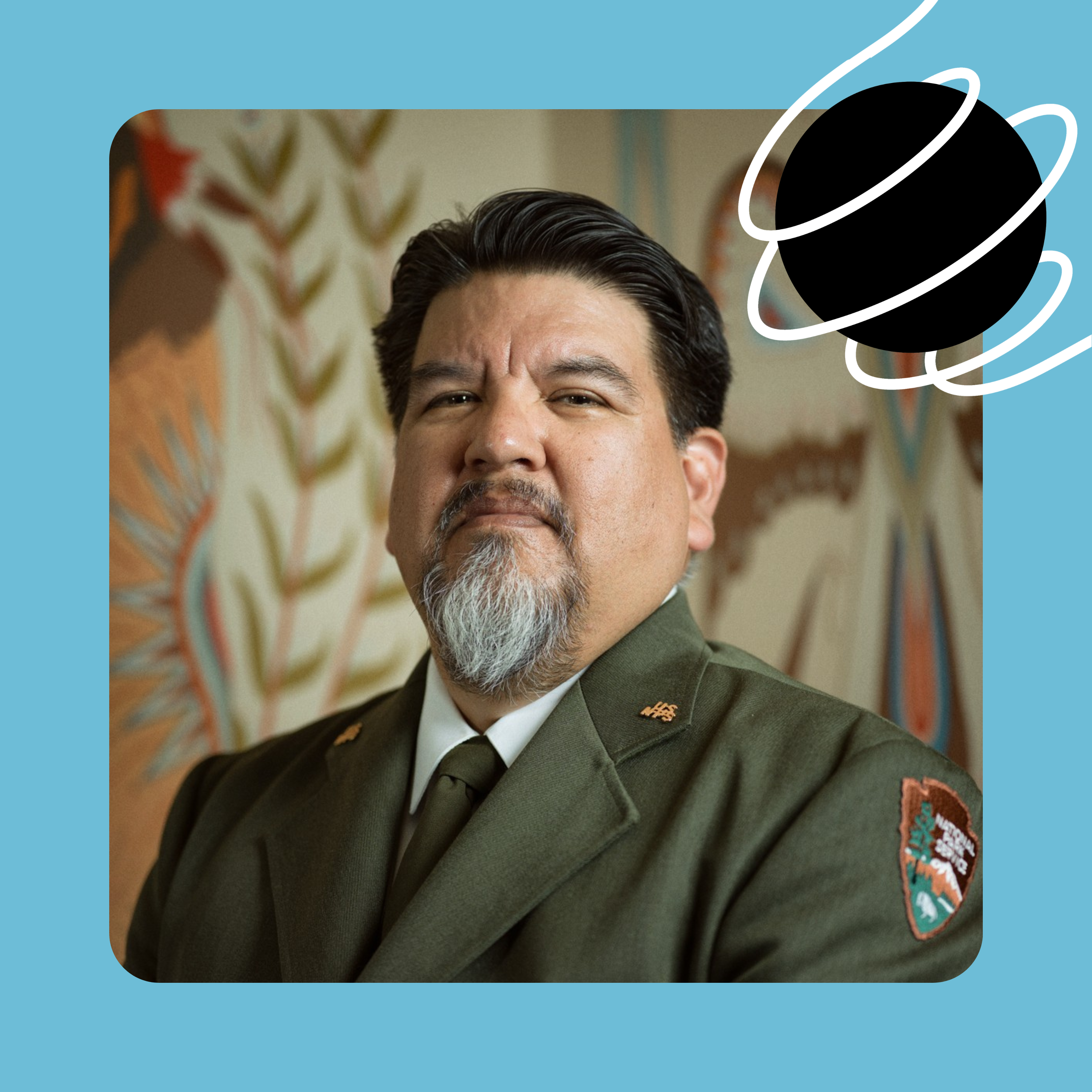
In this episode we talk with Chuck Sams, the nineteenth director of the National Park Service, about public lands, relationships between people and the places where they live, and what national parks are for. Sams is Cayuse and Walla Walla and an enrolled member of the Confederated Tribes of the Umatilla Indian Reservation. In addition to directing the National Park Service, he has served as an intelligence specialist in the US Navy, held leadership positions with the Confederated Tribes of Umatilla and the Trust for Public Land, and was recently appointed by Governor Tina Kotek to serve on the Northwest Power and Conservation Council.
Show Notes
About Our Guest
Charles F. "Chuck" Sams III is Cayuse and Walla Walla and an enrolled member of the Confederated Tribes of the Umatilla Indian Reservation in Northeast Oregon, where he grew up. He also has blood ties to the Cocopah Tribe and Yankton Sioux of Fort Peck. Sams most recently served as the nineteenth director of the United States National Park Service from December 2021 to January 2025. Before that, he was Oregon Governor Kate Brown's appointee to the Pacific Northwest Power and Conservation Council (NW Council). Prior to joining the NW Council, he served as executive director for the Confederated Tribes of the Umatilla Indian Reservation. For thirty years, Sams has worked in tribal and state government, and in the nonprofit natural resource and conservation management field, with an emphasis on the responsibility of strong stewardship for land preservation for this and future generations.
Further Detours
- In "Reciprocity of Tradition," Joe Whittle explores the idea of Tamanwit, or reciprocity, and how it governs the traditional relationships with the land its inhabitants among the peoples of the Columbia Plateau.
- In "Where Are You From?", Wendy Willis considers what it takes to be in relationship with the place you live.
- In "Losing the Forest for the Trees," Juliet Grable writes about her relationship to a piece of the Southern Oregon Cascades where rising temperatures are killing many trees.
- Our relationships to land and other animals are also discussed in a couple past episodes of The Detour: "Democracy of Species" with Robin Wall Kimmerer and Emma Marris, and "Creatures We Love and Creatures We Fear" with Bobby Fossek, Erica Berry, and Wendy Bingham
Transcript
Adam Davis: About 150 years ago, the first national park in the United States was created. Since then, the park system has grown quickly and just as quickly become a beloved and essential feature of our country. So when Chuck Sams returned earlier this year from his role as the 19th director of the National Park Service in Washington, DC, to his home in northeast Oregon where he grew up, we jumped at the chance to talk with him about public lands, relationships between people and the places they live, and what parks are for.
There's a lot to say about what Chuck has done and who he is. In addition to directing the National Park Service, Chuck has served as an intelligence specialist in the US Navy, held leadership positions with the Confederated Tribes of Umatilla and the Trust for Public Land, and was recently appointed by Governor Tina Kotek to serve on the Northwest Power and Conservation Council.
Chuck is Cayuse and Walla Walla and an enrolled member of the Confederated Tribes of the Umatilla Indian Reservation. And he also has blood ties to the Cocopah Tribe and Yankton Sioux of Fort Peck. But instead of saying more about Chuck, we're going to go straight to his conversation in April 2025 at the Pendleton Center for the Arts that was part of Oregon Humanities' Consider This series on the theme The People and the Public with an emphasis, as you'll hear right away, on public lands.
Is there a place that when you were younger, maybe on public land, especially, a place that has some significance for you? Why and where is it to the extent that you want to talk about where it is?
Chuck Sams: It's easy. It's Iskuulpa Creek. Growing up, here on the Umatilla reservation and spending time with my late grandfather, Charles F Sams, Sr., we spent many, many hours on Iskuulpa Creek during different times of the year so that I could understand, not only the seasons, but history. I still carry around the rock that he gave me, a stone that we found in the creek when I was about age five or six, and he would ask me questions from time to time about that rock. Who was here, who stepped on it, how was it formed, what swims over it, what would it attach itself to. It wasn't until I got to high school that I realized that I was getting a traditional education of trying to understand my place in the world with flora and fauna, and my connection to the land, and how do I be a good steward of those resources.
Adam Davis: That word, steward, you just said, I think we're going to probably come back to, but I want to ask you in a way, the opposite of what you just said and ask, do you remember a place when you were younger that you didn't have access to that you wanted to, or that felt off limits in some way?
Chuck Sams: The only place, and it was 1979, and the reservation, for those of you who were here, knew that the reservation was pretty desolate. We were living in the projects, and a group of boys wanted to go play football, and the grass on the projects wasn't really nice. There was a lot of broken glass and other things, but the lawn in front of the Bureau of Indian Affairs building was beautifully manicured. And so we all ran down there from the playground to go play football, and the superintendent came out and yelled at us to get off of this government land. “This is government property.” I stood and turned and said, “I am government property.” He laughed and said, “Well then all you boys can just play football.”
Adam Davis: Okay. So you gave him the right answer. You're freshly back from the National Park Service, still doing natural resources work, but what's it feel like to come back here after being in DC overseeing an institution responsible for so many parks and 22,000 employees? How does it feel just as a way of grounding to come back?
Chuck Sams: It's home. So you finally feel that you're at home. I've done several tours now on the East Coast. In 1989, when I finished intelligence school in Virginia Beach, I got on the plane, back in the days when you still had to walk up to the plane, and turned around and yelled, “I'm never coming back here again.”
It was humid. I don't understand humidity. It was hot, it was uncomfortable, and I swore I never would come back. The gentleman in front of me ended up being my seatmate, and he was a southerner from Norfolk. And he said, “Son, you're gonna live to regret those words.” And he was right. This is my fourth, I don't know if it’s my final, tour. It's my fourth tour on the East Coast and my third tour in the Washington, DC, area.
Adam Davis: OK. And do you feel like… I feel like park is a funny word, and to have a National Park Service Park sounds like play. Does park feel playful to you now at the end of this service you just gave to the National Park Service?
Chuck Sams: No. I mean our parks all across the United States, all 430 plus units, are managed specifically and in different ways from a historical perspective for protection of flora and fauna from and cultural resources. So, you know, it just reflects the diversity of who we are as Americans and the lands we set aside for ourselves.
But no, I'm reminded of when I was there to celebrate the 150th birthday of America's first National Park, Yellowstone, and I made it very, very clear that land was taken away from several tribes, 59 tribes that had usual custom rights to it. Six tribes that actually still own the land and had not been given up by treaty yet.
Adam Davis: So even thinking about the first park, Yellowstone, a little over 150 years ago it was both taken away and in some way protected. Is that accurate to say that? Some of both maybe. Maybe what I'm asking is what's a park for?
Chuck Sams: You know, the Organic Act of 1916 finally defines what parks are for. We set aside these lands for posterity. For ourselves and future generations for our enjoyment and our learning and cultural resources and natural resource protection.
That's true. That's what we do now for parks starting in 1916. But parks that were created prior to that, yes, they were set aside mostly for their environmental splendor. But there was this false idea that these places were untouched by human beings, when people have lived here for thousands of years.
I'm reminded of my grandfather again. When I was a kid in the 1970s, I came home and was so excited to tell him, “I've learned we've been here for 10,000 years,” and he said, “30.” I was like, “What? No. The teacher told me we've been here 10,000 years.” When I finished high school, they said, “We've been here between 12 and 15,000 years.”
I came back and told him in the eighties, “Hey, grandpa, they guess like 12 to 15,000 years."
“30.”
By the time I finished college, you know, they said native people have been here probably 18 to 20,000 years. He passed. Then, most recently at the turn of this last century, they said they've been here for at least 20 to 22,000 years.
And then we discovered footprints at White Sands. The latest data showed between 24 to 26,000. But while I was director, we found another set 20 feet below that, and the carbon dating came back to 30,000 years. Nobody ever just stopped to ask us, how long have you been here? 30,000 years.
Those people, though, manipulated, like all humans do, the landscape. And they had successes and failures. We know that, we can see that. They lived through at least four major climate change events in those 30,000 years, including an Ice Age. They manipulated the landscape to fit their needs so that not only could they survive, but they could thrive. And when Yellowstone was, quote unquote discovered, there were a group of Crow who were managing the meadow that year, they were doing a burn.
Those original journals talk about this burn, and they don't understand why the Indians are burning the grass when they were burning it for a regeneration of traditional medicines and plants, and to ensure the grasses came back stronger for the herds of both bison and elk.
Adam Davis: I mean, as you talk about that sweep of time 30,000 years, and then we think about when the first National Park was created, when the Organic Act happened, when the National Park Service became something that we recognize as what it is today, it seems like a new innovation, almost a kind of technology, a park. It's a tool for something. What's your sense of what it's for? What's the need that a park fulfills?
Chuck Sams: There's a lot of needs. One, it captures a moment in time of flora and fauna, and allows us to take a longer stance in studying that flora and fauna, cataloging it, getting a better understanding of the relationship that we have with the land, the water, the air.
It also allows us to tell the story of what, at that time period, of what those natural resources were. How they are being used by humans. In some places it actually captures and holds our collective history and culture. Whether that is the Hopewell Mounds that talk about, you know, a millennia of culture, or you're at Gettysburg which tells the very deep and sad story of Americans fighting Americans, and you can actually feel the hallowed ground and the sadness in that place.
Adam Davis: It's interesting to think about the human stories. I mean, even in the story of the first thing you talked about, the creek where you went with your grandfather, it felt to me like you were talking both about human to human relationships and relationships to the land, to the stones that were there. I guess I want to ask more about that because it seems like this funny thing was created. This thing that's called a park that includes this idea of use without impairment, which is a funny phrase and it seems like a core phrase, "use without impairment." So the sense that somehow use might be damaging. How do you understand "use without impairment," which seems to be core to understanding a national park, you know?
Chuck Sams: First and foremost, I want to say that I had the huge honor and pleasure of leading over 20,000 dedicated federal servants who loved their job. Many of them used to tell me, you know what, you pay me director, you pay me in sunrises and sunsets. Beautiful, but I'd really like to make a fair wage. And so, I spent a lot of time up in Congress asking for more money for staff.
But you know, their job, they do not see any contradiction, and a lot of people do, between use of the park and the preservation of the park. Because if you were a good steward of that park, you are continually ensuring that the flora and fauna are protected, that those cultural resources are protected, and ensuring that the American public have access to that so that they can learn about what it means to be a good steward.
Adam Davis: I hear you saying that, and I'm remembering my recent experience at Zion with shuttle buses, it felt like not a national park, but an amusement park. And so I want to ask you about, when we're thinking about public lands and maybe especially the form of public lands that is called a park, the relationship between use or access on one hand, which feels thoroughly democratic and participatory, and preservation on the other.
Chuck Sams: It can be difficult in figuring out how to manage. We went round and around. The National Park Service is a, and rightfully so, a very decentralized organization. For the most part, superintendents, he or she, are the captains of their ship. They are given a lot of latitude about how to implement policy.
First and foremost, though, they must look at the particular Org Act that set them up as a park and that they have to manage that park for those purposes. And that's not always easy. And access was one of those. Zion. So I was there when we celebrated putting in the new electrified buses and was very excited to do that.
Yeah, because of my experience of the last time I'd been in Zion Park. It was 1993 when every car could come in and it felt overrun. We were supposed to spend three days there. I spent a day there and I was so angry with the parking that we left at the end of the day and made our way down to Arizona instead.
To come back in and see now that we're using electric buses, people can be picked up and dropped off. The traffic wasn't there. And there were a lot of people on trails and whether that's, you know, Angels Landing or anywhere else, there is that issue. At the same time, we were trying to ensure that we're not restricting because it does belong to the American people, but we were trying to focus then on how do we teach about being better stewards? How do you protect that resource? How do you ensure people aren't just wandering off trail? Are people understanding the different types of plants that are there and what they do and serve? What is their ecosystem function to the rest of the landscape.
Now, most people don't go more than a couple hundred yards from their car, but I liked the buses because it actually forced people… we are now seeing them going at least a quarter mile, if not further into the park because now you know you can do that or you can just stand around and wait for a bus.
Instead, people are actually now getting out and doing so, and so we were putting more folks in the field to do interpretation. And to meet those people, we are now having more back country rangers than there used to be, and doing more interpretation about what it is to be a good steward.
Adam Davis: Early in that response, you said, “Because that land belongs to the American people,” and I want to ask what that means to you. Both that sentence on its face and against what you said about the people that were there living on the land before the parks were created.
Chuck Sams: So, you know, it just depends. And right, for some folks and tribes, land was literally taken from the Confederated Tribes of Umatilla Indian Reservation. It wasn't that we weren't pushed into it and that we hadn't been at war against the United States, but what we have is a treaty of peace. We don't have a treaty of war. We have a treaty of peace, and in that it recognized that one, we would do mutual defense with the United States. At the end of Article Two of the Treaty of 1855, “the president of the United States will arm said Indians from time to time for their own defense against other Indians and other potential invaders.”
And so that's why I think also there are those provisions that exist in a number of treaties and there there are over 370. It's also why you see the most, the largest group of citizens—American Indians—by ethnicity joining the military. We feel we have an obligation to serve and to protect these lands because they are ours.
They're being occupied by the United States and they're being managed by the United States. But we have a responsibility to comanage and costeward those lands hand in hand. And so when I say the American people, you include tribes, because in 1924, whether we wanted it or not, we were made American citizens.
Adam Davis: So it's interesting to think that you just ran the National Park Service. The United States of America's National Park Service, not, for example, a tribal park service. I'm asking about how vexed that felt for you, if it felt vexed at all.
Chuck Sams: No, there's always a mixed feeling. But again, because I come from a group of people who did a treaty of peace and we've fought to preserve our rights to go to all usual customary stations to be able to hunt, fish, and gather, to be comanagers.
That we've won a number of court cases, from the Winans decision in 1905 to the Bolt to the Belloni decision, we have secured that right under treaty to comanage salmon to comanage water, to comanage landscapes and lands held in common with citizens in the United States. It didn't feel that strange to me to be the director of the National Park Service. It just felt an extension of what I'm already responsible to do within the six million acres that we ceded to the United States, and then the millions of acres beyond that, because we went all the way into buffalo country, which is present day Montana and Wyoming.
And when you're there, you're still also helping those other tribes to ensure and protect and preserve those lands and steward them in a way so that those species will keep coming back, and the plants will keep coming back. It just felt an extension of a responsibility that I'd already been charged with.
Adam Davis: So responsibility. And you used the word steward several times already, and that pushes, I guess, me, in the direction of a question about the relationship between public land and private land. I want to ask it as naively as I can. I think that naive is a polite way for me to say ignorant. What can you do on public land that can't be done on private land? And in a way, the same thing in reverse.
Chuck Sams: First of all, I want to get rid of the notion that Native people didn't understand private ownership of land. Some of the very first land leases I ever got to see was when I was with the Trust for Public Land and was working with the Wampanoag and Narragansett people in Massachusetts and Connecticut.
And they showed me some of the very early land leases, which also made me laugh because they're on these pieces of parchment by Englishmen who, when they landed on the shores, they wanted to lease land. The men met them on the shores, went into their villages and went to their women who actually owned the land.
And the women agreed to parcel the land to be set aside for these colonists, and they made their mark. Well, when they brought the paperwork back down to the beach, they tell me, the English were mad because they didn't see the mark being made. And they wanted to know which of the men made the mark. And they tried to explain it was their women who made the mark. We don't own the land, the women own the land. It's a matrilineal society. And you can see the mark crossed out and they made the men re-sign. So you have misogyny right away, coupled with what I would consider an illegal lease. But that's beside the point because even under European international law on land rights, that was an illegal act.
But that being said, the ideas between private ownership and public ownership, there are different… the bundle of rights, which actually come from more of a European concept than a native concept, is still a bundle of rights. Private ownership of land when you acquire that land means that you can grant certain rights for other people how to use those or not.
And then public ownership is for everybody. Now even tribes understood and fought for territory, but they had a general right that is very, very foreign to European understanding of land rights—that’s the ‘use of’ right, which meant that people could travel through our territory. You have a right as a human being to take water, to eat the food off of it, to even camp, and use wood as long as you're moving through the territory. This is why I always point out about the Oregon Trail… how many people came across the Oregon Trail? Anybody know? Three… depending on which years you count, right? About 300,000. About 10% of them died. 30,000 people. Now growing up in the 1970s and 1980s and watching Sunday afternoon Cowboys and Indians movies, I was brought up thinking my people must have killed a lot of those people.
The Army keeps really good records, and their best records show on the Oregon Trail that about 400, less than 500, settlers were killed by Indians. So if you have 30,000 people die, 29,500 of them died from dysentery, snake bites, oxen rolling over on them. But there's been this perpetual thing that said that it must have been Indians who were killing these people, but it's not. Why?
Because the Indians believed in that right. That as long as they're traveling through my territory and you don't stop, I must provide for them, and our own people did that same thing. That's why you have Immigrant Springs. It was a spring. We said, sure, you can get water here. Take as much water as you need, but keep on moving.
Adam Davis: While you were talking, I was thinking again about this. innovation of developing parks and like what was going on here in say, the 1870’s, that some people thought, huh, we gotta change the way we think about this land. We gotta change the way we demarcate the public's access to it. And then that just seemed to grow as we get into the 1920s, 1930s, and now 22,000 people. Or maybe not anymore, but a lot of people. Why, what was happening in the 1870s here, and then the increase of that?
Chuck Sams: 1870s, 1880s? Somebody calls that the Golden Era, not naming any names, and wants to relive that Golden Era, that was the time of the land barons and it was the time of the robber barons and it was the time of industry really starting to pick up in this country.
And they were taking up a good portion of the land for railroads and for construction and for harvesting of timber. And there were conservationists who said, no, we need to figure out how to protect those lands. But conservation in this country has gone through fits and starts. I mean, I look back to early ideas of conservation and there was this idea that we should set aside lands and let the natives live on it and live the romantic lifestyle that they thought we lived on bareback on horses and subsistence. But by the 1870s and 1880s, it was thought that you needed to remove all people on the land.
That this was, you know, the last elements of the Garden of Eden here in North America. We should remove the people from it and preserve these lands set aside for ourselves. It really doesn't become truly ideal as a public land until after the end of World War I and the Organic Act of 1916.
So it's interesting to think in the 1870s, you see a relationship between the protection of some land and the sense that it's all getting bought up and used in maybe more aggressive ways. Why does that continue through, say, the twenties and thirties and the early 20th century? Well, I mean, it did, but by 1916 there's just this recognition that we want to set aside these lands for both recreational and for conservation purposes. And we want to do it in a way that negates the idea that people have been managing this land for eons, and that these newcomers can manage it in a different way, that protects it from ourselves. But in fact, you know, you can't really separate the human beings from the land. There's a symbiotic relationship there. And, you know, I've been fortunate enough to travel around the world and I've seen cultures all around the world have that symbiotic relationship.
Adam Davis: So, just because you said the word management, it made me think of all the different agencies now. All the different… if we're even just at the federal level—National Park Service, US Forest Service, Bureau of Land Management, Fish and Wildlife. I mean, I could go on for a long time, and I used to work seasonally for the Forest Service and then one season for the Park Service, which is where I acquired this jacket, which I kept with me at the end of the summer and I dug out of the closet tonight. But it makes me think back to how the culture of the Park Service felt quite different from the culture of the Forest service, which I think corresponds to different goals.
Why are there so many agencies managing the land? Do you have a clear sense of how the Park Service is distinct from, let's just take those other two that have a lot out here. That is the Forest Service and BLM.
Chuck Sams: You know, I was an outsider of the National Park Service. I spent most of my life throwing rocks at the Department of Interior, so I was a big surprise to actually be asked to come on the inside, and not throw rocks and try to figure out what was going on.
The National Park Service has a very strong and distinct culture. And they, of course, wanted me to know that right away. And that we are different from the Bureau of Land Management, that we are different from the US Fish and Wildlife Service, that we're different from the Forest Service and our friends at the Department of Agriculture.
But the one thread that runs through all of those agencies is that they're supposed to be good stewards of the land. And so I had to change the concept of the staff, especially my associate directors in natural resources and sciences, and tell them, I need you to pick your heads up and I need you to work with your colleagues in Fish and Wildlife, at BLM, at the Forest Service, at the Bureau of Reclamation. We met very early on in this, in the Biden administration, all of those directors, and we sat down and said, we want to do work on a landscape scale. If we are gonna actually restore ecosystem function, how can we do that in the Northern Hemisphere?
How do we get help and support from our friends in Canada and Mexico? So then we came together and decided we needed to look at keystone species. And we would use those keystone species that would run the gamut between all of our land as land managers, all of our institutions and agencies. So we looked at bison, we looked at sage grouse, we looked at wild grasslands, we looked at all the pollinators. And then we took this to the Forum for the Western Hemisphere and met with our counterparts in Canada and Mexico. I was fortunate enough to lead the delegation and the negotiations where we decided that we would set up these corridors and work on ecosystem restoration and ecosystem function with the hope of one day seeing bison be able to roam again from northern Mexico into Southern Canada. That we would see grasslands being put back in. And right now we're facing a collapse of pollinators, which is going to affect humans in a very negative and massive way if we can't figure out how to restore them to where they need to be. Sad to say this current administration has nullified that agreement.
I've heard from my friends in Canada and Mexico, and they're gonna continue to work on that and hope that it comes back around again. But we were ensuring that those of us who were agency heads, department heads, or bureau heads, were forcing our staff to look and start coordinating on a landscape scale rather than just as we had been doing: I'm only responsible for what's within the exterior boundaries of the park. I'm only responsible for what's on the exterior boundaries of BLM land.
Adam Davis: I mean, coordinating on a landscape scale, not just across parks and regions, but across countries, sounds incredibly complicated.
Chuck Sams: It absolutely is incredibly complicated.
Adam Davis: Yeah, it's very powerful to think about. And then it makes me think about some of the conflict we see around public land and public land management. As I'm thinking about…we've been talking for the last few minutes, I guess, about the use of the land from one level or one perspective. And I want to go back to 22,000 people working for the Park Service.
And I want to especially think about entry-level staff. Is it possible to generalize about who the people are that are coming in to do this public lands work entry level? Why are they there? What's keeping 'em there?
Chuck Sams: Well, it's definitely not the money. It is the work itself. It's the relationships that they have with each other.
I mean, the National Park Service is like a small family. Even though there are 22,000 people, you get to know each other very well. And they are like the military. They get transferred from different duty stations over time–many of them, especially if you want to move up in rank in the service. They form long-term relationships and friendships that really, I think, and I've just seen this across the service, push each other to be better at your job, push each other to learn, to be a better steward, to be a better caretaker. And it didn't matter if you worked in history interpretation or you worked in actual environmental restoration, or you did financial planning within a park.
There is a sense of belonging and a sense of respect of being able to wear that arrowhead and know that you're part of something bigger than yourself. That you do this on behalf of the American people. I hadn't experienced that since I was in the military. That degree of comraderie, fellowship, and drive to want to work on behalf of the American public.
Adam Davis: You're listening to The Detour with Chuck Sams.
You know, there's the famous Ken Burns miniseries about the Parks. and there are many books about the parks, and there are some claims for the parks as a kind of expression of democracy. I guess we were talking before about how the parks seem to develop here. Do you feel like parks are democratic or a fundamental part of what democracy wants to be?
Chuck Sams: I think they showcase the best part of us being a democracy, that we hold these lands in common for each other, that we preserve our history and our understanding, that the National Park Service is a learning organization, and does a lot of deep reflection on the stories it tells in the park and tries to figure out what stories are missing and add to them.
There's been a lot of that going on, especially in the last 20 years about what stories were missing. When I was sworn in as the 19th director, Secretary Holland told me that we must be fierce in our storytelling and that I'm charging you on behalf of the president of the American people to go out and find stories that had not been told yet. And let's ensure that every American sees a reflection of themselves in the park.
When I talked to staff, many of the staff really understood that and also wanted to ensure that every American, whether you were just sworn in yesterday as a new citizen in the United States, or you came here on the Mayflower, or you'd been here for 30,000 years, that every American should see a reflection of themselves in the park and find a story that connects to them and who they are.
And it's hugely democratic. I got that sense. As a young sailor in 1989, we were in-between courses at the Intelligence School. The four of us had almost two weeks left before we had to be back to base for school. So we decided to take a road trip from Maine to Florida, with the idea that we'd stop at every National Park, Monument, and Memorial along the way.
We got to walk in the footsteps of our fellow human beings and our fellow Americans. So, in Maine, you know, we walked in the footsteps of the Native people who've lived in Maine for the last 15,000 years. Plus, we got to walk in the settings of colonial Massachusetts. We walked in the same steps of revolutionary soldiers.
We stood on the precipice of the battlefields of the Civil War, deembarkation, industrialization. I remember when we were in New Jersey at Great Falls and looking at that and the whole structure and Hamilton's ideas that we were gonna become an industrialized nation. It was very formative, but what it did, it set a groundwork for the oath that we took to defend the Constitution of the United States against any enemies, foreign or domestic, really to heart.
Because we saw what this idea of our constitution was an idea of a democracy, and that it really is just an idea. And that we needed to preserve and protect that idea. As I watched and I looked at the staff as I traveled around the country, I got to over 120 national parks inside of just over three years and talked to staff.
They also take that same oath, and they believe in that oath, that they are there as good stewards to protect the constitution of the United States, and that they must be able to be true to America's story by telling the diversity of who we are as Americans.
Adam Davis: You've talked a few times about the heavy overlap between your sense of the military and national parks, and even the uniform bears some resemblance. I just want to ask what you think about that, about ways that the two are engaged in a similar project and where they might depart.
Chuck Sams: So not everybody wears a uniform in the National Park Service. People think everybody does. They actually don't. You have to actually get a letter that says that you're authorized to wear a uniform. The uniform, of course, is based on the army because in the early days the national parks were protected by predominantly cavalry. Whether it was Yellowstone or Yosemite. and so after the Organic Act was passed, in 1916, many officers took their retirement and became the first superintendents, and then were able to convince some of their soldiers, if they were leaving the service, to come work for them.
They didn't have a uniform at the time, so they just wore their old uniforms and adapted them to the Park Service. And we've just kept that with the campaign hat, the green jacket, the pants. I personally don't like mixing brown with gray, but that's just me. We have a brown belt with a gray shirt and brown shoes with a hat. But you know, that uniform, though, is actually really egalitarian, and it's one of the things I really like about the National Park Service. It doesn't matter if you're a first-year seasonal or you're the director, you wear the exact same uniform. So I used to love going to the Mall in uniform.
We'd be talking to staff and having visitors come by. And of course they look at the five rangers all standing in uniform. And since I'm the one talking, you must be the senior ranger. And hey, could you tell me where the bathroom is? And you have to have the Ranger point down to tell them that's where the bathroom's at. Here's the train station, Metro Station you're looking for. Here's how you get to the Lincoln Memorial.
Adam Davis: You do do that. Well, you did. Yeah.
Chuck Sams: Yeah. The staff used to love it. As I say, I think that's the best part about being part of the service is our uniform is exactly the same. It's very egalitarian.
Adam Davis: Well, that feels quite different from the military.
Chuck Sams: Well, we all wear the same uniform except we wear collar insignia that tell the difference of rank.
Adam Davis: Right. I guess part of what I've been thinking about is you've been talking about the core democratic institutions, one about our defense, one about our relationship to the land, and so I want to ask again about where you see possible departures between the two or distance between the two.
Chuck Sams: I don't know if there's one. I will say that everybody knows your rank regardless if you wear one or not in the National Park Service. That's democratic too. And so you know, people know who's senior. Just because again, it's a small family. And a lot of people stay with the service for years and decades, so they know who's senior and who's not senior.
Adam Davis: But you see, it sounds like at the core, a lot of real deep overlap or similarity between these.
Chuck Sams: There’s just this dedication to mission and it's very mission-driven. They will block everything else out to meet that mission. And so when you look at the history of parks and the fluctuation of funding, parks have gone up and down as an agent of funding.
The one thing that all Park Service staff do very well is that they will continue to meet that mission. And so if you tell them to do more with less, they will do more with less. If you tell 'em to do more with more, because they got more, they'll do even more with more. and I kept telling them that, you know, the only issue with that is that they will burn themselves out.
We were working very hard, very early on, about work-life balance and psychological safety. We had the very first psychological safety stand down. We brought in more resources because some folks were working themselves a little too hard. And as I was leaving the service, because our budgets were coming down, I was reminding them, I need you to do less with less.
I need you to be more strategic in what you do on your part. Based on what are those foundations? Because I could walk into a park and within a half hour I could tell whether the superintendent came from cultural resources, natural resources, maintenance, or logistics, because that park shined in that particular area.
But that park might not be a natural resource park. It might be a historical park. And I need you to concentrate on interpretation and history and less on that beautiful lawn that you keep wanting to cut.
Adam Davis: So when you step back a little bit, now that you're not in that position anymore, what about things that you think we’re getting wrong with this big agency?
Chuck Sams: What are we getting wrong with it? Mostly that it's underfunded. And what had been wrong for many years is that they were ignoring tribes. They, we, talked about that, that they were not talking to the original stewards. There was a lot of discussion, of course, with gateway communities, which is rightfully so with the states and the state partnerships and the county partnerships that surround the parks in those states.
But there was very little discussion with tribes. A lot of it was a misunderstanding. I had to remind the staff that when they took their oath of office, which is that same one, to uphold the Constitution of the United States against all enemies foreign and domestic, that means that they also have an obligation to uphold and protect over 370 treaties with tribes.
And that there are 574 tribes that expect you to uphold those treaties, and that when you don't do that, you fail to meet your oath. I had 30 and 40-year veterans say, “No one has ever told us that. That's the first time I've ever heard that.” And I said, that's sad because you are so dedicated to the mission. You are so dedicated to the Organic Act, you're so dedicated to your oath. You've actually not been fulfilling that.
Adam Davis: It sounds like the idea of stewardship is in you deep, deeper than it may be for many of us. And I guess I wonder, how do we do that? How do we get, especially young people, to ideas of stewardship, both ecological and cultural.
Chuck Sams: You know, for me, I grew up here, with a plethora of teachers like Bobbie Conner, like Antone Minthorn, like Frenchy Halfmoon, Jay Minthorn, many who have passed on now. My grandfather, his brothers who taught me, about Tomanowi, our law. How we were stood up as human beings and in our belief system.
I know that my eyesight was a gift from eagle, that my skin was a gift from elk as part of its hide. My hearing comes from owl, that my entire nervous system and veins come from the plants who donated because they donated all these things to create me as a human being. And the major gift that we got from salmon was two things. One, we got of its voice completely and salmon wanted us to have a common language, which is where you get Chinook jargon on the Columbia River, as the common language. And plus, you know that because if you ever squeezed a salmon, it doesn't make any sounds. It's because it gave up of his voice completely.
And second, it gave up of its body to us so that we would have something to nourish ourselves. But in doing so, it asked that a covenant be made with a creator who created us as human beings and said, with all these gifts, this thing that you're called human being, must be our steward.
It must protect and preserve and enhance us so that we come year after year. And it's a covenant that my people have kept. Since we were created as human beings, as I've traveled around the country, well, I don't believe that there's pan-Indian overall because each culture is different. That one ideal of stewardship and how they may have been created as human beings or what they've been charged with does seem to be a commonality as I've traveled around the country with tribes.
How do we do that with the rest of the American people? Yeah. And teach 'em as stewards, the Organic Act of 1916 tells us to do that. It tells us that we need to preserve, protect, and enhance these lands for both its recreational and its natural and cultural resource values and the National Park Service is well set up to teach that stewardship mindset because these lands that we've held aside are what's helping us understand better the effects of change in our natural resources. Most recently, as we're combating climate change, we've been able to use national parks because they collect data. We have some of the finest scientists, finest recorders of information, who have over a hundred years of history, can tell us what flora and fauna have done, what it looks like, and how we can start not only mitigating it, but how we adapt for it.
Adaptation was a harder issue for the National Park Service to do because when I had to go and explain, if you go to Redwoods National Forest in California and you dig 60 feet down, there's a different forest there 10,000 years ago. So who planted this redwood forest? But then if you dig 200 feet below that, there's a completely different forest there before then.
That was there 15 to 20,000 years ago. Well, who planted that forest? It tells me that there were different climate change events, and we know that there were different climate change events and the humans who were living on this landscape put in the forest that they needed to adapt for whatever their needs were at the time.
And so we, in the National Park Services, were working on climate change. I had to say, we are going to have to do something different than just mitigation. We're going to have to adapt. When I first came to the forests at Acadia that we were replanting, we were seeing survival rates of only 10 to 15% of the trees because those are the trees in there.
And when I spoke to the natural resource manager, he said, you know, my job is to protect these lands in perpetuity—as they were in the state we found them. I'm like, yes, I need you to look at what trees were there 10,000 years ago and what did that survival rate look like? And we started planting trees that actually were more from the Massachusetts area and seeing a 70 to 90% survival rate.
And so we're starting to plan and look at how across the board were we going to have to change the landscape to fit humans' needs and the flora and fauna of the other animals' needs because we're, we aren't good at reversing what's happening yet.
Adam Davis: Uh-huh. So I've been asking you a lot of questions from the perspective of someone who is on the Park Service side, and I'm thinking also about the loftiness of the goals and to internalize this deeply ethical approach, stewardship.
How explicit or how much should I, just a random park visitor know that I'm not just there for a good view. I'm there to develop, maybe, a stronger ethical relationship to the world I find myself in. Is it important that I recognize that that's some of what's going on?
Chuck Sams: You know, we told everybody when I was in the Park Service, plan like a ranger, and fortunately we have modern ways of doing that.
And the current app, and it's gonna go through some changes, allows you to plan your trip. But we ask people, your first stop should be a visitor center. You should take the time to actually read the displays because it's asking you those questions and what your role is in the park and that everybody plays an important role.
Even if it's as basic as you know, leave no trace, pack in what you brought in and pack it out. If there are ways to learn, a lot of people don't do that. A lot of people just come into the park and they will head to their favorite trail. That's why we were putting more rangers in the park under the Inflation Reduction Act. We knew that the National Park Service was down by 20% of staff from 2010, yet we'd seen a 20% increase in visitors.
And so I cut a deal with members of Congress for a half a billion dollars for 1700 more staff. I really needed about 3,500, but I knew I wasn't going to get that. So I was able to make the deal that these staff would not come to headquarters. These staff would only go out in the field. We hired over 900 of the 1700 by the time I left this last January.
Sadly, those were the 900 that were let go. They're now just slowly coming back because they were in their probationary period. But those folks were people that did the real work in the parks. They were not the excess people that you would find at a regional headquarters or at the headquarters in Washington, DC.
Adam Davis: So I have just two more questions before we open to questions from this microphone. And the first is pointed to by what you were just saying about the loss of probationary staff. And that is that at this moment we're approaching the 250th anniversary of the Declaration of Independence. I assume the National Park Service is planning all sorts of things that will be part of, I think, a very complicated marking of an anniversary.
And, it's especially complicated probably out here. Oregon wasn't a state 250 years ago. There were people living here much longer than 250 years. How do you think about an anniversary like that and public lands and maybe especially the park.
Chuck Sams: I don't know what this administration is going to do. We had laid down the foundation, and we had spoken to the staff and this really came from the staff of how they wanted to celebrate America at 250 and what they really wanted to do, and I thought this was brilliant. When I came on board and they started with the Declaration of Independence and they said who's in it and who's not. They wanted to concentrate on African Americans and slavery. What that meant because it isn't specifically called out in the Declaration of Independence, but they recognize that's what helped build America and its agriculture on the East coast. They wanted to talk about, as Abigail Adams said, women. She had asked John Adams, don't leave the women out, but he did.
They wanted to talk about the "savage" Indians, and what did that mean, and the role they played, and how did they become US citizens. And then from that, they wanted to talk about each and every struggle and our rights to pursuing happiness. What does it mean to be equitable and just, and that we as Americans have had to fight for equality and justice all along the way.
And so they wanted to do that arc, starting with a celebration of those three through the year. and end it with a celebration of the Americans with Disabilities Act and the continued fight for the LGBTQ community that we're doing today to see what those civil rights will end up being.
Because, they said, this idea that was planted in the Declaration has made us stronger by that diversity and that fight. Were there horrific portions of that? Absolutely. We as a nation came out better from it, from learning from it, and the people who stood up to ensure that their equality wasn't being stepped on and that justice would prevail ultimately.
I don't know what this administration's going to do.
Adam Davis: Last question I want to ask is, before opening the floor to questions, is again, now that you've stepped out of this role and are still in the natural resource world, is there for you a question in your head about natural resource work or public lands work that feels like it's genuinely open for you?
Chuck Sams: Yeah, I mean there's always the same question. It's the human thing of when is enough, enough. Is it gonna be enough for us to cut down the last tree? Is it gonna be enough for us to poison our water system before we learn a lesson? Or can we learn from our own mistakes in the past as human beings and learn from them and become better at stewarding those resources because we don't just steward 'em for ourselves in this moment.
We steward them for the children yet born, and we need to think 7, 10, 12 generations down the road to ensure that these resources are here for them, that make us who we are as people.
Adam Davis: Let's do this. Can we say a preliminary thank you?
Just a quick note about questions for Chuck from people who joined us at the Pendleton Center for the Arts. We're mic free, so you'll hear me briefly restate the questions for our listening and online audiences. So I think Frank's question was, do the people working in the parks take into account oral history to understand what's there?
Chuck Sams: Absolutely. and it's been amazing the work of the historical staff and the academic rigor that they go through when they're not only just looking at primary sources, they will go in the field and they will ask for oral histories. Even throughout the Park Service, they've always made sure to record and bring in oral histories.
So we do take into account oral histories and they can end up changing the perspective and the ideas of how we're trying to preserve or protect them.
Adam Davis: So Vicky just asked about property and land and when they're the same and when they're different.
Chuck Sams: I know I, from a human perspective, like to think that we have dominance over land.
When I was working in New York City, I got to work in the nineties on a history project and they invited members of the clergy in, and we were having a dinner with an Imam, a Rabbi, a Presbyterian minister, a Catholic priest, and myself, and we were just talking about it, about this idea, especially under Genesis.
And what made me think something that I'd never thought about before is that both the Imam and the Rabbi said, in Genesis, it wasn't "dominion." That was a Latin word we came up with for the Christians. It was actually "stewardship." Yes, in old Hebrew, in Aramaic, the word was "stewardship." Imagine how the Judeo-Christian lifecycle of working on the landscape would be if we didn't look at dominance and owning property, but that we were stewarding it for ourselves and for everybody around us.
Adam Davis: So Catherine from Pendleton is asking if it's possible that there will be new national parks created in this country.
Chuck Sams: I love this 'cause people always say, when are you gonna create a new park? The National Park Service does not create parks. Congress creates parks, or the president of the United States can do a monument, a National Monument Memorial through the Antiquities Act.
But will this administration, will the Congress make a new national park? I don't know. There's legislation for that sitting in Congress now, I think for three different new sites. It hasn't moved out of committee and it just depends, if they get enough advocates to get them moved out of committee and to voting on the floor.
As you know, this president wants to revamp the Antiquities Act, but that will still be up to Congress to decide. But a president could choose just not to use the Antiquities Act if they want, and that's purely within their prerogative.
Adam Davis: I think as we go to a question back here, I think that question's related to the question about what was happening in 1872 that made it a moment that opened this up, what was happening in the 1920s and thirties, and then again in the sixties, let's say that led to these kinds of openings for more of this sort of thing? Thanks for asking that in that focused way. Okay, Susan, and thank you Pendleton. What would you charge us all to do? What is your charge to us?
Chuck Sams: The charge that I tell anyone is that a democracy is only as strong as the people that participate in it. And I don't care if you are not old enough to vote, or you're one of our elders, we need you to participate in that democracy, and you do so by speaking up. Your First Amendment right to be vocal, to also ask for redress from your government, is a fundamental right that the founding fathers understood, was what is needed if you're going to have a thriving republic with democratic values.
And so I ask each and every American to make sure that your voice is heard, and you can do that in a number of ways.
Adam Davis: Thank you. Okay, we're gonna go, last question and then point of business and then handing it to Bobbie to close us out. Randy from Union County asking about the two greatest threats facing our national parks in the coming decade. A softball of a last question.
Chuck Sams: Well, you know, the first one is inadequate funding. The National Park Service has gone fits and starts with funding. When parks are created, Congress actually does not authorize any more than $175,000 for that park, which is just enough money to put a desk in that park and somebody with a flat hat, and then that first superintendent has to build the infrastructure.
It's amazing. I've seen them do it, and you get somebody who's really good at that and you let them run with it. That is its biggest threat. You know, the two largest funding times for the national Parks was 1956 to 1966 at the 50th anniversary of the National Park Service. Money was put in, new roads were built, visitor centers, and then they provided no money for maintenance.
And they still didn't provide money for maintenance. So when I took over the National Park Services as director, I was told you have $11.7 billion in deferred maintenance, but the Great American Outdoors Act passed, and you're gonna get about 7 billion to deal with it. You won't get all, but you'll get 7 billion to deal with it over a five year period.
Then on the second day, I get a call from my staff who said, we weren't calculating deferred maintenance like the industry standard. It's actually 23.3 billion and the Secretary wants to talk to you. So I go to see the Secretary and she goes, now you need to go up and normalize that with Congress and ask them for more money.
Until that deferred maintenance is taken care of and the parks are adequately funded so that they can take care of their maintenance, we are going to sadly love our parks to death. I think that is going to be the next threat over the next decade if we don't fund them adequately. The second biggest threat is climate change, and if this administration or any other administration wants to deny that it's here, all you need to go to is International Park. They're on the forefront because they've done such a good job of trying to preserve the park in situ as it was when it was formed. You can see what climate change has done in deteriorating the flora and fauna and culture resources. They've been able to try to as long as they can to preserve it as best they can, but it's becoming much more expensive and we need to mitigate and have a better plan for how doing that. Under the Inflation Reduction Act, we had invested in the National Parks $235 million into climate change adaptation and resiliency work.
A lot of that money is just being slowly clawed back now.
Adam Davis: The evening at the Pendleton Center for the Arts concluded with a presentation of a gift to Chuck from Roberta "Bobbie" Conner, the director of Tamastlikt Cultural Institute. Here's a part of that presentation from Bobbie to Chuck. I want to pass it over to Bobbie Conner to close us out for tonight.
Bobbie, thanks for being game. Is it okay if I let you take this seat?
Bobbie Conner: So some of you may know that Chuck in October, while he was director of the National Park Service, was honored by the Oregon Historical Society as a history maker. They are selected each year and honored at an event in Portland at the Art Museum. And Chuck received the History Maker Award in October, and two of our neighbors, John Bishop and Mort Bishop of the Pendleton Woolen Mills Bishop family, wanted to give Chuck a present, but they knew as a federal official, there's a limit on what he gets to keep. So if they gave him a present, then it'd be a present to the National Park Service.
Just noting that the Pendleton Woolen Mills National Parks blankets, socks, hats, cups, all support the National Parks Foundation. So one of the funding mechanisms to support the parks is buying those National Parks products.
So John and Mort Bishop gave Chuck this in October and I've been sitting on it.
So it's camouflaged in a Roundup bag, but it says Charles F Sams, Director. And it's the Crater Lake blanket.
I'll just add that the Confederated Tribes of Umatilla is not only glad to have Chuck back in the neighborhood, but we're still enormously proud of him and we expect more history to be made by the work that Chuck does. Thank you.
Chuck Sams: No, my vanity is still there. So as my wife will point out, if you look at my license plate now of Crater Lake, it says NPSD 19.
Adam Davis: Chuck Sams is the former director of the National Park Service. You can learn more about him in our show notes at oregonhumanities.org. Thanks for listening to The Detour from Oregon Humanities. Anna McLain is our producer, and Alexandra Silvester, Karina Briski, and Ben Waterhouse are our assistant producers.
This is Adam Davis. See you next time.