The drafters of the Declaration of Independence had serious complaints against King George III. They listed twenty-seven “repeated injuries and usurpations” and submitted them “to a candid world.” Among them was this: “He has plundered our seas, ravaged our Coasts, burnt our towns, and destroyed the lives of our people.”
Two hundred and fifty years later, citizen pushback against “plundering” and “ravaging” continues, as governments license corporate entities to act in ways that threaten local ecosystems, natural beings, and the life-supporting climatic systems of the planet.
Is it time for a new Declaration of Interdependence, holding these truths to be self-evident: that all beings are created equal, that they are endowed with certain unalienable rights, that among these are the rights to exist, to flourish, to regenerate, and to naturally evolve for their own sake? *
Some citizens in Oregon think it is long past time for such a declaration. Following the lead of rights-of-nature initiatives around the globe, they brought Measure 20-373 (also known as the “Watersheds Bill of Rights”) to Lane County voters in May 2026. The proposed initiative recognized the natural right of all watersheds in the county to be protected from existential threats. Although the measure failed, it offers a conceptual revolution. Call it a paradigm shift, a new beginning, or a testament to the human ability to think in different ways. It presents an alternative worldview that redefines who we are in the world: not lords or overlords, entitled to take, sell, or ruin the lives of Earth’s inhabitants, but members of interdependent communities made up of living beings, each deserving respect and recognition of their rights.
Evolution of rights-of-nature legislation
Rights-of-nature jurisprudence such as the Lane County initiative “evolves through experimentation and reshapes the debates surrounding sustainable development,” according to Craig Kauffman, a political scientist at the University of Oregon. In the US, the beginnings of this evolution can be traced back to 1969, when the Forest Service approved a proposal from Walt Disney Enterprises to develop a ski resort in the Mineral King Valley next to Sequoia National Park. In a 1972 case called Sierra Club v. Morton, the Sierra Club sued to stop the development, arguing that its members would be harmed by the destruction of “an area of great natural beauty.” The case went to the Supreme Court, which dismissed it on the grounds that the Sierra Club did not prove significant damage to particular members, and thus lacked legal standing to sue.
The harm to the forest, which would be cut to stumps, did not count. The harm to the rivers or salmon, suffocating in silt, did not count. No one asked what would happen to the frogs or the mushrooms. Of course not; none of these are legal persons, and so none of them have standing in court. That means they can’t bring a case in their own name; they can’t use harm to themselves as grounds to stop destruction; and even if they could, they could not use the awarded damages to repair harm to themselves. Only harm to persons matters to the courts, and Sierra Club members had not made the case that they had been harmed.
Ironically, US courts have had no trouble imagining that some other nonhuman entities are what Chief Justice John Marshall called “artificial beings,” with a stable legal identity separate from that of the people behind them. These “persons” include ships, trusts, and corporations. Establishing a corporation as a separate legal entity was important to protect its members from liability for the organization’s misdeeds or failures. The significance of this concept grew dramatically with the passage of the Fourteenth Amendment, which said that no state could deprive any “persons” of life, liberty, or property without due process of law. Accordingly, courts protect the rights of corporations, including, for example, the right to free speech, which has increasingly become the right to control elections. But the rivers and meadows of the Mineral King Valley? In the Morton case, the Supreme Court was unable to embrace them in the circle of moral or legal concern.
Supreme Court Justice William O. Douglas vehemently objected. In a famous dissent, he made the case for the rights of nature. His argument has become the foundation for numerous cases defending ecosystems and the basis of rights-of-nature legislation across the globe.
Inanimate objects are sometimes parties in litigation… So it should be as respects valleys, alpine meadows, rivers, lakes, estuaries, beaches, ridges, groves of trees, swampland, or even air that feels the destructive pressures of modern technology and modern life. The river, for example, is the living symbol of all the life it sustains or nourishes—fish, aquatic insects, water ouzels, otter, fisher, deer, elk, bear, and all other animals, including man, who are dependent on it… The river as plaintiff speaks for the ecological unit of life that is part of it.
In his dissent, Douglas cited a muscular little book that had been published earlier that year by University of Southern California law professor Christopher Stone, titled Should Trees Have Standing? Toward Legal Rights for Natural Objects. Trees may not have voices to speak in their own defense, Professor Stone argued, but they have interests, and those interests can be harmed, often grievously. In that respect they are like infants, who are equally voiceless and vulnerable. Through guardians, courts protect the rights of infants. Why, then, can they not protect the rights of forests, which are no less beautiful, alive, and helpless to defend themselves from violence?
Philosophical grounds for the rights of nature
Douglas’s argument for the rights of nature was revolutionary. It overthrew the central assumption of the European Enlightenment: the belief, spread by colonialism and imperial expansion, that (White, male) humans are fundamentally different from the rest of Creation—separate, superior, and in charge. Humans, this thinking goes, are exceptional because humans alone have a soul or mind, the Cartesian res cogitans, the “thinking substance.” Plants and animals, rivers and minerals are material substances only, created for humans to use for their own ends. Although this material substance, res extensa, has instrumental value to humans, it has no inherent value in itself. Therefore there are no moral limits to destroying it, using it up, or converting it to money in the pocket.
Professor Stone was interested in how we overthrow the “tyranny” of ideas by which we are unconsciously ruled. “Our lives are no doubt ruled tyrannically by a wealth of ideas we have no idea of—until, without warning, we become aware of them one by one.” And so it may be with human exceptionalism.
Maybe it has been a dangerous mistake to think of our species as exceptional. Ecological science, evolutionary science, Indigenous knowledge and wisdom, and all but a few religions are converging on a new (and yet very old) understanding of humankind’s place within the living planet. Plants, animals, the birds of the air, the fishes of the sea, even the chickens in their cages are all members of an interdependent, interconnected community of morally significant beings. We all suffer. We all thrive. We all count. We all have value, in and of ourselves, not just as supper or lumber or transportation or fuel, but as moral beings driven by the will to live. Rather than a hierarchy of value, there is a mutuality of thriving.
At the center of the rights-of-nature cosmology—both ancient and newly emerging—lies an affirmation of the absolute worth of nature as the source of all life: the creative genesis, the mother, Pachamama, Mother Earth. A well-ordered society, the buen vivir, the good life, balances human and other-than-human interests and honors practices that celebrate and strengthen the thriving of the living world. This is how the argument was taken up in Ecuador, where in 2008 a special election led to a constitutional amendment recognizing the rights of all of nature to “maintain and generate its cycles, structure, functions, and evolutionary processes.” In the first court case under that law, a river that had been partially obstructed by highway construction debris sued on its own behalf, making the case that its rights had been violated. The river won.
Since then, nature’s rights laws have been enacted in New Zealand, Bolivia, Panama, India, and other nations, including the United States, in areas ranging from Plymouth, New Hampshire, to Santa Monica, California. In Toledo, Ohio, the Lake Erie Bill of Rights recognized the rights of this Great Lake, which has for years been choked with harmful algal blooms from agricultural runoff; the law was subsequently overturned because of the potential for jurisdictional disputes. In Washington state, a citizens’ initiative established the legal standing of the Snohomish River watershed, although that measure was later ruled invalid for exceeding “the scope of the local initiative power” and conflicting with state law.
Given Indigenous peoples’ traditional respect for the living world, it is no surprise that many of the most successful nature’s rights laws have been enacted on tribal lands and other lands controlled by Indigenous people. In 2018, the White Earth band of Ojibwe recognized the rights of wild rice, passing the first law to grant legal personhood to a plant. In 2019, the Yurok Tribe in Oregon declared that the Klamath River “possesses inherent rights to exist, flourish, and naturally evolve,” a provision that gives the river legal standing in court when its well-being is threatened.
Rights of nature in Lane County
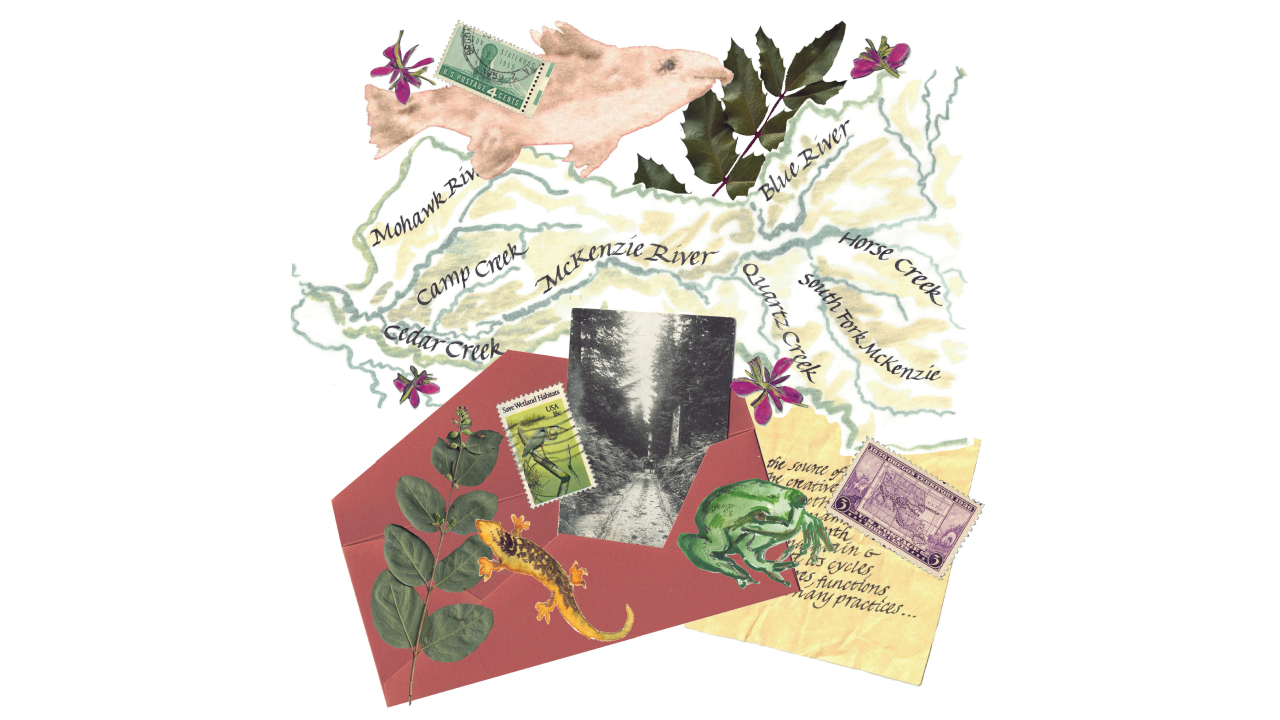
Lane County is alive with rivers—from silver mountain springs to broad valley waterways and sand-bottomed streams that wind through ancient forests and wild dunes to the sea. This year, local residents had the opportunity to vote to recognize the rights of “watersheds, ecosystems, and natural communities within the county to naturally exist, flourish, regenerate, and evolve,” as the voters’ pamphlet put it.
In the narrow river valleys within the Coast Range of Lane County, timber companies routinely clear-cut forests down to mud. The trees are then trucked upstream to be milled into sweet-smelling lumber, which is used to build houses in Oregon, Japan, and elsewhere. Over the cut land, helicopters and, now, backpack sprayers spread various herbicides—chemicals used to kill plants—including 2,4-D, an ingredient in Agent Orange. The goal is to make sure that no species without commercial value grows on that land. Sometimes the herbicides blow off-target, landing on homes, farms, orchards, and in rivers and lakes, where they can enter the drinking water and thus the blood, brains, fetuses, and bones of the people living along the river.
After years of such activities, neighbors began to notice patterns in their health—an unusual increase in miscarriages, cancers, birth defects, cardiac issues, rashes, and other sorrows among the area’s residents. They asked for relief from the international timber companies doing the spraying. None was forthcoming. They asked for protection from the government agencies established to protect clean water, but none was forthcoming. The laws that protect the rights of logging companies are powerful and comprehensive. Michelle Holman, one of the chief petitioners behind Measure 20-373, says, “Outside interests have more power to do harm in our community than we have to protect ourselves.”
This was the beginning of the watershed rights movement in Lane County. Citizens organized into two groups: Protect Lane County Watersheds and the Oregon Community Rights Network. From door to door, at farmers’ markets, and in parking lots, they carried petitions to put a watershed rights initiative on the ballot. They raised $27,183 to fund the campaign.
The initiative was opposed by the Eugene Chamber of Commerce, five local mayors, and a coalition of realtors, industrial timber companies, housing developers, and others. Under the moniker Protect Our County, the coalition raised $435,850 to defeat the measure, sixteen times the amount raised by proponents.
The opposition campaign was organized by PNW Strategies, which describes itself on its website as a “boutique government affairs, political consulting firm.” Much of the money behind it came from two political action committees: the Oregon Business and Industry Candidate PAC and the Oregon Forest Industries Council. Major donors to these PACs include several out-of-state entities, including Koch Government Affairs, headquartered in Wichita; Western States Petroleum Association, headquartered in Sacramento; and Weyerhaeuser Company, headquartered in Seattle.
The initiative went down in defeat. The vote was roughly 38 percent for, 62 percent against.
Can rights-of-nature legislation create change?
How do revolutionary ideas spread, and what effect can they have? Professor Kauffman is interested in precisely that question. “How do new norms regarding human-nature relations emerge and strengthen to the point where they begin to change the way people think about their relationship to nature, and consequently change their behavior?” he asks on his faculty profile page.
The campaign for the Lane County initiative was one way to try to change the way people think, according to Holman. “We’re trying to shake the blanket,” she said, describing a process of dislodging the old ideas that bind us, with the hope that when ideas change, behavioral change will follow.
Legal standing or not, Lane County’s rivers continue to flow. In the hot Oregon morning, the surface of a Coast Range river gleams black as obsidian and as smooth. Yellow leaves sail in shallow indentations, as if fire in the leaves had melted the slick. Clusters of ripe blackberries hang over the water. Reflected light flutters over the white trunks of alders and maples just turning red. The river flows clear and fast over flat rocks, lifting a mist that turns to fog. A fisherman casts toward the shadow of a salmon in a dark eddy. Does the river have the right to exist, to flourish, to evolve for its own sake?
Or, to put it another way, are humans called to acknowledge new moral and legal responsibilities toward the Earth? If natural beings have rights, then humans have duties to honor the inherent worth of living things and the natural systems that support them; to restrain our own behavior in order to bring human profits into balance with the creative urgency of the natural world; and to accept full membership in the family of living things, an interdependent whole that is beautiful and astonishing and alive.

Kathleen Dean Moore, PhD, is the author or co-editor of sixteen books about our moral relation to the living world. Her new book, Weave the Falling Rain, is forthcoming from Yale University Press. Formerly distinguished professor of philosophy at Oregon State University, where she taught philosophy of law and environmental ethics, Moore left academia to speak out about the moral urgency of the climate and extinction crises. She writes from Corvallis, Oregon, and from a wilderness cabin in Alaska. For more information, please see www.kathleendeanmoore.net.
Comments
3 comments have been posted.
The Oregon Coalition for an Environmental Rights Amendment (OCERA) envisions a 2028 statewide ballot initiative envisioned to amend the Oregon Constitution to recognize "the right to a clean and healthy environment." Because this is a statewide initiative, and not a local/county initiative as the Lane County effort, the jurisdictional problem of contesting the state's preemptive authority to govern and manage the laws on ecological impacts is moot. OCERA would add the following language to the state constitution: Whereas governmental actions and inaction have allowed or worsened environmental harms such as polluted air, soils and water; extreme heat, drought and wildfire; and the decline of important native species, habitats and ecosystems; Whereas this Section ensures just and equitable protection for all people; now, therefore, (1) All people, including children and future generations, have the right to a clean and healthy environment. This right is inherent, inalienable and fundamental. (2) The State holds Oregon's natural resources in trust and, as trustee, shall carry out its fiduciary obligations to protect such resources for the benefit of all people, including generations yet to come. Natural resources include, but are not limited to, surface water, groundwater, air, atmosphere, fish and wildlife. (3) Any person may enforce the rights and duties guaranteed under this Section against the State. Courts shall liberally construe this Section, which is self-executing, and shall recognize successful enforcement as an important and substantial benefit for all people.
Christopher Hall | September 2026 | Oregon
Thank you for this beautiful piece. The first thought I had while reading it: the Columbia River has no interest in a 24" fiber cable housed within its belly to serve the greed of the tech sector and endless lust for human "advancement" over the environment.
Keri Handaly | August 2026 | Portland, OR
This is a defense of nature's rights and of the inseparable and dependent relations of humans and the environment that is both scientifically rigorous and esthetically pleasing. It is also historically well informed and nicely contextualizes the legal opportunities and obstacles we face in defending the living world.
Robert Nye | August 2026 | OSU
Add a Comment