Tanya Golden, a fifty-one-year-old saffron farmer in North Plains, processes the world’s most expensive spice by hand. It is painstaking work—it takes more than 500 saffron stigmas to yield a single gram. Even when she works well past midnight, a single day’s harvest weighs less than an origami flower.
The first time I visited Golden’s farm, I told her I wanted to learn more about what drives someone to choose such demanding work. This was only half the truth. There was another reason I wanted to talk to Golden specifically, and though I didn’t know how to articulate my full motive at the time, it had to do with her being a hardworking farmer who also happened to be a mother.
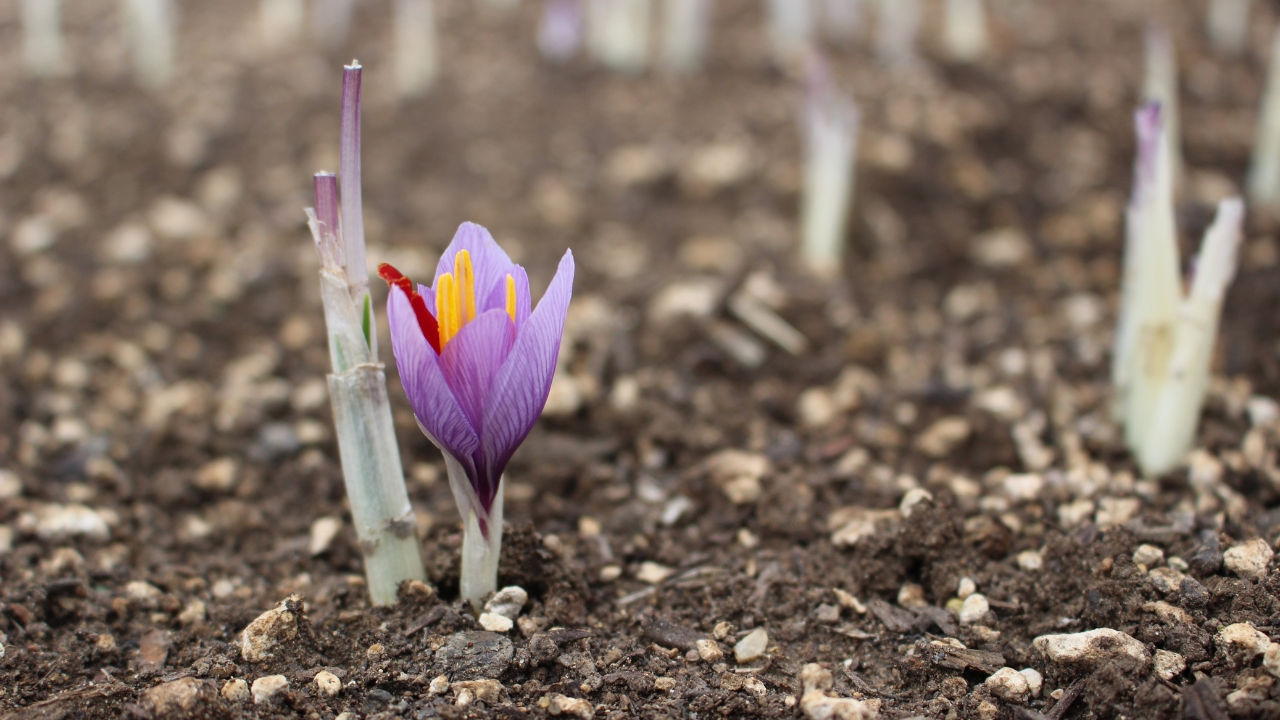
Of Cherokee and Grande Ronde descent, Golden became a saffron farmer—one of only a few in the Pacific Northwest—after taking a microenterprise class at the Native American Youth and Family Center in 2017. Saffron (Crocus sativus) is a tenacious crocus that adapts beautifully to the Mediterranean-like climate of the Willamette Valley. For Golden, though, saffron isn’t just a crop. It’s a moral ethos.
In Golden’s family, farming is something women do. Her mother was a farmer. Both her grandmothers were farmers. Growing up, Golden noticed that when the men in her family managed the land, it was about control. When women interacted with the land, it was about connection. Even though Golden appreciated the latter approach to land engagement, it took her years to consider becoming a farmer herself.
Golden grew up around peaches. “Peaches suck,” she told me, without mincing words, the first time we talked in late summer of 2023. Of course, she said, she loves to eat a sun-ripened peach as much as the average person, but being the daughter of a boat captain, her father often at sea, it fell to the rest of the family—her mother, her brother, and herself—to manage the peach-growing business. During harvest season, the fruit’s fuzz invariably worked its way into every bodily fold, clung to every item of clothing. Golden said that picking peaches is “like hanging fiber glass insulation in an attic in August. It’s horrible.” When she was old enough to leave home, she swore she’d never return to farming.
At seventeen, Golden began hitchhiking, skateboarding, and hopping trains around the country—“being tough, getting bad tattoos, and drinking crappy beer.” When she got pregnant, she was building concrete skateparks, and she had to quit when she became too big to push wheelbarrows. After she had her second child, motherhood reoriented Golden’s internal compass, pointing her back to rural Oregon. This time, though, she needed a different track. She was growing weary of housing instability and craved more financial security, and the hefty market price per gram of saffron was appealing. In 2017, while on food stamps and with the aid of a USDA grant to build high tunnels, she founded Golden Tradition Saffron LLC and planted the first saffron corms on her parents’ North Plains farm.
The first time we spoke, I listened to Golden condense her life story into a neat arc that led her back to farming. What was missing, though, were the details I most craved—whether the unrelenting grind of motherhood was worth all the sleep deprivation, the daily toil, the mental toll. For some years, I’ve been gathering stories from nearly every mom I meet, asking questions like: How do you balance motherhood with the rest of who you are? I’m in the process of trying to decide whether I want to become a mother myself, and what I want from these women is for them to tell me plainly what is hardest. If I can calculate the true weight of motherhood, maybe then I’ll figure out whether I want to carry the load.
I visited Golden’s greenhouses on a November morning in the Willamette Valley. Fall isn’t generally associated with flowers in bloom, but it’s the time of year when saffron noses its way toward light. Around the greenhouses, salal, kinnikinnick, lupine, and yarrow texture the landscape with leafy tiers of green. To help restore oak savannah prairie habitat and to support native pollinators, Golden planted an array of native species, along with strawberries, gooseberries, and evergreen blueberries so she can have something to snack on in summer.
Despite Golden’s knowledge of sustainable agriculture, her demeanor is more punk than earthy, more gristle than home-grown. “I can swing a Pulaski,” she’s quick to point out. “I can run a chainsaw.” Still, a nurturing, patient touch is needed for such gentle work. With saffron, everything must be done by hand—the planting, the harvesting, the processing. When Golden digs up the dormant corms in late summer, she combs the beds with her fingers so she doesn’t cut the roots with sharp metal tools. When transferring dirt, she shovels it into the beds in fistfuls. She manually divides the corms, then replants them by hand. When harvesting, she gives each fragile flower a light tug to separate blossom from stem.
Our conversation was interrupted when Golden’s phone buzzed with an incoming call. It was her daughters’ school; her eldest teenager was playing hooky, and the school was letting Golden know. She cursed, then dialed her daughter. I wandered away to give them privacy, but even from a distance, the subtext of the call was clear: this was not the first time this had happened, and mother and daughter were engaged in a battle of wills.
When Golden and I reconvened, she sat on the edge of a raised bed looking defeated, then poured out her exasperation. She wasn’t frustrated with her daughter, exactly—rather with her own choices and circumstances that had led to housing instability, financial precarity, and volatile relationships. She didn’t feel like she was a bad mom, just one who, despite years of hard work, still feels guilt and shame around the ways she could be doing a better job.
On a subsequent visit to Golden’s farm, I met Michele Ray, a fifty-six-year-old friend of Golden’s who volunteers during the harvest season. Ray sat behind a bucket, her hands submerged in cold water, her hair the same rainbow palette as her tie-dye T-shirt. She was removing aphids from a few hundred corms, soaking the bulbs first in water made alkaline by Dawn dish soap. As she picked bugs from the nooks and crannies, her fingers pink from the cold, she talked to the corms as if they were babies.
“They don’t know what I’m saying,” Ray said, “but it’s mostly the tone.” She told them how beautiful and strong they were, how proud she was of them, how she would take care of them.
Ray met Golden when their kids were in preschool together, and they both view saffron through a maternal lens.
Golden explained that saffron is matrilineal, each planted bulb a “mother corm” that produces “daughter corms.”
“The mother sacrifices itself completely,” Golden said. “It dies, it disappears, and it divides itself into its daughters.”
When she said this, it wasn’t poetry I heard, but a prophetic warning. The metaphor was exactly what I was most afraid of: the way the demands of motherhood can cause a disappearance of self. As a freelance writer, I know that if my partner and I had a child, we would need to rely more heavily on his income, which would mean the lion’s share of parental labor would fall to me, and I would have less time to devote to my work—a prospect that makes me feel like I would become a Halloween pumpkin scooped of its pulp. Sure, I might grin at the beginning, but how long before the walls caved in? Motherhood wouldn’t just destabilize our already precarious financial situation; it would threaten my identity.
Even after eight years of toil, financial security still feels out of reach for Golden. When she penciled it out on paper, she had hoped to buy a house within five years. “It didn’t quite work like that,” she said, then sighed. “Because it is so labor intensive.”
When we first met in 2023, Golden was selling saffron at $60 per gram; even then, she wasn’t making minimum wage. She has since dropped the price to $30 per gram to move more product. She is still living on food stamps.
Wielding a Pulaski in the heat of summer or shoveling mud in winter, Golden sometimes has moments when doubt and discouragement crowd her thoughts. “I've been out there so upset, cussing and crying,” she said. “And then there's the other end of the spectrum.” Sometimes, she’ll look up and notice an eagle flying overhead or a sunset setting the sky ablaze, and she’ll think: This is the best thing ever.
With so many factors outside her control—the weather, the harvest yield, how much money she can bring in—Golden focuses on what she can control. In 2023, she began importing saffron from Herat, Afghanistan, to support women like Sajida Mohammadi, a saffron farmer and mother of three.
Over Zoom, I met Mohammadi, along with Fatimah Qalandari. They explained that since the Taliban took over in 2021, women’s participation in the labor market in Afghanistan has been severely restricted. Women like them have turned to saffron to find meaningful work, support their families, and engage with their communities. Mohammadi has a nine-year-old boy and two teenage daughters, but her son is the only one who can continue his education past the age of eleven. Because the Taliban prohibits schooling for teenage girls, both Mohammadi’s daughters process saffron threads alongside her.
For Mohammadi, the pungent purple flowers are not only a refuge from the larger forces of constraint, but an outlet for joy. In between harvest seasons, she misses the saffron. She can’t wait for the smell and the feel of the blossoms. “I love saffron so much I can’t even express it,” she told me.
Mohammadi and Qalandari both work for Heray Spice, a cooperative that partners with 186 farmers, some of whom are women. Because men and women aren’t permitted to work under the same roof, all the employees at Heray Spice’s processing facility are women. Even when cloistered in a room tweezing flower after flower, there’s something expansive about the work, making the women feel connected to the rest of the world.
“I wanted to talk to you because you're like me, a woman,” Mohammadi said. “I wanted to make that connection as a fellow human being, so you learn my story.”
Most of my adult life, when I’ve thought of motherhood, I’ve pictured tired women. That mental image has now been replaced by active maternal work: Golden swinging a Pulaski to prepare a plot of earth; a circle of mothers in Herat chitchatting animatedly while they lay saffron flowers across their open palms.
What makes these women tired is not motherhood itself, but rather the agricultural, domestic, and political systems that create untenable conditions for earning a living while also keeping their children fed, housed, and enrolled in school.
Last year, a mom friend shared with me her thoughts on motherhood. She leaned in, shifty-eyed, as if she didn’t want anyone to overhear something confidential. “Parenting is easy,” she nearly whispered. What she meant was that, for her, loving her children is the most effortless thing in the world. That’s not the hard work of it. The difficulty comes from straining against institutionalized systems that unevenly distribute parental labor and push most of the weight onto women.
“It’s commonly said that being a mother ‘is the hardest job there is,’” writes Nicole Graev Lipson in Mothers and Other Fictional Characters. “But I’ve become suspicious of this type of praise, which—in a country that denies women paid maternal leave, all but ignores postpartum health, and offers no systematized childcare solutions—strikes me as inauthentic.”
In the US, gendered labor disparities seep into agricultural work, where pervasive inequity continues to disadvantage women farmers. Despite women making up nearly one third of farmworkers in the US, it is more challenging for women farmers to earn a viable living. According to a 2024 report by American Farmland Trust, women-run farms receive less government support and face more barriers to entry in securing land tenure, not to mention the institutionalized sexism that leads to greater risk of violence and discrimination.
“All farmers have it hard, but women have it a lot harder,” Ray said. “Because of, you know, America.”
This is why the maternal approach to saffron farming is so radical. A gentle, patient, reciprocal, maternal relationship with saffron is the only way farmers reap the rewards of their labor.
“You can be rough,” Ray said, “but then you’ll break them, and you won’t get what you need. But if you’re gentle, you can get what you need and everybody flourishes.”
There’s no greater threat to institutionalized systems of power than mutual thriving. If a farmer gets what she needs, everybody flourishes. For certain people to remain in power, though, others must be kept oppressed. Moms who find ways to get what they need, who seek wholeness—by doing work they love or engaging with the world outside the home—divert the flow of progress away from capitalist, patriarchal agendas and toward something far more collectively nourishing. There’s nothing wilted about this image. The mother-as-tired-woman trope exists because it preserves the status quo.
For Golden, growing saffron is an act of resistance against the impulse to vanish into motherhood. Becoming a saffron farmer requires growing outward, asking for support and, in turn, helping where she can.
When Golden was first getting started, a friend lent her an excavator. A few people from the Native community came out and worked in the mud while others helped her with landscaping and building planter boxes.
During peak harvest, which extends from September through November, Golden falls asleep working, tweezing crimson threads—three per flower—from hundreds of blossoms late into the night. During this time, Golden enlists the help of friends and family. Together, they labor over the saffron until everyone’s hands are coated in pungent golden nectar, a welcome change from peach fuzz.
“They smell how they look,” Golden said. “They smell purple and red and yellow. You walk into those greenhouses in bloom, and it's on par with jasmine or roses or mimosa.”
Ray shares Golden’s reverence for the heady scent that has an aromatic profile as complex as wine. “It makes what ought to be a very tedious process a joy to do,” she told me. The previous day, Ray spent three and half hours just pulling stigmas. Using her thumb, she showed me how she gently bends the stem of each flower until the stigma pops out. “If you approach them the right way, they’ll lay themselves open.”
For Tanya Golden, Michele Ray, and the women of Herat, saffron is a source of sanity, even when they are made to feel like undervalued members of society. Thanks to them, I better understand how the challenges of tending to such a labor-intensive crop—these fall-blooming crocuses with their delicate stigmas—can be a means of gathering strength.
During one of my visits to Golden’s farm, she asked if I would help her unroll long skeins of chicken wire between the beds to keep the voles out. It was an unusually warm October day, and the greenhouses ratcheted up the temperature to a tropical degree. Hunched and dripping sweat, I lugged the heavy roll of wire along each row. There was nothing glamorous about this work, but rather than feeling weighed down, I found myself considering how much more I could carry.
Comments
4 comments have been posted.
Devon—This is a wonderful essay, one of your best I think. I always marvel at how thoughtfully you weave what seem to be disparate “threads” together into powerful stories.
Dara Fredericksen | October 2025 |
Tanya Rocks on ALL LEVELS. XOXO
Timothy OConnor | October 2025 | Honolulu Hawaii
nuttin but LOVE🖤
jason taulbee | October 2025 |
This is such a lovely, deep, and emotional story of Golden. It such a great honor that I know Tanya Golden and proud witness her labor of love. Being a mom and being a farmer are holy, lovely, and true acts of kindness. I hope that Tanya and her beautiful brand of saffron grow into a big company. And become a source of income and stability for her and her lovely family.
Mohammad Salehi | October 2025 | Chicago, IL