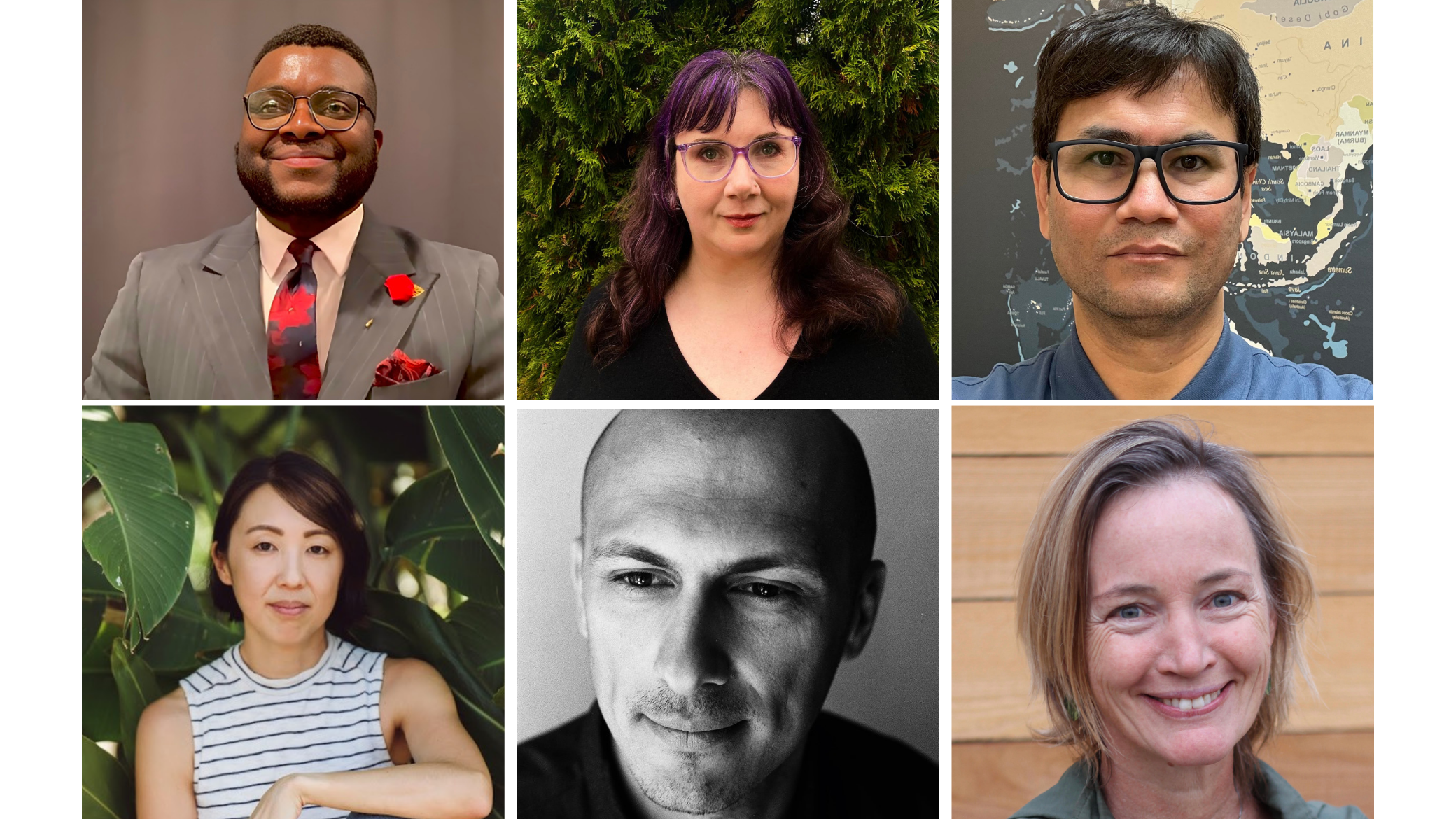
We are excited to announce the recipients of the 2026 Community Storytelling Fellowship, which supports nonfiction storytellers who belong to communities that are underrepresented in Oregon media. Our six fellows will each receive $5,000, and their stories will be published in Oregon Humanities magazine, in Beyond the Margins, on The Detour, and in partner publications.
The goal of the Community Storytelling Fellowship is to provide time, space, and resources for stories that connect people and communities. We hope the stories shared through this fellowship will allow more Oregonians to see their experiences represented, fill information gaps, and encourage readers to work toward a more inclusive and civically engaged state.
This program is made possible thanks to generous support from the Ford Family Foundation.
2026 Fellows
Dr. Bright Alozie (Woodburn) is is a Nigerian-born historian, author, and educator, and an associate professor of Black studies at Portland State University, where he coordinates the African studies certificate program and holds affiliate appointments in history and in women, gender, and sexuality studies. He earned his PhD in history from West Virginia University. Dr. Alozie’s interdisciplinary research explores colonial and postcolonial African history, the African diaspora, gender, memory, oral history, social movements, and decolonial thought. At the heart of his work is a commitment to recovering overlooked histories and centering marginalized African and African diasporic voices. Through both scholarly and creative approaches, he brings intellectual rigor, narrative depth, and moral imagination to questions of power, belonging, and historical justice. His scholarship and teaching have been recognized with numerous fellowships, grants, and awards, including the North Atlantic Conference on British Studies Diversity and Inclusion Fellowship, the Charlton Oral History Research Grant, the Hagley Oral History Project Grant and Fellowship, the African Humanities Program Fellowship, Portland State University’s John Eliot Allen Outstanding Teaching Awards, and the Peggy Renner Award for Teaching and Curricular Innovation. He is the author of several publications, including Petitions and Petition Writing in Colonial Igboland, 1892–1960: African Voices in Ink (2024) and HerStory: An African Feminine Archive (2026). Dr. Alozie is currently working on two books Intimacies in Flux: Exploring History, Law, and African Sexualities (a co-edited volume with Zanele Nyoni-Wood) and Black Voices and the African Diasporic Experience: An Oral History of African Immigrants in Oregon, USA, forthcoming in 2027.
Read Bright's fellowship story:
- "Flavors of Home" in the "Labor" issue of Oregon Humanities magazine
Jennifer Chambers (Veneta) is a writer, publisher, teacher, and podcast host. A former newspaper and magazine columnist, she founded TEDxVenetaWomen and attended the Iowa Summer Writing Program. After surviving a traumatic brain injury at fifteen that erased her early memories, she relearned everything from walking to speaking, a journey that deeply informs her work. Her award-winning writing inspired a museum exhibit, fulfilling a lifelong goal, and her latest book is The Murder of Sheriff W. W. Withers: Other Eugene Cases (Arcadia Publishing, 2025). She hosts the podcasts Beyond The Margins with Jen Chambers and Same Crime, Different Time, available wherever you listen to podcasts.
Read Jennifer's fellowship story:
-
"I Think We're Supposed to Have Fun" in Beyond the Margins
Aleksandr Chernousov (Beaverton) is is a theater director and storyteller serving as a courtesy researcher in the Department of Russian, East European, and Eurasian Studies at the University of Oregon. He is the recipient of numerous awards, including a Fulbright Grant, an Andy Warhol Foundation grant via PICA, a Beaverton Art Grant, an RACC Arts3C grant, and an Oregon Arts Commission grant. He dedicates significant time to volunteering with immigrant communities in Southwest Washington and Oregon, and is currently developing the Slavic Oregon project. Drawing on his background in theater and film direction, Aleksandr combines his writing skills with twelve years of visual storytelling and performance experience, seamlessly merging his two passions. He currently calls Oregon home.
Read Aleksandr's fellowship stories:
- "Justified Fear" in Beyond the Margins
- "In Search of Zucchini Caviar" in Beyond the Margins
Marisa Woo Grattan (Portland) is a Chinese American documentary filmmaker and visual storyteller raised in Honolulu, Hawai’i. Her work brings a personal, place-based lens to stories of migration, memory, and cross-cultural belonging—particularly within Asian American and Pacific Islander communities. A self-taught producer, cinematographer, and editor, Marisa’s films have screened nationally on PBS and in international spaces, including at the United Nations General Assembly Hall. She previously led the global video portfolio at UN Women, directing documentary and advocacy films that centered the lives of women and girls around the world. Marisa holds an MA in international affairs from The New School and a BA from the University of California, Berkeley.
Mohsin Jamal (Salem) was born in Kabul, Afghanistan, and grew up amid the Soviet occupation, civil war, and the US invasion of the country. He has a bachelor’s degree in international relations from Kateb University in Kabul and a master’s degree in politics and security from the Organization of Security and Cooperation in Europe (OSCE) Academy in Bishkek, Kyrgyzstan. Mohsin has five years of experience working as a news anchor and reporter, bearing witness to ongoing conflict and terror attacks in Afghanistan, and he worked for a US defense contractor for years, qualifying for a Special Immigrant Visa (SIV). After the collapse of Afghanistan to the Taliban in 2021, Mohsin narrowly escaped the escalating danger with his wife and three kids and immigrated to the United States in 2022, now living in Salem. Mohsin currently works at Salem For Refugees, advocating for and helping refugees like himself settle in their new home.
Read Mohsin's fellowship story:
-
"From Teacups to Volleyball Courts" in Beyond the Margins
Maud Powell (Jacksonville) is professor of practice for Oregon State University’s Small Farms program at the Southern Oregon Research and Extension Center in Central Point. She and her husband have owned and operated Wolf Gulch Farm, a small diversified vegetable and seed farm in the Applegate Valley, for twenty-seven years. She is currently the president of the Rogue Valley Food Systems Network, and serves on the boards of Our Family Farms and Klamath-Siskiyou Wildlands. Maud has an MA from Antioch University Seattle in environment and community studies and an MFA in children and young adult writing from the Vermont College of Fine Arts. She published her debut novel City of Grit and Gold in 2017, and she has written articles and essays for publications including Oregon Humanities, Reckoning, and Environment: Science and Policy for Sustainable Development. She also writes, directs, and produces community theatre with the Little Apple players.
Read Maud's fellowship stories:
- "Warning Shot" in Beyond the Margins
- "What Remains" in Beyond the Margins
Any views, findings, conclusions, or recommendations expressed in this program do not necessarily represent those of the National Endowment for the Humanities or Oregon Humanities.
Comments
No comments yet.