Events & Opportunities
October 29, 2026
Community Led Harm Reduction Conversation
Join Rahab's Sisters for a community conversation about harm reduction, drug use and overdose response! Participants are invited to sit together in dialogue over a light dinner to help deepen compassion and care for people who use drugs and to better understand how to participate in community care. This event is intended to bring people with lived experience and people who want to learn more together in dialogue toward the goal of deepened community connection and understanding.
Each participant will also receive overdose prevention training rooted in compassion, designed and led by those with lived experience.
This event is supported by a Public Programs Grant from Oregon Humanities.
6:00 p.m., Montavilla United Methodist Church, Portland
November 4, 2026
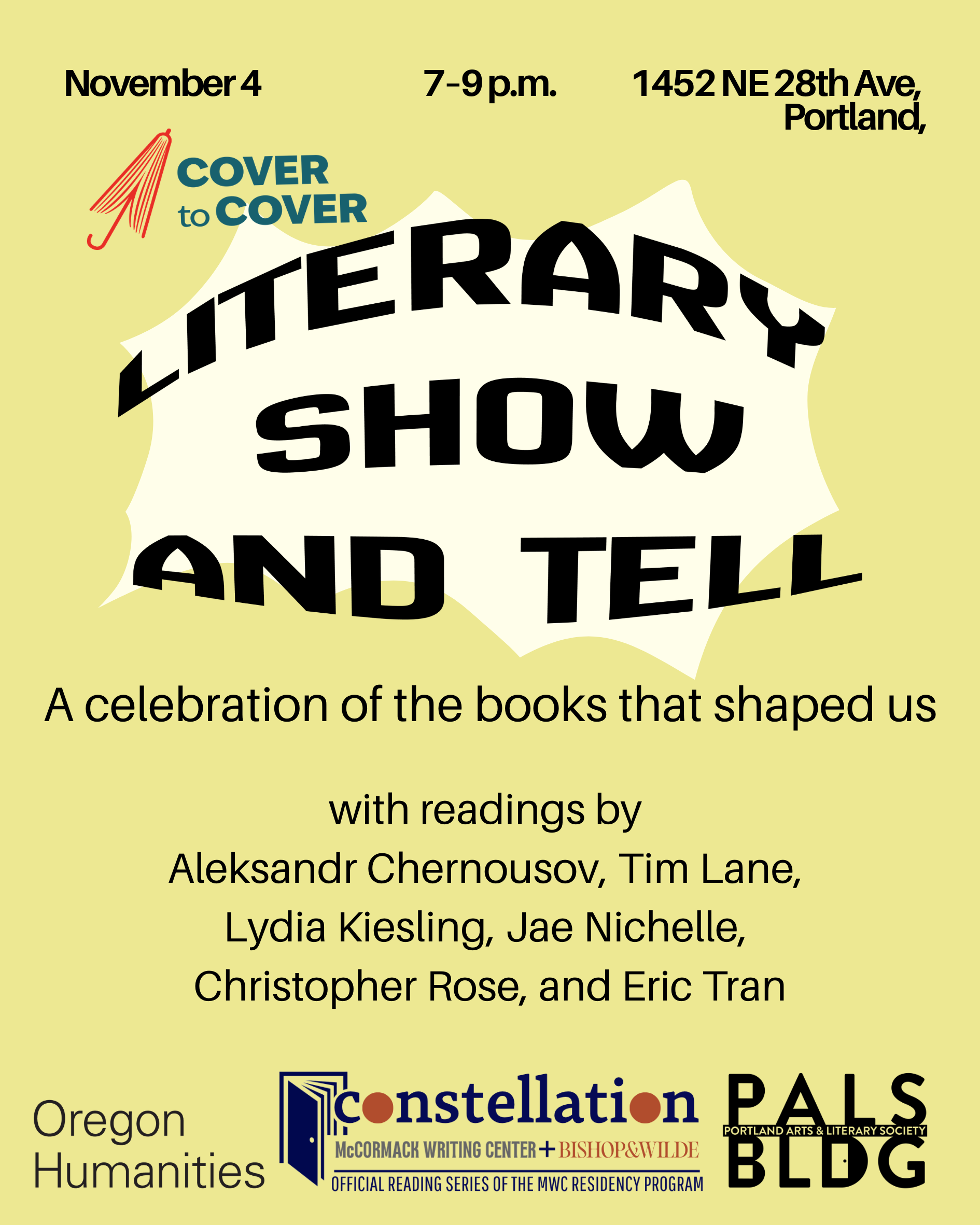
Literary Show and Tell with Constellation Reading Series
Inspired by Oregon Humanities magazine’s Works Cited section—where authors unpack the foundational texts that shaped their lives—we’re gathering a stacked lineup of OH contributors and Constellation alums at the new P.A.LS. (Portland Arts & Literary Society) Building for a night of literary show-and-tell. Featuring flash readings from Lydia Kiesling, Eric Tran, Aleksandr Chernosov, Jae Nichelle, Christopher Rose, Tim Lane, and more, plus a lightning-round open mic where you can step up to share the book that started your literary origin story.
7:00 p.m., P.A.L.S Building, Portland
November 5, 2026
Writing Around Harney County
A public reading at the Harney County Library featuring Oregon Poet Laureate Ellen Waterston.
6:00 p.m., Harney County Library, Burns
November 7, 2026
Are We Created Equal?
This conversation will explore equality. It is a core national value of the United States, even if we have not always lived up to that value. What does it mean to say, as the writers of the Declaration of Independence did, that “all men are created equal” and to declare that this is a self-evident truth? In what ways are or should we be equal? How does this ideal of equality show up in our daily lives, our communities, and our politics? How, finally, has this ideal of equality changed over the past 250 years—and how might it change further over the next 250?
11:00 a.m., Grants Pass Library, Grants Pass
November 10, 2026
To What Do We Pledge?
While the opening of the Declaration of Independence gets the fanfare and the fireworks—“When in the course of human events” and all that—the closing clause contains a quiet promise: “We mutually pledge to each other our Lives, our Fortunes, and our sacred Honor.” When we talk about the founding, we often think of it as a severing from a distant power and a proclamation of individual rights. And yet, buried in that big individualistic origin story, there is a pledge of support, solidarity, and mutual aid. Today, as we witness political violence, hostility, and polarization, this conversation invites us to explore what it means for us to be bound to one another and to ask ourselves: Is there any idea, any value, any dream for the future that we care about enough to tie ourselves to one another to protect or pursue it? What would it mean to “mutually pledge” ourselves to one another today? What would it look like? Feel like? Is it even possible?
Facilitator Wendy Willis is the founding director of Oregon's Kitchen Table, a statewide community engagement program housed at Portland State University. She is also a poet, an essayist, a stitcher, and a self-proclaimed democracy geek. Wendy was raised in Springfield, but now lives with her family in Portland.
6:00 p.m., Eugene Public Library, Eugene
November 12, 2026
Community-in-Action Series with Living Opportunities CEO Amber Myre
The Jacksonville Community Center is proud to partner with Living Opportunities for a meaningful community gathering.
Living Opportunities is a non-profit organization that serves as one of the largest service providers for individuals with intellectual and developmental disabilities—such as autism, cerebral palsy, and seizure disorders—in Southern Oregon. They empower adults and children to live independently and actively participate in their local communities through 24-hour residential care, supported living assistance, tailored job coaching for local business employment, creative arts programs, and specialized behavioral consulting.
The current CEO, Amber Myre will highlight the experiences, perspectives, creativity, and advocacy of people living with intellectual and developmental disabilities.
This program is funded in part by a grant from Oregon Humanities.
4:00 p.m., Jacksonville Community Center, Jacksonville
November 16, 2026
Consider This: Trust and Political Institutions
Join us in Portland on November 16—two weeks after election day—for a conversation about trust, elections, and our political systems and culture with Paul Gronke, director of the Elections & Voting Information Center at Reed College, and Susheela Jayapal, a former Multnomah County Commissioner and current fellow with the North Star Civic Foundation.
Polling of voters in the US shows that confidence in elections and political institutions has fallen over the past two years. In this onstage conversation, moderated by Adam Davis, we'll dig into the factors that affect the public's faith in our democracy and how that declining trust shapes how we vote and how we govern ourselves.
Tickets are $15 and available from The Old Church.
7:00 p.m., The Old Church, Portland
November 16, 2026
Consider This Watch Party: Trust and Political Institutions
Join Oregon Humanities for a live watch party of our Consider This conversation about trust, elections, and our political systems and culture. Our guests for this conversation are Paul Gronke, director of the Elections & Voting Information Center at Reed College, and Susheela Jayapal, a former Multnomah County Commissioner and current fellow with the North Star Civic Foundation.
7:00 p.m., HQ, La Grande
November 18, 2026
At a Loss for Words
Join Oregon Poet Laureate Ellen Waterston for a free and public event in the Lincoln City Cultural Center. The event will include a presentation and time for audience Q&A.
6:30 p.m., Lincoln City Cultural Center, Lincoln City
December 2, 2026
Cheers to Community
Join us for an evening filled with conversation and curated wines while supporting Oregon Humanities' winter fundraising campaign. We are delighted to partner with our friends Ora et Labora Wine Shop to gather neighbors and supporters at the Vinum Lounge to celebrate the many ways our community is coming together to support greater connection.
5:00 to 7:00 p.m., Ora et Labora Wine Shop and Vinum Lounge, Portland