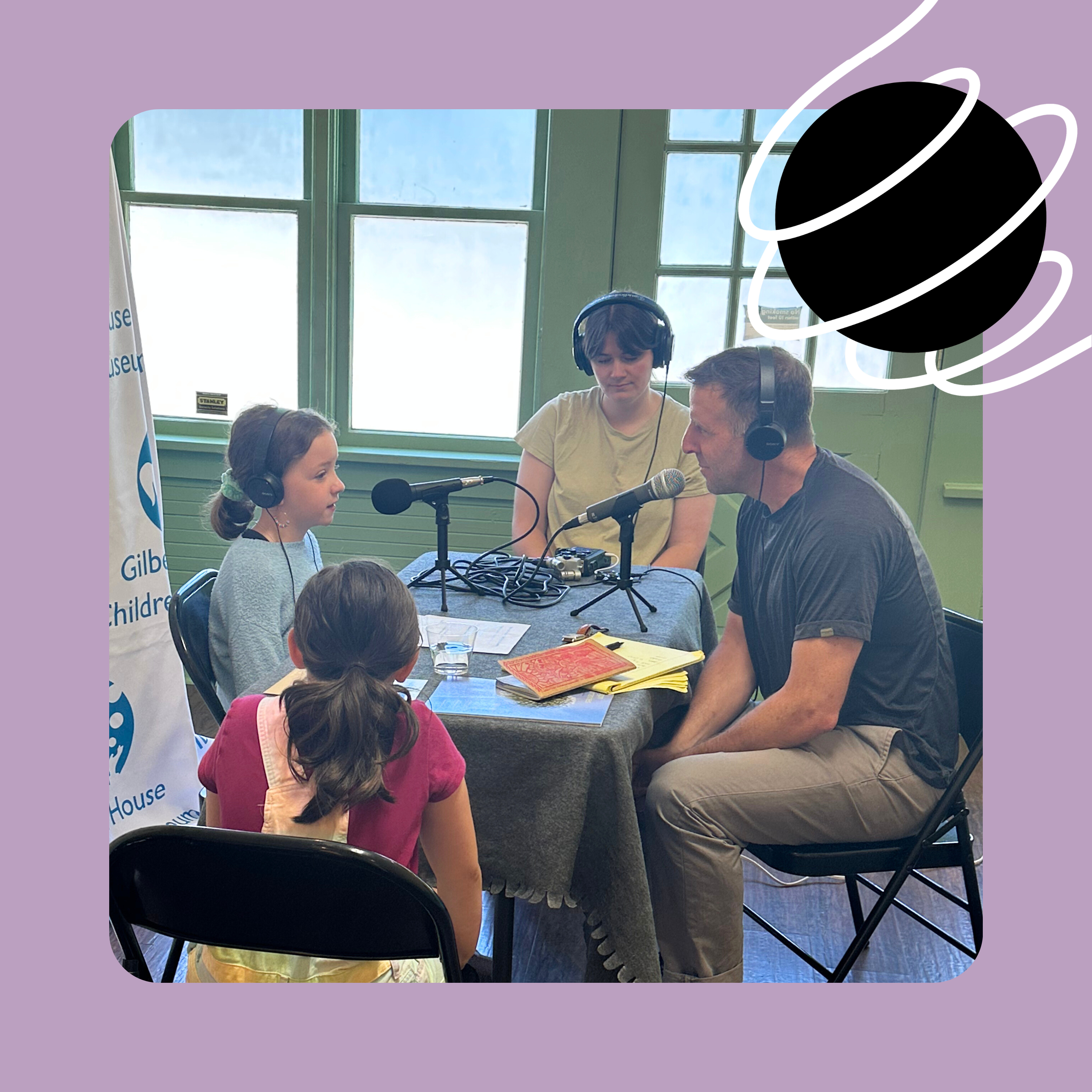
In this episode, we talk with kids at the Gilbert House Children's Museum, in Salem, and and at Grace Art Camp, in Portland, about learning, creativity, and joy, and also about school and the summer.
Show Notes
Gilbert House Children’s Museum is a nonprofit dedicated to providing hands-on, play-based learning experiences that spark curiosity and creativity. Nestled in downtown Salem’s Riverfront Park, the museum has been inspiring young minds since 1989. Named after Salem native A.C. Gilbert—an inventor, Olympic gold medalist, entrepreneur, and advocate for learning through play—the museum celebrates his legacy through interactive exhibits and innovative programming. Gilbert’s most famous invention, the Erector Set, serves as the inspiration behind the museum's 20,000-square-foot Outdoor Discovery Area, home to a giant, climbable Erector Set and other engaging structures.
Since 1997, Grace Art Camp has been dedicated to creating awareness through art, culture, and story in a process-oriented environment for children. Art studios are led by professional artists and offer a variety of experiences and skills in the visual and performance arts, storytelling, fused glass, ceramics, and fiber. High school and college youth lead and support the campers in all activities in a caring and nurturing respectful way. Studio projects are often process-oriented, and activities are inspired by the “story of the week” culminating in a weekly celebration to honor the community cultivated over the course of the week together.
This is our fifth episode featuring children's voices. Check out our previous episodes:
- Talking with Kids About Becoming (September 2024)
- Talking with Kids About Belonging (March 2024)
- Talking with Kids About Success (April 2023)
- The Constant In-Between (August 2022)
Transcript
Various speakers: A detour is like when you're going on one trail and then like you take a side path. So like you can learn something new, which is like what we do in, like, school, which is like if we get to learn something really well, we'll still do that so we can keep knowing it really well. But then we'll go on detours so we can learn new things.
Welcome to The Detour from Oregon Humanities.
Welcome to Detour of Oregon Humane Society.
Welcome to The Detour for Oregon Humanities.
Welcome to The Detour from Oregon Human Humanity.
Welcome to the, or-- welcome to the director from Oregon manity.
Adam Davis: On a hot July day, we pulled up to a bright orange and blue Victorian house: The Gilbert House Children's Museum in Salem. Outside kids braved the heat, digging dinosaur bones in a sand pit and playing on colorful abstract structures. Inside, they took charge of elaborate, make-believe exhibits from a submarine to a diner to something I couldn't quite understand.
When we started to work on this episode of The Detour, we didn't know exactly what it was going to be about. We did know we would talk with kids at the Gilbert House, and after that we learned we could also talk with kids at Grace Art Camp in Portland. It was only once we started talking with particular young people we talked to that we learned what the episode would be about.
It would be about learning, or about learning and creativity, or about learning and creativity and joy, and also about school and the summer. These all seemed like good things to focus on as we turned from summer to fall and with fall to the start of the school year. So let me just say that again, shorter.
At first, we didn't know what this episode would be about, and then we did what stands between not knowing and knowing, maybe learning what's learning. That's what we're grateful to all the people at the Gilbert House and Grace Art Camp for helping us explore. Here's what 11-year-old Olivia had to say.
Olivia: Learning is like, I actually really, it's hard to explain, but like learning how to do something that you have never done before, or it's like discovering new stuff. And learning along the way.
Adam Davis: What's a thing that you think, ‘huh, I've learned this and here's how I've learned it?’
Olivia: Well, I'm still learning how to draw. I'm still learning new techniques and stuff to do it.
Adam Davis: How do you learn new techniques for drawing?
Olivia: Basically you're just doodling on paper or whatever medium that you use, and then you discover that looks good, so you keep practicing drawing that. Then you learn a new technique.
Adam Davis: Ah, like when you think about learning, is that something you're mainly doing on your own? Are you doing it where there are teachers helping you?
Olivia: I've been doing drawing by myself for a bit. I also, sometimes I watch YouTube videos about how to do it, but not that often. I just doodle.
Adam Davis: It's really just doing the thing and seeing what works and then--
Olivia: Yes.
Adam Davis: Trying to do more of that.
Olivia: Yes.
Adam Davis: Uhhuh. That's cool.
Olivia: Or looking at other artists and seeing their kind of art.
Adam Davis: Hmm. You ever find learning difficult?
Olivia: Yes. Learning can be difficult. Definitely math.
Adam Davis: Math. Why is math difficult to learn?
Olivia: Because it could just never stay in my brain. When I get it into my brain, after the summer, it's just gone. Or like after a couple weeks it's gone.
Adam Davis: So you said after the summer. What do you associate with summer? Like do you think of summer for learning or for other stuff? What's summer for?
Olivia: Summer's basically for doing whatever you want. You can do whatever you want.
Adam Davis: Okay. So, Olivia, we might finish up this interview. I want to ask you, like, have you heard any jokes lately or that you would, you wanna share a joke or something funny?
Olivia: Sure. Where'd you leave the chicken with no legs.
Adam Davis: I, I don't know.
Olivia: Exactly where you left it.
Adam Davis: And that's where we'll leave this conversation. So thank you Olivia. Great to talk to you. Thank you for taking time.
Olivia: Thank you.
Adam Davis: And putting the headphones on.
Olivia: You're welcome.
Alfie: My name is Alfie and I am eight years old.
Adam Davis: Tell me a little bit about what's it like to be eight?
Alfie: Can't really describe it. I'm not really good describing stuff.
Adam Davis: Okay. What kinds of things are you learning?
Alfie: I'm learning writing, science and math.
Adam Davis: Huh. When you say writing, like what are you doing when you're learning to write?
Alfie: Well I'm writing new words so I can learn how to write them without needing help.
Adam Davis: Words like superficial?
Alfie: No. Or I'm not on those. I'm like on smaller ones.
Adam Davis: Like Cat?
Alfie: Yeah. C-A-T.
Adam Davis: So you're working on spelling?
Alfie: Yep.
Adam Davis: Do you like spelling?
Alfie: A bit. My favorite type of school is math because it's so easy for me.
Adam Davis: Math is easy.
Alfie: Yep.
Adam Davis: What's easy about math?
Alfie: Well, you just gotta add up the numbers in your brain and then you put them on paper.
Adam Davis: Okay. What about multiplying? Are you doing that yet? Or you're sticking with adding for now?
Alfie: I am on multiplication, like 20 times 3 is 60.
Adam Davis: Okay. You did that pretty fast. How do you, in your head, go from 20 times three to 60? What are you doing in your head?
Alfie: So here's what I do. I just memorize what it is and then I can just say it quickly.
Adam Davis: I see. Okay. Okay. Maybe we'll move to the end of this conversation. I want to ask you the same question I asked your sister. You got either a joke to share or something funny that you, you're smiling a little, so maybe you're thinking of something.
Alfie: I don't have a joke, but I have a riddle.
Adam Davis: Bring it.
Alfie: What is green and blue and moves a million miles per hour?
Adam Davis: What is green and blue and moves a million miles an hour?
Alfie: The earth.
Adam Davis: Okay. Thank you Alfie. I'm gonna be thinking about that when I drive back home later. Going a million miles an hour plus 60 or so. Yeah.
So can you tell us your name again?
Benny: Bennett, but I go by Benny.
Adam Davis: Benny, how old are you?
Benny: Six.
Adam Davis: What are you doing at Gilbert House? What are you up to here?
Benny: Well, today we are just learning about the disaster stuff about volcanoes.
Adam Davis: What's a volcano? How do you describe a volcano to someone who doesn't know?
Benny: So there's a bunch of rock in the bottom of the earth and then there's just a bunch of magma that pushes it up and it creates a mountain. And then there's the magma in the mountain. And then when there's so much magma, it is too close to there. When it keeps filling and filling up with magma, it turns into lava and then it explodes. And the top blows off.
Adam Davis: Whoa. That's actually an excellent explanation. Do you, do you think you knew about all that when you were two years old?
Benny: No.
Adam Davis: And now you're six and you know all that.
Benny: Yeah.
How did that happen?
Benny: My head just thought of it.
Anonymous child: You are listening to the director with camps in Salem at the Gilbert House Children's Museum.
Kate: My name is Kate and I am 11.
Adam Davis: What are you up to at the Gilbert house?
Kate: So we made a lot of friends here. Every Wednesday we try to meet up with all of them, and then we get to run around and play games together.
Adam Davis: Uhhuh, do you feel like you are learning as much during the summer as you do the rest of the year?
Kate: Yeah. Our mom makes sure that we still do school so that we don't forget stuff over the summer. And it's also really fun 'cause since we don't have as much school, we get to do other stuff and learn more outside in different places.
Adam Davis: Cool. Like if you were gonna explain what learning is, how would you?
Kate: Learning is kind of like you get…you learn things all the time. So even if you stop doing school, you'd still be learning other things like how to be a better person or how to tell this from that and so that you can be better off when you grow up and you don't do school with your mom or your dad anymore.
Adam Davis: How do you learn to be a better person?
Kate: So if, if by making mistakes. So whenever we make mistakes, we get to learn about what we did wrong, so we can figure out what we do right next time or how to help ourselves with that mistake. Our mom helps us a lot with that, so she helps us figure out what the problem is so that we can fix it.
Adam Davis: So you gotta kinda see it, think about it, approach it differently.
Kate: Yeah. So another thing, like you can also try anticipating your mistakes, which works too.
Adam Davis: Can you?How do you, like, can you give me an example of anticipating your mistakes?
Kate: So like, if I'm about to do something wrong, I'll usually start feeling bad in my head and then I'll notice and I'm trying to like notice that, so I figure out that's not the thing to do.
Adam Davis: That's interesting. You're noticing something inside you. You're paying attention to that. What about with math or science? Can you anticipate mistakes in math or science? The same way as with a good person?
Kate: So it's a little harder, but if you can look at the answer you got or if you can think over the answer you got, then you can figure out like, wait, that doesn't look right. Or like, how does that work? Or like, it doesn't seem to work that way.
Luke: I'm Luke. I'm nine years old.
Adam Davis: When you're here at Gilbert House, do you feel like you're learning stuff here?
Luke: Mm-hmm.
Adam Davis: What kinds of things are you mostly doing here when you're here?
Luke: Like friends and us come here on Wednesdays and we run outside and do Fastest Tagger in the West.
Adam Davis: What is Fastest Tagger in the West?
Luke: Fastest Tagger in the West is where if you tag somebody before they get to tag you, they sit down and you're still up. So the main object of the game is to get you to tag everybody.
Adam Davis: Do you think you learn stuff when you play Fastest Tagger in the West?
Luke: I mean, you learn what people do for strategies for trying to get you down.
Adam Davis: Have you heard a joke over the last couple months that you like that you would want to share?
Luke: I came up with one.
Adam Davis: Well, let's hear it.
Luke: What did the peanut say to the pecan?
Adam Davis: What did the peanut say to the pecan?
Luke: You're driving me nuts. Still both nuts.
Adam Davis: Thank you. Thanks a ton. I think we might ask you to switch out with your mom for a second. Yeah.
While we talked with Kate and Luke, their mother, Kelly, was standing in the corner of the small room listening. And given that experience, along with Kelly's role in her kids' education, we asked if she might be willing to put on the headphones as well.
So we just talked with two of your kids, who it sounds like you're teaching or you're accompanying, as they learn. What do you think about the educational work you do, you're doing with them?
Kelly: I think you just hit the nail on the head. I am not their teacher. I am just the learning enabler. And most of the time we're having enough fun that I just try to be a student with them. 'Cause otherwise I'm missing out.
Adam Davis: How do you enable young people, especially your own young people, to learn?
Kelly: Mostly by having no formal instruction or idea. What I'm doing-- my background is in advertising, and when you're trying to get a consumer not just to try your product but to adopt your product and be loyal for life to your product, you don't tell them, "You need to do this because I said so," or "You need to do this 'cause you're gonna use it someday." You have to entice them, you have to win them over, and you have to, in a meaningful way, show them the value in what you have to offer. So that's, it's essentially just coming up with a different advertising campaign for each lesson and each subject.
Adam Davis: That's interesting. I wasn't sure if you meant each lesson or each subject, or if you meant the whole endeavor.
Kelly: No, you gotta have a variety of campaigns or it just gets old.
Adam Davis: How did you decide to take this on?
Kelly: Mostly it had been floating in the back of my mind. There were subjects that never made sense to me in school, and I still got good grades, but it always bothered me deeply that I didn't know why I was getting the good grades. So when I was pregnant with Kate, I started reteaching myself some of the subjects that hadn't made sense because I didn't want to tell her, “I can't help you with this.” And in the course of reteaching myself, some of the subjects I found out, oh, these are actually kind of fun. Like, I wish I'd known that back then and that made me think maybe I'd want to try homeschooling.
My husband was horrified. As he pointed out, you have zero background in education. Maybe you should read some of the fundamental literature. And I looked up what that was and started with How Children Learn by John Holt, and reading that as I'm watching this infant develop, it perfectly articulated everything I was observing and in terms of how Kate was engaging with the world and learning about the world. And that reawakened my own curiosity, which I hadn't realized had been dormant for so long. And at that point there was no going back.
Adam Davis: Do you know when your formal role in your kids' education will change?
Kelly: When they tell me it's over.
Adam Davis: Will you be asking them to tell you or will you let them come to it?
Kelly: We've, we've had many conversations and actually, with Kate recently, you know, telling her, look, you're about to start sixth grade here in Oregon. That's middle school. We can keep doing what we're doing. Or you could go to public middle school, or we could try to find a co-op. I offered her a few other options and what she told me was, "What I'd really, really like is for you to homeschool all my friends." And I said, "Well, that's not what anybody else wants. As much fun as that would be, I'm pretty sure their parents don't want that either. But maybe we could start doing, maybe I could start teaching a weekly language arts class. To which your, you know, your friends would be invited. And it will be goofy and silly and irreverent, and hopefully their parents aren't too offended by it and want their kids to participate."
Adam Davis: Amazing. So how does Gilbert House Children's Museum figure into the educational stuff you've been doing with your kids?
Kelly: So, Gilbert House is the first time in my life where I felt a true sense of community. And I think it's because despite all the research, all the talk about the importance of learning through play, this is the one place I've ever encountered that actually believes that and acts on it. And they offer homeschool adventures courses here. So it's a once a week class for kids from five to age 11. And from teacher Julia, I've not only learned some really good educational techniques, I've learned good parenting techniques.
Kate came home when she was probably seven or eight from homeschool adventures and informed me that if you want Luke's attention, you need to do what teacher Julia does. You need to make eye contact with him before you speak. Wow. She was right. Julia also, when she teaches engineering in her classes, anytime someone's prototype doesn't work, she gives them a sticker and tells them it's a failure sticker. And it's a good thing, 'cause every time your prototype fails, you've figured out what to change the next time to make it work.
Even little things like, there used to be when we first moved here and started coming with the kids, there was a China exhibit in the first building on the second floor, and there was an abacus in the exhibit, and there was a little sign that explained how to use the abacus, and I had never used an abacus, but as I'm reading the directions and playing with it, this light bulb went off and I just thought, oh my gosh, why? Why didn't I learn math this way? So I got an abacus and that's how both kids have learned math and it's a night and day difference in terms of their understanding of it and mine. And that's all due to an exhibit here at the museum.
Adam Davis: Can you, like, what's learning as you understand it?
Kelly: I think it's being a bad student. A good student has the right answers, and learning is ultimately about having fun and being curious and yeah, that doesn't always get rewarded.
Adam Davis: Kelly, thank you. Thanks for what you're doing with your kids and thanks for talking to us for a few minutes.
Kelly: Thank you for giving me some insight into my kids. That was fun.
Adam Davis: Okay, good. Thanks.
Various speakers: You are listening to The Detour with campers in Salem at the Gilbert House Children's Museum.
To me, learning is doing new things and learning how to do things better. It makes me think of speaking languages. Knowledge, school, math, art, 'cause art's, a learning thing, except mom doesn't count it as school teaching.
Whenever I think of the word learning is like, I don't really know
What does the volcano tell the other volcano?
What?
I lava you.
Mika: I'm Mika and I'm eight years old.
Adam Davis: You're eight years old, and you're at Gilbert House Children's Museum today. What are you doing here?
Mika: Summer camp.
Adam Davis: What's the camp?
Mika: Oh yes. Science.
Adam Davis: Science. What are you doing in science camp? Like what kinds of things?
Mika: Today we did geysers just now with vinegar and then baking soda. And then you put the baking soda with the vinegar and you have to hold it out and then it'll come out. And there was volcanoes that we made in the sand pit with an empty plastic water bottle, and baking soda and vinegar, and then it came out all over the sand.
Adam Davis: Okay. So you're doing this stuff over the summer, but then during the school year, were you just in second grade or third grade?
Mika: Second.
Adam Davis: Second grade. Do you feel like the learning you're doing during the school year is the same or different from the learning you're doing over the summer?
Mika: It's kind of the same.
Adam Davis: What makes it the same?
Mika: Mm. You're kind of learning stuff, which is like you learn stuff in school, but it makes it funner than school school. Like they give you an activity to go with it. Like they're teaching you something like with an activity.
Olivia: I'm Olivia and I am eight and a half.
Adam Davis: When are you happiest at school?
Olivia: Hmm. Maybe when it's like reading or art.
Adam Davis: What do you like about reading or art?
Olivia: I really like reading because like my dad always said to me, if you can read, you can do anything.
Adam Davis: Do you think when you're reading, you're learning?
Olivia: Mm-hmm.
Adam Davis: What do you think you're learning?
Olivia: Learning how to read more better.
Adam Davis: How do you practice a word? How, like how does that work?
Olivia: Like you keep on doing it over and over again.
Adam Davis: Huh. And then eventually that word ends up working.
Olivia: Mm-hmm.
Adam Davis: I don't know.
[Whispering.]
That's Mika again, off mic. Whispering a suggestion to Olivia.
Mika: Sound it out.
Olivia: Oh, you sound it out.
Adam Davis: I like the coaching. I feel like there's some learning here too. So. When you're doing art, 'cause you said that that was the other thing you really like. Is art easy to learn? Hard to learn.
Olivia: It's not really hard to learn. Like you can just do scribbles and it's basically art. Like just art. Yeah.
Adam Davis: Like just art.
Olivia: Yeah.
Adam Davis: Do you think I'm learning when I do that?
Olivia: Yeah. So like when you make a mistake you can see if you can make it something that you didn't. When you make a mistake, you can fix it into something new that you like.
Adam Davis: And that's part of how learning works.
Olivia: Yeah.
Adam Davis: Have you heard a joke recently that you'd wanna share?
Olivia: Hmm. Yeah. Why can't dogs use the remote?
Adam Davis: Why?
Olivia: Because they always hit the paws button.
Adam Davis: Okay. Thank you.
Alicia Bay: One of our primary goals is building community. I did it as a parent myself, bringing little kids here and having that social time for myself and my kids.
Adam Davis: Alicia Bay is the executive director of the Gilbert House Children's Museum, and she's on the Oregon Humanities Board of Directors. Zach St. Lawrence is the education coordinator at the Gilbert House.
I guess I wanna ask both of you about the relationship in your mind between that social time or community and learning. How much are those two distinct from each other? How much are they a part of each other?
Alicia Bay: For me, they're intertwined. Because when a child comes here, they're coming with an adult, they drive the car, they choose to come here. And so there's very much the interaction between the adult and the child in how they experience the place, where they go, the rooms that they identify to play with, or the prompts that are given to them afterwards.
We also try to build our exhibits and outdoor spaces in a way that children will intuitively know how to play. They'll spontaneously play with each other because they know some of the implicit rules that are there. So if they walk into a fifties diner, one can be the server and one can be the person being at the restaurant and ordering.
So they're, we're social creatures as humans. And so when we think about play, it's typically with other people. So if children are going to learn through play, it should be through human interactions.
Zach St. Lawrence: To add on that, I see our space as available for any age range as well. Like we have kids coming in, asAlicia said, who just know what to do. But they all interact with everything so differently. Some of the little kids are at the most basic level, but then those other older kids start to develop some more reasoning and think things through more and develop their own patterns and habits within our play structures that we have here.
And it's fun to watch how all of them still manage to have a great time by just doing their own thing. And to add on to what you were saying about how education fits into it, it's also informal, but at the same time it's always there. Like, there's always something that they can take away from it.
They might not realize they're learning something, but after they go home, they're gonna remember that experience and build off that in their own ways.
Adam Davis: I have a question for both of you. When you were a kid, was there a place in your community that did the informal community and learning together particularly well, that stands out for you?
Zack St. Lawrence: For myself, I can't think of anywhere that we had like that. There were no children's museums. This was up in Yakima, Washington. The closest thing would probably have been the library for me. My family spent a lot of time at the library and it was a little more formal than what we offer here, but it was the closest thing to what I can think of.
Alicia Bay: I have a distinct memory of probably second or third grade going on a field trip to a children's museum in Los Angeles. And so that's one of the reasons I'm so committed to our field trip programs because for many children that visit Gilbert House, it's only through those field trip programs that they'll come and see us and experience it. And so we hope to create similar types of memories.
And you didn't make me share my age at the beginning, but I'm definitely from that generation that spent a lot of time outside. And so those social dynamics of creating our own games, of creating our own rules in the neighborhood or out on the playground were those experiences that I had. And so this is a safe place where families can come and children can have some of those social interactions that they may have had in neighborhoods or on the playground in years past.
Adam Davis: What's the difference between a school and a museum?
Zach St. Lawrence: Well, I, the structure, I mean, just how things are set up in a school. Everything is regimented in a way that there's a pattern to how the day goes. Whereas you come into the museum here, it's open. You just go do what you want, wherever your imagination leads, that's what you're gonna be doing here. And I've worked in both and it feels so much more free to work at a place like the Gilbert House just because I can see kids come in and they lead their own imagination, they lead their own instruction. Essentially they decide what they wanna learn or what they want to do that day instead of being told what they're going to do that day.
Alicia Bay: So I also have experience teaching in a classroom, and I really enjoy bringing that knowledge and experience to this informal setting. And like Zach was expressing, watching children follow their own curiosity and take those learning experiences that support what they're learning in school or in a homeschool program and in those more formal settings.
Adam Davis: What about the difference between a museum and a children's museum? What are the things that most stand out to you as distinctive about a children's museum?
Zach St. Lawrence: We want them to touch and play with everything, and usually at a museum, things are behind glass or are on a wall and are meant to be looked at. And here we design exhibits that are specifically about children manipulating different–we call them props, but different tools that have to do with the learning and growth and play. The thought process that goes into what you put out is so different between the two, I think. As I'm designing a new exhibit, I buy things and see if they will tear apart. Whereas I don't think that's gonna happen at a history museum. They're not gonna see if they can rip their exhibits apart because we know that's what's gonna happen here. The kids are gonna get their hands on it and really just have at it. And so we wanna design things that are meant to be played with and meant to be, not abused, but used.
Adam Davis: When you hear the word learning, what comes to mind? One word answer doesn't have to be one word.
Zach St. Lawrence: Learning to me is experiencing new things in many different ways. And I hope that's what we provide here.
Alicia Bay: Taking in new information and being able to retain it or a new skill. And when you're watching little children, they're doing that constantly. And as a parent and as an observer here at the museum, being able to watch children just grow in their skills and knowledge base on just that daily basis is really amazing.
Adam Davis: Do you have a question as you have been going through your days lately related to this work or this place?
Alicia Bay: Always and like 27.
Zack St. Lawrence: So my, my recent questions have been, okay, how can I build this thing that will engage the kids and help them learn even if they're not sure they are.
Adam Davis: Great. Well. Listening to the kids talk throughout the day, it's clear they're getting lots of learning, lots of interactive time, lots of joy and I think they know they're learning too. I just wanna--
Zach St. Lawrence: Oh, they do.
Adam Davis: Yeah. So, which is interesting to hear them talk about and reflect on even at eight or 11. And so thank you for what you're doing here. Thanks for what you're doing with this place.
Zach St. Lawrence: I love being here. It's my favorite job I've ever had.
Alicia Bay: Mine too.
Adam Davis: Cool.
Alicia Bay: Yeah. Just so remarkable and so gratifying to hear, like you said, children talk about this place. 'Cause as they walk out, they're not going like, Hey, thank you very much. I learned a lot.
Adam Davis: Back in Portland, we joined campers in Northeast at the long-running Grace Art Camp. For almost thirty years, kids from four to twelve years old have learned from professional artists, youth, and young adult counselors. That July morning we arrived just in time for their opening assembly.
Various speakers: Good morning.
Adam Davis: Here's Vincent, a camper, filling us in on what's going on and what this camp is all about.
Vincent: We first sit down for an assembly.
Various speakers: Hello. Good morning. My name's Ashley.
Vincent: And they'll like sing songs and then we will get to choose what we do for the day for the first part of the day.
Then we have lunch and then we go back to the assembly part place, and then we get to choose again what we do for the rest of the day.
Various speakers: You're listening to The Detour with campers in Northwest Portland at Grace Art Camp.
Cosmo: Hi, My name is Cosmo, and I'm seven years old.
Oliver: I am, my name's Oliver, and I'm seven years old.
Adam Davis: Do you have a favorite thing that you do in school?
Oliver: Art.
Adam Davis: What do you like about art?
Oliver: It's that my teacher's really, really nice. Her name's Miss Brook.
Adam Davis: Mm-hmm. What school?
Oliver: Beverly Cleary.
Adam Davis: How about you, Cosmo? How would you answer the question of what you most like doing in school?
Cosmo: I like doing math.
Adam Davis: Doing math. What do you like about math?
Cosmo: I don't know. Just math, like subtracting stuff.
Adam Davis: You like that?
Cosmo: Yeah.
Adam Davis: That's good-- numbers. They're good. You got one suggestion for Grace Art Camp. If you could, if you could add one thing to the camp, what would you add?
Cosmo: Math studio.
Adam Davis: Math Studio. Interesting. Awesome. What do you think, Oliver? One thing you could add maybe.
Oliver: A skate park because it's a type of art.
Adam Davis: I guess skate park is a type of art. Yeah. Okay. Awesome. What do you think an art is?
Cosmo: Something that is cool and fun.
Adam Davis: Something that is cool and fun.
Cosmo: and kind of beautiful and stuff.
Adam Davis: And kind of beautiful, interesting.
Adam Davis: What do you think an art is, Oliver?
Oliver: Like something that somebody made like a masterpiece or something like that.
Adam Davis: Got it. Okay. Do you have a joke in your head that you would like to share? Oliver, hit it.
Oliver: Oh. What do you call a wolf that's lost?
Adam Davis: I don't know.
Oliver: A wherewolf.
Cosmo: What does the ghost eat for his breakfast?
Adam Davis: What?
Cosmo: Boo berries.
Nora: My name is Nora Morris and I'm nine years old.
Adam Davis: And what are you up to today, Nora?
Nora: I was working in beat making, so we were using a laptop, and like we were using the app Garage Band and then choosing different beats or songs for a playlist, I think.
Adam Davis: Do you ever wake up in the morning and go, today I wanna learn this?
Nora: Sometimes.
Adam Davis: Sometimes, yeah. I guess I'm wondering if you think learning happens on purpose or by accident or how those go together?
Nora: Sometimes both. Like on purpose you can try to learn how to jump rope or something, or by accident, you can just be like fooling around with jump rope and broom, you can jump rope.
Adam Davis: Okay. Do you prefer one way or the other way?
Nora: No, not necessarily. I think it's sort of a surprise when you like do it by mistake.
Adam Davis: Like a good surprise?
Nora: Yeah.
Adam Davis: What would you say is the biggest difference between what's going on at camp and what's going on at school?
Well, in my opinion, it's more fun. Like you have more opportunities to be creative and like do art. And you have more opportunities to be with friends and talk with friends.
Adam Davis: This may be a strange question, but when you say more opportunities to be creative, can you explain what you mean by ‘be creative?’
Nora: Trying to be yourself and like putting yourself into your art or like whatever you do.
Adam Davis: Hmm. I actually love what you just said there.
Zoe: My name is Zoe and I'm six years old.
Adam Davis: How are you spending today? What classes or activities are you doing today?
Zoe: Well, we were making salmon drawings and then we were gonna put watercolor on them.
Adam Davis: Do you think you're getting better at drawing the more you do it?
Zoe: Yeah.
Adam Davis: Why?
Zoe: 'Cause you are doing the thing and every time you make a mistake, you can learn from that mistake.
Adam Davis: That's it. Can you think of a mistake that you made drawing that you learned from and did better the next time?
Zoe: One time I forgot to do hair when I was drawing me and my mom.
Adam Davis: How'd that look?
Zoe: I don't know.
Adam Davis: Hey, how's it going?
Lorelei: Good.
Adam Davis: What's your name?
Lorelei: Lorelei
Adam Davis: Lorelei. My name's Adam. You're going straight to the headphones? Huh? You're not waiting at all?
Lorelai: No, I'm not.
Adam Davis: You're ready to go?
Lorelai: Yeah.
Adam Davis: Lorelai, how old are you?
Lorelai: Eight.
Adam Davis: How's it going?
Lorelai: Good.
Adam Davis: You like eight?
Lorelai: Yeah.
Adam Davis: What do you like about it?
Lorelei: I like being young.
Adam Davis: I hear you. I totally hear you. What do you like about being young?
Lorelei: I like being young because you don't get like eye bags under your eyes.
Adam Davis: Are you saying that 'cause you're looking at me?
Lorelei: No, it'll just be like droop, droop, droop.
Adam Davis: When do you stop being young? Like is there an age when you stop being young?
Lorelei: Forty.
Adam Davis: Forty. How did you say that with such certainty?
Lorelei: Hmm. You just know it.
Adam Davis: Yeah. Do you think, in addition to the thing with your face and it, the bags and stuff, do you think you learn more when you're young or when you're over forty?
Lorelei: Over forty you learn more over time.
Adam Davis: Wh- why do you say that?
Lorelei: The more older you get, the more wisdom you get. You learn more things as you get older, like, you learn that you gotta get old sometimes.
Adam Davis: But you're eight and you already know that.
Lorelei: I know.
Adam Davis: How did you learn that already?
Lorelei My parents. My parents are very smart.
Adam Davis: So do you think you learned from your parents?
Lorelei: Yes.
Adam Davis: I gotta ask you this 'cause I think I know you're gonna have something. Do you have a joke you'd wanna share with us? Any jokes in your head you'd wanna share?
Lorelai: I actually do have a riddle.
Adam Davis: Bring it.
Lorelai: What can clap but has no hands? The answer is thunder.
Theo: Hi, I'm Theo and I am eleven years old.
Vincent: Hi, I'm Vincent and I'm twelve years old.
Adam Davis: Do you know that your names are the names of two brothers? Artist brothers? You know that?
Theo: Yeah.
Adam Davis: Who?
Vincent: No.
Adam Davis: Okay. You wanna explain what you know about that?
Theo: So, there's Vincent Van Gogh, and then there's Theo Van Gogh, and they're two artists.
Adam Davis: How did you know about Vincent and Theo Van Gogh?
Theo: I just heard it on, I just heard it somewhere like, I remember I was like, I was like with my parents and I was like, yo, Vincent, you're Vincent Van Gogh. And then my parents were like, you know that Vincent Van Gogh and Theo Van Gogh are two artist brothers? And I'm like, really? That's cool. And that's how I found out.
Adam Davis: What, what are you up to today? Like, how are you spending the day?
Theo: I'm gonna start with some glass art, which is, we're making animals and then I'm trying to try to get into fiber art, which is like, kind of like getting like cloth and like baking cool stuff.
Adam Davis: Vincent, how about you? What are you thinking for the day?
Vincent: I'm also doing glass and fiber art.
Adam Davis: When you wake up in the morning, do you think like, Hmm, it's Thursday, I'm gonna learn today? Do you ever think something like that?
Theo: Sometimes, like when I wake up in the morning, I'm like, yo, like I think I'm gonna choose like glass today, or something like that. I do think that I'm, I'm also like, yeah, sometimes, but not like every single day. Just like, yeah, sometimes.
Adam Davis: If you weren't going to school and you weren't going to camp, how would you spend your days? And this question is for both of you.
Theo: Definitely I would love hanging out with friends like Vincent and like a lot of my other friends. And I also like to play video games online with them 'cause we love interacting online. And also we like, like, I like going to Oaks, amusement park and like, stuff like that.
Adam Davis: I hear that. Yeah. How about you Vincent? What do you think?
Vincent: Same with him. I also like to spend time with like friends or, or also play video games with friends. Because video games are fun.
Adam Davis: Yeah?
Vincent: And also go outside with friends.
Adam Davis: Any joke in your head that you wanna share with us?
Vincent: I recently got a dog from the local blacksmith. When we got home, he made a bolt for the door.
Theo: I have one in mind. It's pretty classic. Why'd the chicken cross the playground?
Adam Davis: Why?
Theo: To get to the other slide.
Genesis: Okay. So I'm eight years old and my name is Genesis Williams.
Adam Davis: How does it feel being eight years old?
Genesis: It feels fine. I feel taller and I feel like older.
Adam Davis: How does camp feel different from, or similar to school?
Genesis: It feels similar 'cause I have to wake up early and because we have to do a lot of things.
Adam Davis: Are there any ways that camp feels different from school?
Genesis: It feels different because it's like, it's not the same thing as school, but it's kind of like school, but not really. Because the counselors are younger and there's more teachers than a normal school.
Adam Davis: When people say the word education to you, that big word education. What does it make you think about?
It makes me think about math and learning things. Do you have favorite subjects at school?
Genesis: I like. Hmm. I like music.
Adam Davis: Did you sing along with the songs this morning and all of that?
Genesis: Sometimes.
Adam Davis: Sometimes. How do you decide when to sing along?
Genesis: If I know the song really well, I will, but if I don't, then I won't.
Adam Davis: How do you learn a song?
How I learn a song is, I listened to it a few times. So then I get to know the lyrics and then I might try to sing along, but if I can't, then I'll just listen to the lyrics more.
Various speakers: You're listening to The Detour with Campers in Northern Portland at Grace Art Camp.
The word that comes to my head when I hear the word learning,’ is a pool.
Math or reading.
How to ride a bike.
Science.
I think of creative.
The word that comes to my mind when you say learning would probably be reading.
Math.
I don't really think of any words except for the word, ‘learning.’
Adam Davis: So we make a podcast called The Detour. And sometimes we talk to young people especially. Like the kind of people you're working with. And, this one we're sort of thinking about things like learning and art and that sort of stuff. So that's what we're gonna ask you some questions about.
All right. Sounds good.
Okay. So for starters, can you just say your name and how old you are?
Maria: My name is Maria and I'm fifteen years old.
Adam Davis: Maria is one of a group of counselors in training working with Grace Art Camp this summer. How are you spending the week this week, Maria?
Maria: I've been spending it taking care of the orange pod, which has been really fun, getting to know all the little kids.
Adam Davis: What's the orange pod for people who don't know?
Maria: They're the ages four and five.
Adam Davis: So you got a group of four and five year olds that you're responsible for.
Maria: Yeah.
Adam Davis: What are you doing with them?
Maria: We do fun activities around the camp. We go like to t-shirts and glass.
Adam Davis: So one of the things we've been asking even much younger people about is like how they learn. Do you feel like you're learning stuff this summer?
Maria: Yeah. I'm learning how each kid, like not everybody, has the same emotions. Everybody controls their emotions differently and which is one way you realize that there's many ways to help the students. They're not gonna be, you can't all help them the same way. You're gonna have to help them in a way that they're gonna be comfortable.
Adam Davis: How are you learning that general principle of needing to adjust? Like how, how did that get so clear for you?
Maria: When I realized the first, like the first. My seventh week coming here, like the first week when I came, everybody was not shy, like everybody got comfortable around each other like that quick. But this week, it was the same again. Like some of the kids got comfortable, but some of the kids were like getting really, like, they would get scared like to get around those kids. Like you gotta teach them that it's all right. Like everybody's nice here, they're gonna welcome you. Yeah.
Adam Davis: So that actually seems like a kind of hard thing to teach because it's a little bit emotional.
Maria: Yeah.
Adam Davis: How do you teach something like that?
Maria: Teaching them like if you need help, you can always go to one of your little friends. Like they'll help you in a way. Like you shouldn't be shy. Everybody's here to help. Like for example, us, the CITs and the counselors, like we do it with each other since we all met, like this week, like, yeah.
Adam Davis: What do you think? You want to, you wanna talk a little bit?
Amy Gray: I don't know. Today the listening is good.
Adam Davis: The listening's good. Amy Gray is the outgoing executive director of Grace Art Camp and a longtime arts educator in Portland and Hood River.
Amy Gray: Just listening to you talk to all these campers and counselors is just like, yes, I'm in the right place.
Adam Davis: So let me ask you about that. Why? What? What do you mean?
Amy Gray: I mean, I think there's just always the question of. Where to be, what to be doing in the world. And I think formal education and being a classroom teacher is always sort of the dangling, like maybe should have gone that path. But listening to kids talk about their experience in out of school programs is always so heartening. 'Cause it's like, oh, they're learning so much and they're loving it. And that's where I am: beside them. But it's also, you, when you're in a nonprofit and you change roles a lot, there's not sort of the security maybe that being in the public school system would provide. So you're always kind of wondering, well, if I'd done that, would that have been a safer route? But it's great to do this.
Adam Davis: You said they're learning a lot and they're loving it.
Amy Gray: Yeah.
Adam Davis: And those are two different things, but it sounds like you see them as going together. Can, can I just ask you about, in your mind, the relationship between learning and that feeling of loving it?
Amy Gray: Yes. Well, and the first thing I think of is just the flow and that whole concept of when you're enjoying the learning, then you can meet the challenge and meet the potential. Like mistake making or failures or when things don't go how you had hoped they would go, but you're in it enough to keep going, like struggle longer and then learning starts to really happen. 'Cause then the new information is coming. But if you're not loving it, it could be really hard to stay with the path of learning.
Adam Davis: What feels most challenging to you about helping shape the day for 117 or 162 campers.
Amy Gray: I guess the most challenging thing has sort of disappeared now 'cause I think for a long time I felt like it was up to me to figure out how to shape the day. And over the last four years I realized that everybody is shaping it every minute of every day together. And pretty much they're doing it the same now as they were doing it ten years ago, probably, and four years ago. And I'm just sort of trying to remove any obstacles that could get in the way. Like if there's a leaf blower, I can go and talk to the person about potentially waiting ten minutes. You know, they look to me to like this leaf blower is like crowding out the storyteller. That's my moment. But other than that, I'm just hanging around.
Adam Davis: Uh huh. What is different for you about hanging around a summer program as distinct from a classroom?
Amy Gray: Oh, well, I'm not sure, 'cause I've never taught in a classroom as the teacher year round. So I think the relationship-building is something that I, that I miss. Like, I don't know what it's like over nine months to get to know thirty kids deeply and be their person. And so I feel like that's-- something I don't, I don't ever know, but I feel like what I see is just that teachers can never stand back. They're always on and here because of the structure with all these really astute fifteen-year-old volunteers who wanna be here and give all this time. And then sixteen-, seventeen-, eighteen-year-old counselors, and they're all paid to be here. It's their first job. And so they're like counting on their first chance to have authority of any kind really. And then the artists. It's everybody's just holding everybody else. So it's like nobody's alone. So you don't, I don't feel like anybody feels too much pressure. And so the campers feel safe, and then the campers mostly, you know, navigate their own learning journey. So everybody's just kind of hanging out.
Adam Davis: Just kinda hanging out, feeling comfortable attached to other people, therefore able to do some learning.
Amy Gray: Exactly.
Adam Davis: I want to go back to the experience of you've been bringing campers over either singly or in pairs, and then you've been listening and what, what's most been standing out to you as you listen to them talk about their experience here?
Amy Gray: I mean, every single one of them said something wonderful. Something that was just this little gem and I'm like, oh, how can I hold on to each of those little gems for each of these little people and like realizing, you know, kids I've seen every year for four years who are just like getting taller and older every year. But then kids who I've never met before this year, that feel already so much like they have a sense of belonging here.
It struck me that this idea about learning is so tied to math and reading for kids that we've like kind of gotten in there with our public school system to really solidify that math and reading are the most important things, or that they, that they actually equate to learning because there are so many other words and they're doing so many different things here, but also like a suggestion that we add more math. And so I'm like, math is in art every second. It's always part of everything. It's all integrated. So it's just interesting how we pull things out and then attach them to concepts. That strikes me.
Adam Davis: Do you remember, when you were like ten, What, what subjects or what you liked to do at school?
Amy Gray: Oh, I think I've always liked to do the things that felt the most creative and free. So art making, theater, acting, singing, like those things always felt safe and easy 'cause they were just natural. So I think I struggled with math, but I think, yeah, I, I, it was probably a lot like it is for them.
Adam Davis: Are you like, today or end of the summer, do you think you'll carry a question outta here?
Amy Gray: I mean, I, I, yeah, I have lots of questions. Mostly how can I just stay connected to all these humans? It feels really special, but I think it's the sauce, you know, it's so I have to just let go of the humans and hold the theory and the idea and the structure. I mean, I won't be here next year, so I'm moving and this'll be the end of four years at Grace, but I never went to camp as a kid. I feel like I just did all my camp from, you know, my forties now. So I, I, I'm a new person now. I'm a camp person now.
The sauce. Yeah. This mentoring, like just this, what it really means to be mentored by someone and I don't think mentoring has to be, you don't have to be older than someone to mentor them. You know, it's like this idea that somebody knows a little bit more about something than you know and can show you and wants to show you, and how much joy there is in that, and how much that can happen when you have you know, all the different—there's the leafblower!
Adam Davis: There's leafblower. Ask him to give us 10 minutes.
Amy Gray: It seems fitting in some way. Right?
Adam Davis: How about this? I'm gonna say thank you.
Amy Gray: Thank you.
Adam Davis: I'm gonna say thank you for making time for us here. Thank you for talking with us. Thanks for doing so much in this and lots of other environments today. Make the sauce.
Amy Gray: Thank you. This has been so fun.
Adam Davis: Awesome. Thanks, Amy.
Amy Gray: That's perfect.
Various speakers: Thanks for listening to The Detour from Oregon Humanities.
Thanks for listening to The Detour from Oregon Human Society.
Thank you for listening to the director from Oregon Human Humanity.
Thanks for listening to The Detour from Oregon Humanities.
Anna Michael
Anna McClain.
Anna McClain is the producer,
Alexandra Silver
Alexander Silverton
Alexandria Andrea Silvester,
Alexandra Silvester,
Karina Briski,
Karina Brisket,
Karina Briski,
Karen Bliss,
and Ben Waterhouse,
Ben Waterhouse,
Ben Waterhouse are the assistant producers.
Adam Davis is the hoster.
Adam Davis is the host.
Adam Davis is the host.
Adam Davis is the host. And that's you?
Adam Davis: It is, yeah. You can learn more about Gilbert House Children's Museum, Grace Art Camp, and Oregon Humanities in our show notes and at oregonhumanities.org.
Various speakers: See you next time.
See you next time.
See you next time.
See you next time.
See you.
Do you think my parents will hear this? I love you, mom and dad!