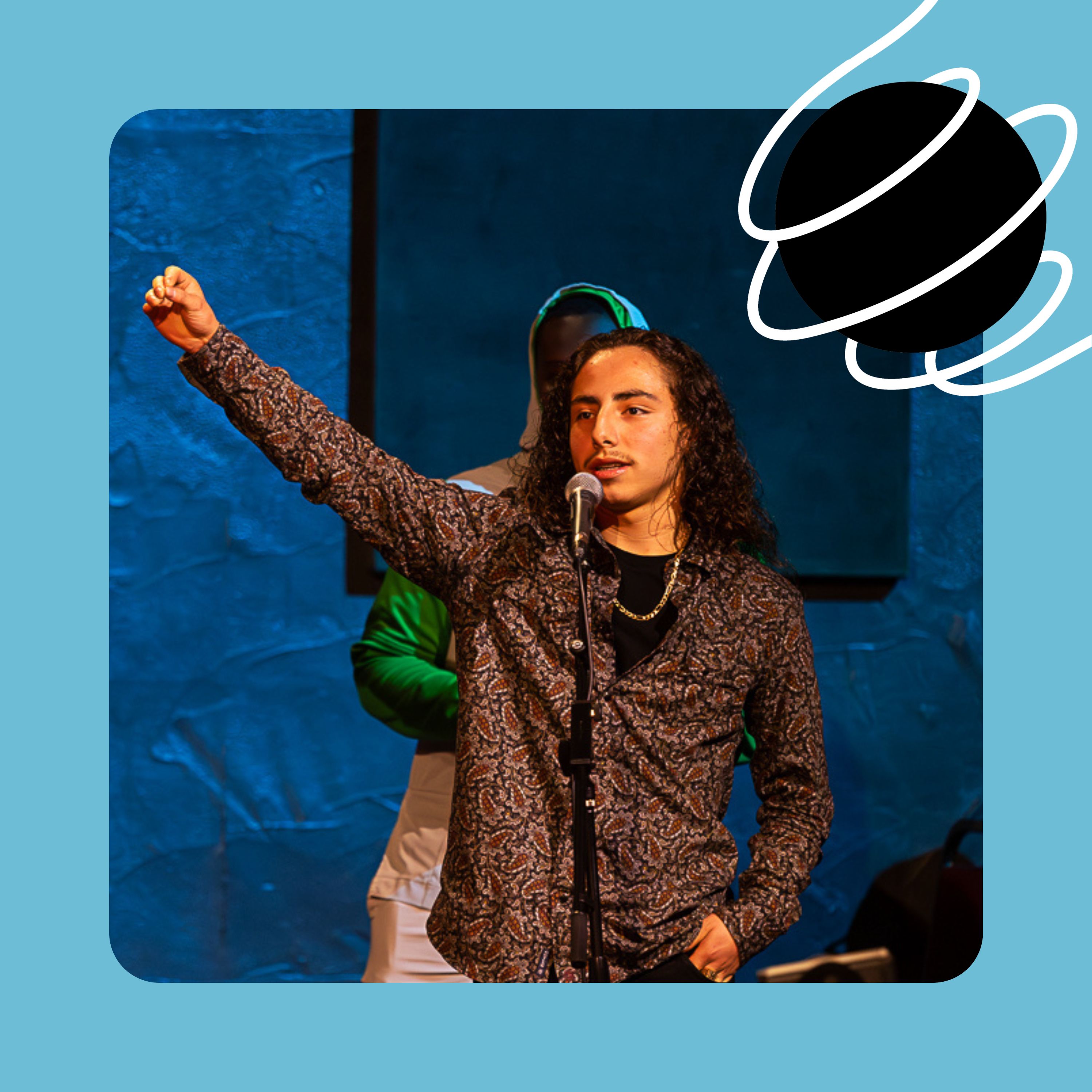
In this episode we hear from Colum McCann, a National Book Award–winning novelist and cofounder of Narrative 4, a nonprofit organization that uses personal storytelling to build empathy between young people. Colum is Irish and lives in New York, and he joined us in February 2026 for a conversation about stories, national character, identity, and the 250th anniversary of the Declaration of Independence. You'll also hear from Beyti, Jaylen, Uliana, Malaki, and Steve—five students at Adrienne C. Nelson High School in Happy Valley who participated in a storytelling workshop led by Narrative 4.
Show Notes
About Our Guest
Colum McCann is the author of eight novels, three collections of stories, and two works of nonfiction. Born and raised in Dublin, Ireland, he has received many international honors, including the U.S National Book Award, the International Dublin Literary Prize, a Chevalier des Arts et Lettres from the French government, election to the Irish arts academy, several European awards, the 2010 Best Foreign Novel Award in China, and an Oscar nomination. He is the president and cofounder of Narrative 4, a nonprofit organization that uses personal storytelling to build empathy between young people. He lives in New York with his wife, Allison, and their family.
Narrative 4 works with K–12 schools to create classrooms where students feel heard and valued. The Story Exchange is a facilitated experience where students share, listen, and retell stories. It helps students feel heard and learn from one another’s perspectives. To learn how to host a Story Exchange at your school, visit narrative4.com.
Further Detours
The conversation with Colum McCann is excerpted from a Consider This program on February 3, 2026. You can watch the whole program here.
For more conversations about the power of stories, listen to our episodes with Sarah Marshall, Eliot Feenstra, and Stacey Rice.
Nelson High School is named for Oregon Supreme Court Justice Adrienne C. Nelson. Justice Nelson joined us for a Consider This conversation about the court system in 2020. You can watch it here.
Transcript
Beyti: I am an African American, so having that hyphen is just, I've never really thought of it because it's been said so much in my life that it's just really become just like a piece of who I am. If you drew a picture of someone's face, you are not gonna forget the eyes. Obviously, a person is gonna have eyes. Obviously, I'm African American.
Adam Davis: Welcome to The Detour. I'm Adam Davis. You just heard the voice of Beyti, a student at Adrienne C. Nelson High School in Happy Valley, Oregon a few weeks ago. Beyti and four other students, Jaylen, Uliana, Malaki, and Steve, joined us on a Tuesday morning in a second floor classroom to talk about identity hyphens, belonging, stories that shape us, and cheeseburgers.
This conversation was a follow-up to a packed school day in early February that began with 24 students from five affinity groups, as well as six educators gathering in the high school library to participate in a workshop led by Narrative 4, a nonprofit organization that uses personal storytelling to build empathy between young people.
Narrative 4 was co-founded and is co-led by the National Book Award–winning author Colum McCann. And Colum was part of the story-sharing workshop in the library in Happy Valley that morning. Later that day, column joined Oregon Humanities at the Alberta Rose Theatre for a conversation about stories, national character, identity, and the 250th anniversary of the Declaration of Independence, as well as the work with students that Narrative 4 is doing.
This episode of The Detour first explores what the Adrienne C. Nelson students made of their experience in the story-sharing workshop and how they think about who they are. We then turn to Colum McCann's reflections on how stories might hold the world together, or in some cases break it apart. Now back to Beyti and Malaki, followed by Steve, Uliana, and Jaylen.
It's Tuesday morning at Adrienne Nelson High School. Maybe for starters, could you just say, your name and what year you are?
Beyti: My name is Betuel. People call me Beyti and I'm a sophomore.
Adam Davis: Cool. Thanks.
Malaki: My name is Malaki Aguilar and I'm a sophomore as well.
Adam Davis: Alright, cool. A few weeks ago you both participated in this story exchange, and I wanted to ask what it felt like to tell a story about you to someone you didn't know so well. What did it feel like to do that?
Beyti: At first nobody really knew each other, so at first everybody was like really shy. But then I think really quickly everybody started to talk to each other more.
And I just felt personally that was, it was really nice to speak to another person that I've never seen before and never really talked to about what my life was like and how I came to the, to where I am now because most people don't really think about what their life has been like. So thinking about that, but also having such short amount of time, it was really just eye-opening.
And I went home thinking, huh, what else has happened in my life? And I just started thinking about other stories that's happened.
Malaki: I like that.
Adam Davis: You remember what it felt like for you, Malaki?
Malaki: Yes. For me at first, like the person I was speaking to, he understood more English than he could speak. He was Ukrainian and I, as he was telling me his story, I was like, okay. Like I was fully understanding it and I appreciated that. He felt good enough to tell me his story and felt comfortable enough. And I, one, I was thinking about my story on what I was gonna tell him. I was like. Dang. Like, how is he gonna tell my story? So in my head I was just thinking, how is he gonna tell my story? Cause he can't really speak that much English. And then I started thinking like, that's like a selfish way to look at it. At least I'm here understanding his story and putting myself in his shoes. So I felt good to be able to communicate to everybody else and tell his story,
Adam Davis: Easy or difficult to tell your partner's story as if it was you?
Beyti: My partner's story, like the person that, the person's story that I was supposed to tell was heartbreaking a little bit. So I didn't know how to like really convey that. So I didn't, I didn't want to like have that person have a negative connotation of that person through other people's eyes. And second, I wanted to tell it, right?
Adam Davis: Now you guys came to that event, that Narrative 4 put on with the affinity group that you're a part of, or with an affinity group that you're a part of?
Malaki: Yes.
Adam Davis: What's the Affinity group you're a part of, Malaki?
Malaki: LSU, Latin Student Union.
Adam Davis: How about you Beyti?
Beyti: I'm the representative of the Black Student Union here, which is also known as BSU. we're open to everybody that supports black people and black lives in general.
Adam Davis: Yeah, so this is actually super interesting and I think it's super related to the idea of a story exchange, and even this episode, which started with this conversation with Colum McCann, who was here, one of the early questions I asked him was, he identifies as Irish American, and I asked him, what does it feel like to be hyphenated?
To be both Irish and American, to be Irish American. How much does that hyphen matter? And so can I ask that question to you guys? Like how much do you think of yourself as having a hyphen as part of who you are?
Beyti: Personally, I am an African American, so having that hyphen is just, I've never really thought of it because it's been said so much in my life that it's just really become just like a piece of who I am is just more like if you drew a picture of someone's face, you are not gonna forget the eyes. Obviously a person is gonna have eyes. Obviously I'm African American, so I don't know. I never really thought of it in that sense.
Adam: Yeah. What do you think about hyphen?
Malaki: I feel like I always felt like Mexican, and I remember growing up, I grew up in the apartments in Beaverton and they're all, every, all the kids around me, they were all Mexicans and Hispanics, like Mexicans, and they know where their family came from Mexico. And then they would always tell me like, you're not dark enough to be a Mexican, or like Hispanic. Or they would say like. Where's your family from? what part of Mexico are they from?
But my family, they're from Texas. Cause Texas used to be Mexico, so my family are Texans, but we're like Mexican. So like growing up in there. But with around all those, kids who like knew their background, like where they came from Mexico and they were like dark skinned at first. I'm like, dang, am I Mexican? Like I was questioning myself and I feel like, when I moved out here and as I came out here, it made me stand out more as a Mexican and really feel like perfect. This is what I am.
Beyti: Just to piggyback off of that, I was born in Maryland, so in that area there are a lot of Ethiopians. So when I moved here, when I was like around nine years old, that's when I really started noticing the amount of Ethiopians. Cause back then it was like so normalized. Cause I used to see them like every single day. And then I come here and there is still like a big population of Ethiopians, but not so much in schools.
There are so many Asians here. There's so many white people here. So it made me scared. Is it gonna be super different? Is it gonna be hard to make friends? But yeah, it's been like not so hard to make friends 'cause I feel like no matter what type of person you are here at Nelson, you're always gonna find at least one or two friends who are like you in some type of sense.
Adam Davis: Okay. Is it unusual to be in a room where you have, for example, the Latino students affinity group, African American students affinity group, Ukrainian students affinity group? Is it unusual to be in a room with so much attention to the groups that the people are part of? Or is that a normal thing?
Malaki: I thought it was interesting. It was fun sitting at a table with my like Latin people, my LSU, and then looking around just seeing like the different shades of color and the different affinity groups. It was like all of us were just like, all of us from our affinity group were like, important. So it felt like nice. Like we all have like our own spot here.
Adam Davis: Interesting. Yeah. How about you Beyti?
Beyti: It didn't feel unusual per se. Because I know that was like one of the main reasons why all of us were here, to connect. But for me, like personally, it wasn't unusual. It just felt like I was talking to like just a random person. Because I talked to so many different people, with different ethnicities every single day. So yeah, to me it wasn't really unusual. It was just like talking to a person I was told to talk to, and then that slowly became like a person I really wanted to talk to.
Adam Davis: It's interesting. I remember being in a room where the person who was leading this discussion that I was in, they encouraged us to pick five, like features that would characterize us. Like I would pick man, American, from Chicago, whatever. I'd pick those and then they, they said, okay, get rid of two of them. So we were down to three and then they said, okay. You can pick one. And I remember thinking that's a pretty intense question.
Malaki: And what was the one that you picked?
Adam Davis: Weirdly, I did pick American, and I don't identify strongly, but I felt like there was something about it that felt like, ah, if I show up in other places in the world, or if I try to understand myself, there's something about who I am that is, I don't know what. Do you have a sense of what you'd pick if someone would cruelly push you, like I'm pushing you now, to do that?
Beyti: If I had to go from five to three to two to one, I would either pick Ethiopian or woman. That would most likely be my top two choices. I don't know if I could choose between Ethiopian and woman, because they're such like big parts of my life. I think the reason that I would choose Ethiopian is because when I'm reading a book and they say the main character is a woman, I don't get as excited as I do if they were Ethiopian, be like, oh, the main character is a girl, next page, and then I see Ethiopian, I'm like, I can't wait to see how she is like me, how she represents us.
Malaki: I could relate to that. I think if I broke it all down, it would probably have to just be my ethnicity, so Mexican. Because that's who I am, and I just, love representing it.
Adam Davis: Yeah.
Malaki: Because it like, feels good.
Adam Davis: Yeah. That's great. Last thing I'll ask is if you have, a word in your head, any word that you don't need to explain. You got a word in your head now? Any word?
Beyti: After this, "identity." Probably that would be the word that I've gathered from here.
Malaki: I'll say "failings."
Adam Davis: Cool. Hey, thank you for spending this Tuesday morning talking into microphones with headphones on in this classroom. I really appreciate it. Thank you for having us. Appreciate it.
Malaki: Appreciate you Mr. Adam.
Adam Davis: Thank you, Malaki. Thank you, Beyti.
You're listening to The Detour with students at Adrienne C. Nelson High School.
Jaylen: I guess I could start off y'all, howdy everyone. My name is Jaylen. I know, I just said howdy. That's crazy. It's Tuesday morning. We start stuff off. I'm a junior here at Adrienne C. Nelson High School.
Adam Davis: Thank you.
Uliana: I'm Uliana, I'm a senior here.
Steve: I'm Steve. I'm a junior at Adrienne C. Nelson High School.
Adam Davis: Okay, awesome. Thank you for being here on this Tuesday morning, and you guys were all here several weeks ago when Narrative 4 did the story exchange, and maybe for starters, just want to ask like what did it feel like to share a story with someone you didn't know?
Uliana: I feel like it was really unusual because each story is so different, and it started like really weirdly because we had to do like association with warts and all of that stuff. We were like really suspicious about all of that. So I think it was really like interesting, but also like it was really uncomfortable in the beginning, but by the end it just felt like so natural. to share your stories and all that stuff,
Steve: Yeah, I would say, it was really fun experience because I thought it was gonna be just like a normal just group talk experience. I'm really used to talking to multiple people from multiple states, so I'm like, okay, it's just another day walking the park. But it was so much more different of an experience because I'm talking to so many different people from different countries. So you have so many different perspectives other than just, a perspective that you might see in the States.
Adam Davis: Yeah. So the fact that people were from different places changed it in some significant way for you?
Jaylen: Yeah.
Adam Davis: Yeah. How about you, Jaylen?
Jaylen: I was just expecting, like them, this is gonna be like we all sit around in like a giant circle and then we all just share a story about ourselves and people get to ask questions. I thought I was gonna be like, yeah, like a easy walk in the park and be like, oh, I'm just talking. I'm like talking. But then, they actually had me think and I was like, oh wait, hold up, wait, what's the story? Like I actually share that. Actually fall under like these categories of what do I want to choose? There's just so many and then there's just so little at the same time. I'm like, whoa, this is hard. Actually. This is really hard.
Adam Davis: Hard to choose a story that met the rules or hard to choose a story that represented you?
Jaylen: I think a bit of both. I think just hard to find the story that like, fiit the rules, but then hard to choose a story that really represented me as a person because I'm like, there's this story, but I feel like that's really say enough as like a, for something I could exchange with someone else who might be telling me something valuable to them.
Adam Davis: How do you know, what's a story that's valuable to you about you? Like what do you, what are you paying attention to? You go, yeah, this is a story that's valuable about me.
Steve: I would say if a story relates to you. I see that many people, if they try to get communities together, they're trying to, relate to that community. They're trying to bring everybody together through relation. What's a piece of you that matches in everybody?
Adam Davis: A piece of you that matches in everybody. Huh, that's interesting.
Uliana: I would say also a story that actually changed you in some way. So I think each story has an outcome and if it's that story change you in somehow and other person can also relate to that. I think it's really important because this perspective of actually changing your perspective on something or having like other experience.
Jaylen: They're like really taking all the good stuff, I'm gonna be honest, Steve. That what you said earlier, that was a bar, Steve. So I'm gonna give you that. I think, yeah, if the story can just relate to you or it's just something that you see. That could be like a part of your history in some way. the story that I chose was just like the story of like my grandparents and like how they came to Oregon. So I think for that it's just something like the history, like my family tree. That's why the story was important to me.
Adam Davis: Are you game to give us a short version of that story?
Jaylen: Yeah. Yeah, I can try. Let's see. So my family, my grandparents were both from South Arkansas. they both moved to Oregon separate times, but they just so happened to meet in Oregon. They went to like different colleges. My grandpa, went to the army. My grandma went to college and stuff like that. They both did their jobs. They met, fell in love at a young age and then got married. The rest is history. they had three kids and then those three kids had two to three kids each, and then there's just like eight grandkids.
Adam Davis: So I just want to note for a minute that like as I look around even this small room this morning, I'm thinking like, okay, so Arkansas, Ethiopia, Mexico, Kenya, Ukraine. So that's unbelievable that we're sitting here on a Tuesday morning from so many places. It strikes me as unbelievable. I don't know. Did anything that makes you think about or feel Uliana?
Uliana: I think no, because I moved here four years ago and like when I moved from Ukraine to travel through a lot of countries, I went through Ukraine to Romania to Hungary to Germany to France and then to Switzerland, and then back to France, and then I moved to the United States. So throughout that trip from Ukraine to United States, I actually experienced a lot of like different people from different countries. So it's really believable.
Adam Davis: Steve, how does that strike you to think about those of us in the room right now and where our families are from?
Steve: It's really it's mindblowing. Where I come from in Kenya because around the population is around 54 million and they give like less than a thousand opportunities for people to come to the States. So you're basically fighting for an opportunity hoping that, you have what it takes to not only come to the United States, represent your country back at home and be able to show that, yeah, we can really do something if you really open the door for us.
Adam Davis: That's intense. That feels like responsibility or pressure or something. Do you feel that?
Steve: Slightly, a little bit. I feel like they look up to us.
Adam Davis: Okay.
Steve: You're also trying to represent also in the United States. That you're not only just coming here just to, meet, but also bring something to the US.
Adam Davis: And Jaylen, you started with your grandparents coming from Arkansas. Presumably part of the Great Migration is what I hear, but like when you hear about all the other countries people here are pointing to, what's that make you think?
Jaylen: It makes me think of how small I am in the world. last year I got to meet students from Italy and Spain and I was just so fascinated and I kept asking 'em questions like, Hey, what do you, what is this like for you? Or What do you think? And they were just so happy to answer. And then I answered questions for them about the US and then sometimes I was like, Man, y'all came here. Portland's so boring sometimes. Look at the rain, look at the weather like, huh. I guess for me it would be boring at this point 'cause I've lived here my whole life, but for them it's something new, something exciting. 'cause this is like the US I'm like the ideal high school experience is supposed to be here. Like I remember asking, I was like, so what's You're excited for? It's oh, like the prom, or oh, the sports or something else. yeah, that's pretty valid. Yeah.
Adam Davis: Okay. Is there, Is there a story of this high school of Adrienne C. Nelson High School that like, what's the story about Adrienne C. Nelson High School? Is there a shared story about Adrienne C. Nelson High School that you could tell if you were telling someone you knew at home in Ukraine or if you were connecting with someone back in Kenya? Or if you were like, yeah, I still have a, I still have cousins in Arkansas. And they said, where are you gonna go to high school? What's that place like? What would you say? About the high school you're at?
Steve: I would say it represents something bigger than just a student represents the community because Ms. Adrienne C. Nelson was, basically her story was fighting systemic racism because she was from Arkansas as well, and since high school, she was always fighting racism and unfairness, and she made it known. She spoke out about it and she became very successful put her head to her goals, like her mind on her goals, and she was able to achieve them, be very successful.
Adam Davis: That's great. That's helpful. Yeah.
Uliana: I would say Adrienne C. Nelson gives so many opportunities in schools in Ukraine, even in private schools that I went to. We don't have that much opportunities like we have here, and it's amazing that like one public school in Happy Valley, Oregon can make such a big difference for many people, like big field trips, big clubs, so many other communities like we have so multiple clubs for each and every member of us that it just unites all of us at the same time, even though like we're so different.
Adam Davis: If I were gonna ask you to say not the professional story, not the polite one, is there something like if you were talking to a couple friends. And there's a story about this high school, what would you say?
Jaylen: That's a hard one because we're recording or it's hard just otherwise. I think it's both because we're recording and then I have to think about it. I think a story that I always like to tell to my friends is just the grind that I have to do. Not me, but we have to do for like our BSU assembly. BSU has the best assemblies every year. So I think it's just that pressure of living up to that and to just show off. I like consider myself a one of the leaders for BSU, so that's why I just said me. But, I think just being on that grind, like me, me, Beyti, there's some others, like we just worked hard to put on an assembly for everyone. But I think just doing that and then having Judge Nelson there, Judge Nelson is so supportive. She, and whenever we reach out to her and ask her if she wants to come, she like makes time in her day just to try to make it out to us and she always just bes there for us, not only like the BSU but for sports where like our basketball teams, our football teams, our dance, our cheer, like I've seen her like all over for like different sports and that just says a lot about her and how much she values at school and the community that you're here with.
Adam Davis: Yeah, she really shows up. I have seen her show up over the years since I've been here as well, it's great to hear. But it's interesting to think that sometimes a name feels far away from what a place is. I want to ask you the same last question really that I asked you guys, and that is just if you have a word in your head, don't explain the word, just any word that's in your head right now.
Jaylen: You really don't want me to go first because it's just a stupid word.
Adam Davis: I absolutely do. But don't explain it. Don't explain what you said.
Jaylen: Oh, cheeseburger.
Adam Davis: Excellent. Cheeseburger.
Jaylen: Was that weird?
Adam Davis: Great.
Uliana: do you wanna go next?
Steve: I was thinking unity.
Uliana: I was thinking freedom.
Steve: Okay.
Jaylen: Hey, can I change my word?
Adam Davis: You can. You can't change it, but you can add it.
Jaylen: Yeah. Okay. I'll add to my word. Togetherness. I think that's something that really just like unity, togetherness.
Adam Davis: All right. So I wanna say thanks to all five of you, both for talking with us this morning and for just how you're showing up. It's great. It's really awesome. So thank you.
Hey everyone, this is Anna, producer on The Detour. This year on the show, and in conversations all over Oregon, we're taking the 250th anniversary of the Declaration of Independence as an opportunity to explore questions related to democracy, equality, and freedom, and we wanna hear from you. What's your wish for the United States in 2026 or for the next 250 years?
What are your hopes or ideas for how this anniversary might be observed? Tell us by recording a voice message on your phone and sending it to detour@oregonhumanities.org. You can also call our phone line at (503) 607-8592. Again, that's (503) 607-8592. We might share your message in a future episode. Okay, now let's get back to the show.
Adam Davis: Let's turn to our conversation with Colum McCann at the Alberta Rose Theatre. We start with a few questions for our audience. If you are in any sense hyphenated, some kind of mix of identities, can you make a little noise? If I say "American national character" and a picture comes to your head, can you make a little noise? Okay. That's a striking silence, and I hope it's good, given that the questions today are around nation and character.
I wanna start by asking you that the question really, how do you identify? In terms of nationality and what does it mean to you? You talked about being Irish and now you've been in the States for many years, and if pushed, would you say I'm a little more Irish than I am American? Yeah, or a little more? What would it mean to say I'm American, 20%? What would even that mean?
Colum McCann: I will tell you this. This is bad.
Adam Davis: That's good. We're already there. It's good.
Colum McCann: So when I go, I have two passports. I have an Irish passport and an American passport. No matter where I go, when I get to the airport and have to show my passport, I look at the lines, is the European line gonna be shorter than the American line? And I'll go either way. This is me. It's like I'm very purple about this sort of thing.
However, this is where the real confession comes in, I keep my Irish passport over my American passport as I go through, because I don't know. I'm Irish. And I live in America, and I feel like a New Yorker. And yes, I'm all the, all these different things, but I really exist in the place where all these other stories of other people are also existing at the same time.
Adam Davis: Earlier today, when we were at Adrienne C. Nelson High School, one of the things you said, which I've also seen you write, is that stories hold the world together. So I wanna, I want to keep pushing a little bit on this, and that is how important are national stories? Are they important?
Colum McCann: If you look at Ulysses and then you read James Joyce and, when Bloom is talking and been asked by the citizen, what is your nation? And he says, Ireland, I was born here. But then the question is, but what is a nation? A nation is people living in the same place, but it's also people living in different places. So this stuff is messy, and I think the embrace of messiness in relation to nationality is something that we have to bring back into the debate. If you can be from many different places, we can embrace the proper democracy that we're supposed to understand. And we're living in really broken times. We're really living in difficult times where all our connections to these things are exposed. And you and I talked a little bit backstage about, what I like to call the disease of certainty. We're all so certain. About what it is that we think we're all so certain that we are entirely right, and what it becomes is these canals of certainty. But very few of us are operating on the floodplains in between, and I wish that we could talk to our country somehow and say. Let's get out of our canals of certainty. We're all so right, we're all so correct. We're all so sure that this is the absolute truth, which, it gets deeper and deeper and somehow flood the canals and push us out into the floodplains that are in between and get it a little bit messy again. And if we can embrace that sort of messiness, then you get back to some of that, original American character.
It was interesting that, the silence we heard about like America tonight, the American character. Which was so inviting, so beautiful, so tempting. When, you think of someone like Walt Whitman, again, do I contradict myself? Very well, then I contradict myself.
Adam Davis: I'll just say this in part, to push into a difficult spot that it is worrisome to me to be in a room of 400 people and at least in that moment not have noise around the possibility of seeing national character clearly.
Colum McCann: I agree with you.
Adam Davis: I think that's a concern. Yeah. And I think you could both have a clear picture of national character and not hold it too certainly, which feels different from not having a clear picture of national character. Could our country produce Walt Whitman today? Maybe that's the way to ask the question. Now I'm putting you in the role of sort of Tocqueville or Creve Kerr, someone who sees us more clearly, even though you've been here for a while, but in part because you're not from here originally, so do you feel like you are sensing that we actually don't know who we are nationally?
Colum McCann: I will tell you, that I do think that there is a very distinct and available, national character, and I think that I still will be, the pessimist of the intellect and the optimist of the will. I went out to, I'm gonna mispronounce it, Clackamas.
Adam Davis: You got it.
Colum McCann: Yeah. Alright. So out there today with these kids, by the way, is Malaki in the audience tonight? There was a young student who said he might be here. Is he here?
Adam Davis: Alright, good to see you again.
Colum McCann: I am so happy that this young man is here. Stand up for a second.
Malaki was part of the storytelling that we did today. And we had a group of Ukrainian kids here and we had a group of queer kids here and we had a group of, kids who were from an African American background and we had kids in all these different groups. And Malaki was part of the Latino group.
And everyone was separate at first, and then after they got a chance to tell stories to one another. There was a huge coming together, a sort of Americanness of character that was broken down by the fact that they were able to listen to and to tell one another story. There was a beautiful Americanness, the sort of Americanness that I grew up with and dreamed about. I come from Ireland, and I grew up with literature and this sense of the Irish identity, this nationhood, this, what is my nation, what is my nation? But I always had a thought about what America happened to be. And at the age of 21, I came to the United States to sit down to try to write a novel, failed miserably and ended up taking a bicycle then, across the United States, started in Boston and finished in San Francisco being an entirely different person because I learned the value of stories and storytelling and I loved meeting people and I still love meeting people, but I loved listening to people.
But something very elementary struck me at that very young age is that we all have a story, and this is the vast democracy that we, actually enter. I didn't realize I wasn't conscious of it, right? But years and years later, then I got together with these artists who were organized by a woman by the name of Lisa Consiglio who wanted to bring all these artists together.
She said, what is the highest aim of storytelling? And we got together and we said, the highest aim of storytelling is to listen to and understand somebody else's story, not even to tell your own story. And this was profound for me. This shifted me and this shifted me into this organization, Narrative 4, that, brought me to Malaki's School, today, and brought me into this room with 24 students, not a lot of students.
But what happened over the course of a couple of hours was so powerful, that I knew that a couple of lives would be shifted, and I just felt that this is in this mess of students who are here. This is a very good portrait of what I really would like America to be in its 250th birthday and especially on a 350th birthday.
Adam Davis: Yeah. And in a way, I guess that's, I've been thinking about this since I heard you say this morning, that stories hold the world together. They also divide the world up.
Colum McCann: That's right.
Adam Davis: And I feel like in a way that's what's been happening increasingly, not just in this country, but with a lot of power in this country.
And so I guess I want to ask about that power of storytelling. Stories about we seem to be incredibly powerful and especially when it's a we that we can hold onto in some way. So how? How to build stories that feel expansive rather than contracting?
Colum McCann: First of all, stories are really dangerous. So you can listen to me talk about, my experience at Clackamas today and say how wonderful, but guess what? Stories can take your house away. Stories can take your country away. Stories can take your identity away, right? And people use them in all sorts of ways. So there, this is a battle, but the embrace of somebody else's story is where I believe that a lot of the really true muscularity, comes from, and the ability to be strong. And, rather than coming indoors, closing the curtains, like shrinking our imaginations down to some GPS coordinate, if we can somehow break out of all of those strictures, then I think that we can, go somewhere different. Is this naive? Possibly. Is this sentimental? No. Is it full of sentiment? Yes. There's a difference.
Adam Davis: So if we were taking the anniversary of the declaration seriously? That short document tells a story pretty powerfully. What's your impression that the abiding story from, say, the declaration forward, is? Do you have a sense of what the key elements of that story as a storyteller might be?
Colum McCann: As we internalize, life, liberty and, happiness, but what it, what is all of that? and can you actually, define all of that? No, you can't. I will not be comfortable with somebody telling me, I'm gonna tell you about life, right? Or I'm gonna tell you about liberty. Or I'm gonna tell you about the pursuit of happiness. That's boring. But if somebody tells me of a story, then suddenly that particular story, the personal story, the non-didactic story, is the one that actually binds us together. I would besiege these communities that seem to be at odds with one another to somehow come together and not try to win an argument, not try to be cool, not try to be smarter, not try to drag the other person down into the drowning canal that they live in, but to say, yeah. Now does that sound a little bit twee? Yeah. Did someone say, yeah, you're probably right, but it's actually true. So for example, I will tell you that in Narrative 4. We brought together kids from the South Bronx and eastern Kentucky. You get 'em in a room together and they're absolutely terrified of one another.
I've seen grown boys from the South Bronx cry their eyes out because I'm about to ask them to exchange a story with a young student from Kentucky, and then suddenly, when they realize that they have a story and that they can tell a story, and that the story doesn't have to win an argument, but it can just be an ordinary story, then things that get into that messy, nuanced, beautiful area that actually lives in between, how are we gonna do that as a nation? I have no idea.
Adam Davis: So I do wanna ask you what, looking towards building that sense of connection, what can we count on that we can go to and say, here's here are the things you know we can build on to get people connecting across the kinds of differences you're describing.
Colum McCann: People wanna create a sense of fear. They want to create a sense of the other. Mostly these are corporations and they're governments and they are wealthy people who have an investment in keeping us away from one another. I do think that a lot of it is about money and power. And I do think that those things, yeah, can they be entirely dissolved? Of course not. But you have to dream yourself into a way that we can actually begin to really try to talk to one another. And is this stuff possible? Is it possible between Catholics and Protestants in Northern Ireland, or nationalists and loyalists or whatever way you look at it? I do think it's possible, but it's really grassroots. It's really deep down grassroots. If an alien came down from outer space, would that alien be able to understand why we fund, like this type of human and not fund that type of human? They would not, they would be completely perplexed by it all. So one of the things that we do at Narrative 4 is we want stories to lead to action, to lead to change, and things to not come from above, but to come from underneath. So if we are generous and kind to our schools and we start to invest in them and so on and allow these people to come along and open the debate for us rather than us believing that we have the answer.
I think something profound can happen, but I think fundamentally, somebody like Greta Thunberg is right. You walk outta your classroom on a Friday afternoon on your own, and you're embarrassed. And then the following week, six of your classmates come out and the following month, all of the students in your country come out because you're devastated by the idea of climate change. All of that is going to come from, from underneath. Is it gonna win in the end? I don't know.
Adam Davis: I guess a couple things about the example you just gave us. One is that. Alien has become such a vexed word.
Colum McCann: I'm an alien.
Adam Davis: That right. That choice of word itself reflects the challenge. And the other is that, an unknown other. Like the unknown other is the imagined threat. Which seems to me just brings us back to the problem that I feel like what we're talking about in some way again is how we constitute a we.
Colum McCann: Yeah.
Adam Davis: In non-toxic ways. And I think the reason I'm coming back to it is because I think it's really hard.
Colum McCann: Yeah.
Adam Davis: That actually for every nation, it's really hard. It's the achievement of a nation: to constitute a we, hopefully in relatively non-toxic ways, and as you pointed out, based on the classroom we were in today, we may be trying to do it in harder conditions here than many other countries throughout history.
Colum McCann: I do think so, yeah. But this constitution of a we is really important. You're never going to actually achieve it. It's impossible. the dream is impossible, but it's the approach of the dream that, that, that's gonna get us there. I'm not naive. I am not sentimental. I'm actually hardcore realist, but also hardcore optimist at the same time. The ability to hold these contradictory ideas in the palm of your hands at the exact same time. If you can do that. Then, you have something, some, something I think that's truthful and powerful. That's why this stuff with the storytelling with the young people actually works. We go into a school with Narrative 4. If we run our full program, right? Not just a once off and go in and out and about, but test scores go up, absentee levels go down, engagement goes up, empathy goes up. All of these things that are there in this really bad time that we are living in, these really, they feel to me like the most broken times. The theme must be repair, and I think if the theme is repair, the process to achieve repair is through, storytelling, but even more than storytelling story listening.
Adam Davis: I want to ask you the question you asked the students and teachers, at school this morning. You had people find the person they had paired with after they'd come back to a whole group and you ask them to share what they hoped for that other person. Which is a powerful question and a powerful invitation. You talked earlier about a hundred years forward, and I want to ask you about...
Colum McCann: My hope?
Adam Davis: Your hope, and to imagine we're all gone a hundred years out.
Colum McCann: Yeah.
Adam Davis: A hope or two. Maybe even, let me push it closer to the theme, a hope or two for this country.
Colum McCann: Well, a hope or two is that we're not gone. I love Wendell Berry, the Kentucky poet, right? And in one of his poems, he says, raindrops on the tin roof. What do they say? We have all been here before and my hope is that we're not completely, tumbling towards doom. My hope is that the America that I took a bicycle around 40 years ago is actually still, even though it looks different, sounds different, in its actual core, it's still the same place. My hope is that, we don't lose this actual dream. My hope is that we don't lose our optimism, even when we are wildly aware of all the stuff that is going on and all the darkness that's going on. My hope is that we can somehow harness the energy to survive this stuff, and to be better. What I really care about is about all of you and all of us together, and we have to do it together. It's not about this one person or this one series of people who supposedly are in our government or in our governance. It's more about engaging on a much more powerful level than that. Thank you.
Adam Davis: Thank you.
You're listening to The Detour. You just heard part of our consider this conversation with author Colum McCann. Before we go, I want to turn back to Jaylen Baty. Malaki, Steve and Uliana at Adrienne C. Nelson High School for one final question.
Do you think it's important that there is some sort of shared story about being American? do you have in your head a sense this is what an American is?
Beyti: No. To be American? I don't think that there's like a set type of personality that you need to have in order to be considered American. I think that if you've been here and you've explored the culture and you really like it, and I think that you can say oh, I'm American. It's so nice to be here. I love America. Then yeah, I think you would consider yourself American by then.
Adam Davis: What do you think?
Malaki: So I would feel like that, to answer your question, an American is someone who's in America.
Adam Davis: Interesting. Is there a story or a core part of the story about the United States that stands out in your head? And I know that's an impossible question. But still.
Uliana: I would say it definitely changes the perspectives for you when you move here, because at the beginning when I dunno if you guys experienced that, but before I moved to the United States, I really thought about the American dream and I was like, oh my gosh. American High School. Oh my gosh, parties, oh my gosh, football games. That's amazing, how could ever anyone experienced that and I thought that, like United States has endless opportunities for me, and I really wanted to move to the United States. And when I moved here I was like, oh, it's really different at the same time, but really the same also because people are really nice. You guys love small talk, which I really unexperienced to. And I walked into the coffee shop and I was like, "Hey, can I get a coffee?" They're like, "How's your day going so far?" And I'm like, "Why? Why do you need to know that?" I really appreciate it though. But like why? Again, like for the few weeks I was like, okay, why are they talking to me? Did I do something wrong? But you guys just so nice people. And this endless amounts of opportunities actually comes to your mind. You're like, I have to use them if they're given to me, I cannot just give them away and just sleep through them or procrastinate and just really have to focus on them. But of course, like the American dream is, I would say it's non-existent, but it really depends if you work for it. Because if you just came to the United States, it's not gonna do anything. You really have to work for that American dream like they call it. So the opportunities that United States are given to you actually have to use them to achieve that.
Jaylen: I think for me it's just the moments of people rising up in the US and I'm talking about for Martin Luther King, Malcolm X, like people like that who like rose up against something that they saw was wrong. And I think that's really something that I respect, they saw racism and they were like, we can do this without needing violence.
There's like different ways to approach this, and it's not only that there's people standing up, like all over like different types of ways like sports, I remember seeing like during the Black Lives Matter movement, there was athletes who were supported like in their way.
Adam Davis: Like Colin Kaepernick and stuff.
Jaylen: Yeah. And I think just seeing those around, like in America, it's just impressive. Just like wowing, is that a word? Wowing? Wowing to, witness or just read about or hear about, the way that they stood up. And it is just a solidified part of American history and it's something that people should not just only look at when it comes up in February and stuff like that, or just like something you could just like witness throughout all history. It's something that happened and it's something that people stood against.
Adam Davis: Yeah. Thanks.
Steve: I would say if there's one story to represent the US it would be either different or bold. If you go back in history, the US didn't like how they were being treated by the countries and they decided to be different. They decided to be bold. They did something about that. And they brought people from other communities, whether it was natives, then it was blacks. Even if there's history there, they just continuously built on it, as like Jaylen was saying, Martin Luther King, he saw something wrong with the system. He said something about it, Being different, like other countries. The US doesn't only represent like one thing, like Kenya represents Kenyans. Ukraine probably represents mostly Ukranians. Whenever you hear America, you hear so many different people, so many different ethnicities. You know, there's so many different opportunities. I would say back at home in Kenya, they have a high school test, right? And that basically determines your career path in life. And if you don't score good, then you can't go to those big universities and you can't get those opportunities. But if you come to the US you can slowly build your way up, seeing those, like those doors open and you know, being different and being bold, and it really builds off of each and every single person, even if down to the bone. I represent. I'm a Kenyan, I have the Kenyan features. currently right now, I would say I'm part of something bigger than just me.
Jaylen: That's a bar. I'm sorry. That's amazing. Oh my goodness.
Adam Davis: In this episode, you heard the voices of students at Adrienne C. Nelson High School in Happy Valley, Oregon.
Huge thanks to the educators there who did so much to make these conversations possible.
Colum McCann is the National Book Award–winning author of Let The Great World Spin, Transatlantic, and many other books. He's also the president and cofounder of Narrative 4, a nonprofit organization that uses personal storytelling to build empathy between young people. You can learn more about his work at colummccann.com.
And you can hear the entirety of our consider this conversation with Colum at oregonhumanities.org. Thanks for listening to The Detour from Oregon Humanities. Anna McClain is our producer. Ally Silvester, Karina Briski, and Ben Waterhouse are our assistant producers. This is Adam Davis. See you next time.