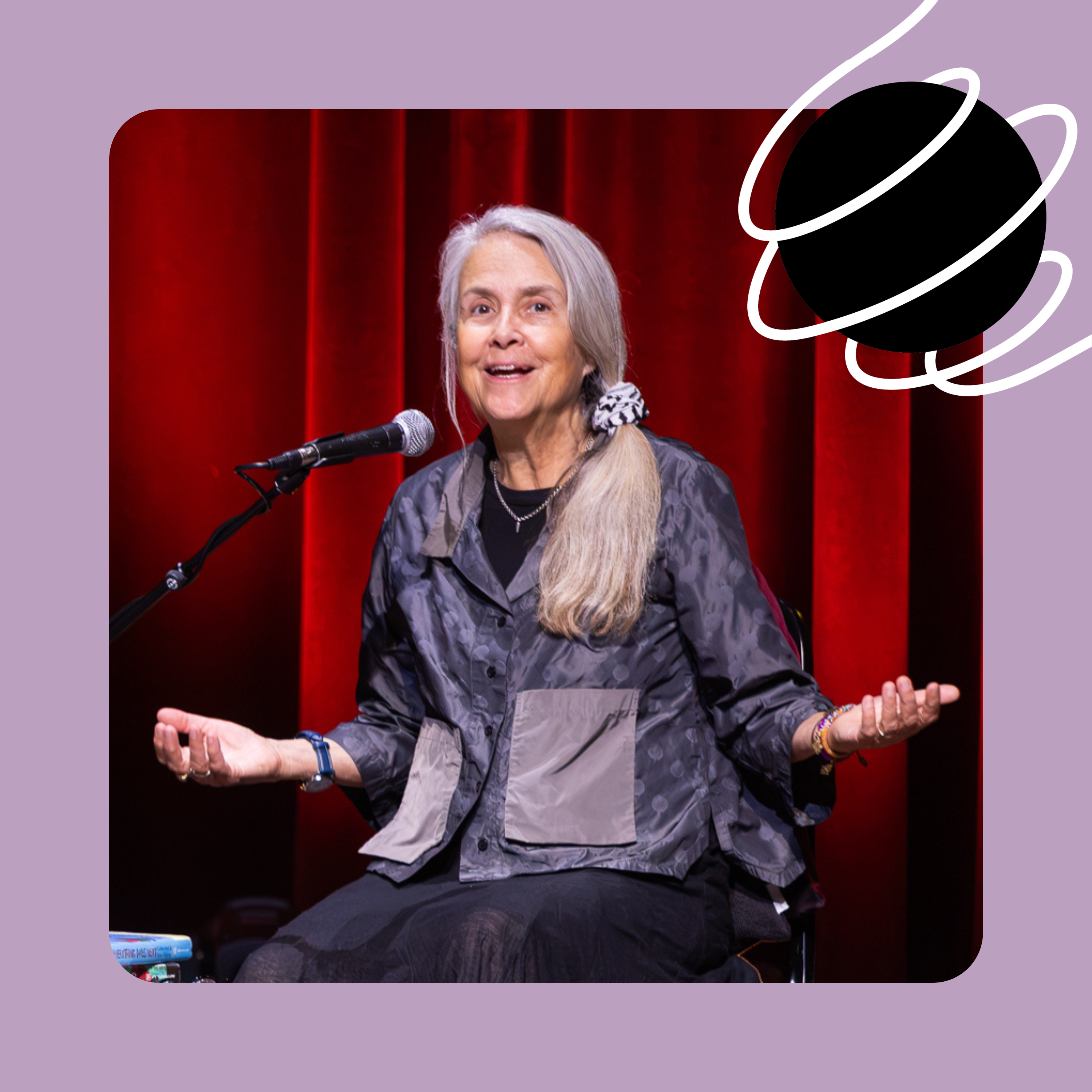
In a world often divided by borders and beliefs, how can poetry and storytelling bring us back to one another? Naomi Shihab Nye is an award-winning poet and novelist who has traveled the world meeting people and observing the ways poems offer meaning, comfort, and belonging. She sees poetry as a true bridge between people, cultures, and nations, sharing that in all her travels, she has yet to find a place “where poetry does not live.” In this conversation from June 2026, Naomi reads from her work and reflects on poetry’s ability to capture both change and continuity, helping us not only understand what separates us, but transcend it.
Show Notes
This episode features several poems by Naomi Shihab Nye:
Speaking about various efforts to bridge Jewish and Palestinian communities, Naomi references several organizations and projects: Hand in Hand, Neve Shalom, Seeds of Peace.
Naomi's visit to Portland was part of the 2026 Stafford Challenge Conference, which took place June 18–21.
About Our Guest
Naomi Shihab Nye describes herself as a “wandering poet.” She has spent more than 40 years traveling the country and the world to lead writing workshops and inspiring students of all ages. Nye was born to a Palestinian father and an American mother and grew up in St. Louis, Jerusalem, and San Antonio. Drawing on her Palestinian-American heritage, the cultural diversity of her home in Texas, and her experiences traveling in Asia, Europe, Canada, Mexico, and the Middle East, Nye uses her writing to attest to our shared humanity.
Naomi Shihab Nye is the author and/or editor of more than 30 volumes. Her books of poetry for adults and children include 19 Varieties of Gazelle: Poems of the Middle East (a finalist for the National Book Award), A Maze Me: Poems for Girls, Red Suitcase, Words Under the Words, Fuel, Transfer, You & Yours (a best-selling poetry book of 2006), Mint Snowball, Voices in the Air, Come with Me, Honeybee (awarded the 2008 Arab American Book Award in the Children’s/Young Adult category), The Tiny Journalist (Best Poetry Book from both the Texas Institute of Letters and the Writers League of Texas), Cast Away: Poems for Our Time (one of the Washington Post's best children’s books of 2020), Everything Comes Next: Collected and New Poems, and Grace Notes. Her next book will be Sidekick (BOA Editions, September 1, 2026).
Transcript
Naomi Shihab Nye: You know, I've never really read a poem that wanted to conquer or wanted to have more power. Poems aren't interested in that. That would, like, get in the way of a poem. To be invisible and to be observant, that's much more the spirit of the poem.
Adam Davis: Hello, and welcome to The Detour from Oregon Humanities. I'm Adam Davis. That voice you just heard talking about how poems don't want to conquer, they mainly want to observe, that's the voice of Naomi Shihab Nye, whose poems and presence have done so many good things for so many people over so many years.
Naomi is an award-winning Palestinian-American poet and novelist based in San Antonio, Texas. She's the author of many acclaimed collections of poetry and books for children and young adults, including Grace Notes, Sidekick, The Tiny Journalist, and Words Under the Words. Naomi joined us in May 2026 at the Alberta Rose Theatre for our final conversation in this year's ‘Consider This’ series on the theme Beyond 250.
And even though Naomi talked some about politics and our nation's 250th anniversary, she also seemed to transcend both the moment and national borders altogether. Through her poems and the thoughts she stitches between those poems and the spirit that emanates from her, Naomi is a bridge builder. She brings us closer to the shared world so many of us hope for.
Here's Naomi starting the conversation off with her poem, "Trying to Name What Doesn't Change," one of a few poems Naomi read that resonates strongly with some of the big questions our Beyond 250 initiative has been exploring.
Naomi Shihab Nye:
Trying to Name What Doesn't Change
Roselva says the only thing that doesn't change is train tracks.
She's sure of it.
The train changes or the weeds that grow up spidery by the side,
But not the tracks.
"I've watched one for three years," she says,
"And it doesn't curve, doesn't break, doesn't grow."
Peter isn't sure. He saw an abandoned track near Sabinas, Mexico, and says,
"A track without a train is a changed track."
The metal wasn't shiny anymore.
The wood was split.
Some of the ties were gone.
Every Tuesday on Morales Street, butchers crack the necks of 100 hens.
The widow in the tilted house spices her soup with cinnamon.
Ask her what doesn't change.
Stars explode.
The rose curls up as if there is fire in the petals.
The cat who knew me is buried under the bush.
The train whistle still wails its ancient sound, but when it goes away,
shrinking back from the walls of the brain, it takes something different with it every time.
And I would say since I wrote that poem some years ago, I definitely have thought a lot about that question: what doesn't change? I mean, administrations change, and attitudes change, but there are these principles like hope or democracy or every person's voice matters, that don't feel as if they change.
Adam Davis: Can I follow up though a little bit on that and ask you about when you think about the nation we're in and things that don't change and things that do, what first comes to mind?
Naomi Shihab Nye: Well, I always think about my father because he was an immigrant at the age of 22 to the United States from Palestine. And he came here because he imagined a sense of welcome that could include him.
And to me, this has always been a country of welcome, and even if many people pretend it isn't, or doesn't want to be anymore, I don't find that manifesting itself. Wherever I go, I find a profound desire among people in every place to welcome one another and to welcome people who aren't exactly like them.
I mean, that was my father's thrill about the United States, that you got to meet so many people from everywhere. And our house was always filled with immigrants from different countries, and that idea there's room for us, there's space for us—I think what eventually drew him to Texas was the big horizon, the spaciousness.
Um, that idea anyway, the metaphor of space. And I think people still hold that close. You know, I live in a 63% Latino city, and so the idea of people from Mexico not being the total heartbeat of our city is a crazy idea. It's unfathomable.
Adam Davis: What's behind asking people what doesn't change? What's the feeling behind it? What's the hope there?
Naomi Shihab Nye: I'm trying to find what is enduring, what offers comfort to people in their own times of sorrow or trouble. You know, I think anyone in this room who's ever worked in workshop situations, whether with children or with adults or with anyone anywhere, and so many wonderful workshops happen around the world that I think we all cherish the idea of people inviting other people to write, to talk.
That's part of humanities. That sense that we all might have a different response, but no one would be wrong. I mean, I don't recall anyone telling Peter, the boy who was arguing with Rosalva, that he was wrong or that she was wrong. They were just going, "Oh, yeah, I never thought of that." And then the whole thing that came up about the train whistle—we have very prominent train whistles in old San Antonio downtown, and the idea that all these kids, and I, heard these train whistles at night, and what does it make you think of?
And then that became a whole other writing topic. You know, when you hear that whistle, it made some people wish they were going far away. It made some people lonely for someone in their family who had disappeared. You know, it made everybody think of something different. So that idea that any of us who work in workshop situations, we're always trying to evoke someone else's interpretation of something or metaphor around something.
Like, I think one thing that's traumatizing these days is people who want everything to match. What? Why? I always love seeing somebody wearing two different socks, or you sit down at someone's dinner table and all the napkins are different, and you think, "They're not caring about this matching idea. They just want you to have a place and a napkin and a plate, but it doesn't have to look like his or hers." And that whole concept of matching, not matching—I mean, I see the strength of the last 250 years as diversity. So when diversity became a different kind of word a few years ago, I was working for a Texas State university then, and suddenly, not only did diversity training cease at the campus, but we weren't ever supposed to say the word.
And I looked around the table of my writing students, and they were from Syria, Lebanon, Nigeria, Mexico, Malaysia, and I'm thinking, "How can we not say the word?" I mean, it's a beautiful word. That's what this country is.
Adam Davis: Mm-hmm. Another kind of diversity in this poem, again, you say, "Ask the widow what doesn't change."
Naomi Shihab Nye: Yeah. Well, that's time. There's time. I'm a different person than when I first came to Oregon because so many things have changed in the world and, you know, in family, and our beloved ones move on past vision, and they're still with us always, and how we come to terms with that. You know, how we have a birthday party for someone who's no longer there, or how we just understand one another's losses differently as we live.
I mean, so far I haven't met anyone who doesn't experience grief or loss. And so that idea that we can always ask each other, "Well, what did you do?" And maybe I should throw this out. My Palestinian father used to say—people always asked him. He was a journalist, a newspaper journalist, but he had started out in radio working for the BBC when he was a teenager in Jerusalem.
But people would always ask him, "Do you think there's any hope for Jewish and Arab people living together in peace?" And he would always say, "Of course, I do. We're all Semites, for starters, and we're part of the same family, and the land that we seem to wanna live on is very small. And when I grew up, we were all playing together and sharing food, and why couldn't we live together? Look at this country."
And then he would say, "People just need to ask different questions like, 'What's hard for you? What hurts you? What makes you feel scared?' Not, 'We wanna take that whole village and make it ours.'" I mean, that's not a question.
Adam Davis: Well, so I mean, both asking a question and asking questions about the other person.
Naomi Shihab Nye: Yeah, because by then you develop so much empathy, you would not wanna take their village.
Adam Davis: So you just spoke about your father, and I wanna actually ask if we can go to the poem "Blood."
Naomi Shihab Nye:
Blood
A true Arab knows how to catch a fly in his hands, my father would say,
And he'd prove it, cupping the buzzers instantly
While the host with the swatter stared.
In the spring, our palms peeled.
True Arabs believed watermelon could heal 50 ways.
I changed these to fit the occasion.
Years before, a girl knocked,
Wanted to see the Arab. I said we didn't have one.
After that, my father told more stories.
Shehab, shooting star, a good name borrowed from the sky.
Once I said, "When we die, we give it back." He said
That's what a true Arab would say.
Today the headlines clot in my blood.
A Palestinian boy
Dangles a toy truck on the front page.
Homeless fig.
This tragedy with a terrible root is too big for us.
What flag can we wave?
I wave the flag of stone and seed,
Table mat stitched in blue. I call my father.
We talk around the news. It is too much for him.
Neither of his two languages can reach it. I drive into the country to find sheep,
Cows, to plead with the air.
Who calls anyone civilized?
Where can the crying heart graze?
What does a true Arab do now?
Well, I had no idea when I was a child, all the sorrows to come. I kind of thought war was over. You know, you heard about war when you're a child, and you think, "Oh, people are smarter than that now." And all the religions say, "Thou shalt not kill." And, um, it's been confounding to me. I would say the biggest trauma in my life is how much war does exist and how the common person can't stop it.
I mean, we can speak against it as much as we want, and we keep doing that, but we can't stop it.
Adam Davis: I think this is related to what you've just said about our not being able to stop it, maybe. The refrain in there is this idea of your father saying, "A true Arab." And I think I want to just ask about that phrase. Well—like, what's a true Arab? What's a true American? What, what does it mean to say something like that?
Naomi Shihab Nye: You know, I think the word 'humanities' comes up. What creates a sense of your humanity within the community? What makes you feel at home somewhere? What makes your most humane instincts, you know, rise, rise up and, and be made evident?
And so for people to be speaking out for justice wherever they are. I herald and cherish my Jewish friends who have been speaking out as much as they can over the past years saying how this does not represent them. I treasure my Arab friends and their grief and their constant worry and trauma over what's happening to people we are connected to in other places.
And I think community to community—and sometimes the smaller the community, this can be evident really quickly. I once worked in a program, thank you Kim Stafford and the Northwest Writing Institute for getting me involved with this wonderful program with Oregon Rural Libraries, where I got to go to towns like Clatskanie and Astoria and many small towns around the state of Oregon and work in Oregon libraries with other writers, Oregon writers like Terrence O'Donnell and John Daniel and just great people from this state.
And hear all this humanity from the different backgrounds of towns and communities that created the texture of Oregon. And in Texas too, I've worked in so many rural towns in schools. So there was this feeling always that wherever you go, poetry is there. Poetry is waiting for an invitation to emerge.
There are so many things these people care about that we could celebrate together, savor, describe, discuss. So many people still write about what they're doing in their lives with their writing, and you just think writing and creating and making, and I think all this as humanity's work that is savoring life.
That's sharing life. That's welcoming that variety, that difference, the different strains of possibility. Whereas the tone of the moment may not be as conducive to that, but I haven't met anyone anywhere yet who says they really don't wanna have that. Everyone still wants to have that, so we need to keep speaking about it, how important it is.
Adam Davis: But in a way, it's that ‘anyone, anywhere’ that I'm especially curious about, that I think you're making an argument for a kind of universal humanity.
Naomi Shihab Nye: Absolutely. Yeah.
Adam Davis: And what I guess what I wanna ask about is what your father's talking about—
Naomi Shihab Nye: Yeah...
Adam Davis: when he says, "A true Arab," which again is actually, it's bigger than any nation. It's—
Naomi Shihab Nye: Yeah...
Adam Davis: supra-national.
Naomi Shihab Nye: Yeah.
Adam Davis: And with this, we're gonna see a lot of big red, white, and blue flags in the next few weeks.
Naomi Shihab Nye: Yeah.
Adam Davis: And so I guess I wonder how you think about the national celebration fitting with these other ways we think about being together. How we think about who we are.
Naomi Shihab Nye: Well, you know, I think it's very difficult when you're in a country that has been promoting a lot of war and bloodshed and disaster and money for weapons in other places, to feel very proud of that when you're abroad, when you're in other countries.
And you know, kids in France ask me all these deep questions with tears in their eyes about how hard it must be to be an American and see, you know, what was happening in Gaza and know that I was paying for it. And I said, "Yeah, it's really terrible. It's, it's so horrible, but that's not all that we're paying for in our country, and there are so many of us who wouldn't pay for war if, if we could figure out a way not to."
Just to keep talking about it and keep identifying so much goodness is happening at the same time as these strident voices are suggesting otherwise.
Adam Davis: Yeah. If I were to push you to do a version of what your father does in this poem where he says, "That's what a true Arab would say. That's what a true Arab would do."
Naomi Shihab Nye: Yeah.
Adam Davis: What if we switch the word? What if we said a true American?
Naomi Shihab Nye: What would a true American do? A true American would keep speaking. Always keep speaking. Don't be shy to speak. And, you know, one thing that happened, for example, at Texas State University was the students were told they couldn't write any op-eds about all this advocacy for Palestine on their campus.
They couldn't write about it. They had to pretend like it wasn't happening. But we saw it happening, but they couldn't talk about it. And so they kept doing this thing where they kept interviewing me. Because they said, they kept saying to me, "You wanna retire anyway... so if you get kicked out, you'll be happy. But we wanna finish our educations." So there was this predominant series of interviews with me. And I kept saying to the students, "This is getting ridiculous. Everyone's gonna say, who is this person in creative writing who never shuts up?" But they didn't get in trouble because it was me talking, and I didn't get kicked out, but I did leave.
I mean, I retired this year.
Adam Davis: Yeah.
Naomi Shihab Nye: But,
Adam Davis: But always keep speaking is—
Naomi Shihab Nye: Keep speaking, and kids wanna speak, you know? If you talk to kids about speaking, is it important we speak out? They'll say, "Yes, absolutely, all the time. We have to keep speaking." And the whole idea that someone would feel ill at ease about speaking truth or speaking honorably about, you know, I really believe in thou shalt not kill.
I was a religion major, and every single religion says that, so I'm going with them. Thou shalt not kill. I'm adhering to every religion on Earth that says that, you know? I'm not defying my country. I'm adhering to—
Adam Davis: Mm-hmm...
Naomi Shihab Nye: the bigger spirit.
Adam Davis: I wonder if we can follow that to one of the other small group of poems we talked about, and that's a newer poem, the poem called “Bridging.”
Naomi Shihab Nye: Thank you. Some of you here knew our son when he was a boy. He loved Portland. He thought this was one of the great cities in the world he ever got to visit. And yesterday would've been his 40th birthday, and he died almost four years ago of complications of COVID. He was seemingly the strongest one in the family, so that was pretty sobering.
My 94-year-old mother at that time never even got COVID, and he got it five times in a row quickly. It was hard to function after that and go back into the world. And so Adam and I were talking about how many times, in our lives or in shared history, history of our nation, we have to bridge a difficult time, just listening to people's stories.
So I was trying to write. How did I come back, back into wanting to be with, you know, society and other people and cultural experience? And so, um, this poem has three parts. It's very short, though. It's dedicated to Lorraine Anastasio, who is a San Antonio friend, and W.S. Merwin, the poet, who loved William Stafford so much that the year after William Stafford died W.S. Merwin started every one of his readings with William Stafford poems.
Bridging
Lorraine made a cup of tea to serve to a grieving
Person in a peaceful upstairs room.
Honey in a small vial, a spoon, ginger or cardamom,
Something calming.
I would be safe there from chatter or questioning.
The ceiling rose to a high peak and held me.
My friend gently left me in solitude
With steaming brew, and I could hear the world
Going on downstairs and wish still to be part of it or not.
But I wasn't called upon.
There was memory warm in my hand
How we come back.
Someone makes a bridge. We walk
Slowly across it, or time makes it.
We hold what we can, stare out across water.
No need to carry everything we thought we knew.
Only a few things will soothe, and they keep changing.
Someone saying the hummingbird is her father may help her, but not you.
William's red bird landed on the railing of his lanai every breakfast for a
Blueberry, a crumb. William spoke to his friend even after he was blind.
He felt her when he couldn't see her, his bridge to sky.
After he died, it was sad to think of her landing and waiting.
Anyone who ever sat with him there
Probably tried to live differently with people, birds,
Wherever they were.
Such a small thing, maybe. So these totemic moments of comfort are often what we have to offer one another. And I think of poems as these totemic objects of comfort. I've always loved how a poem can be carried, as William Stafford did, in a pocket, or you can write it on a card, or you can write it on a Post-It note, very tiny, and stick it to some neighbor's door when they need it or when you think they need it.
And there's just something so endearing and compact about a poem, how it tries to notice, cherish, and savor, and then pass it on. You know, I've never really read a poem that wanted to conquer. Or, or wanted to have more power. Poems aren't interested in that. That would, like, get in the way of a poem. To be invisible—
Adam Davis: Mm.
Naomi Shihab Nye: and to be observant, that's much more the spirit of the poem.
Adam Davis: First I wanna say it's very generous of you to share that poem—
Naomi Shihab Nye: Oh, thanks...
Adam Davis: with us.
Naomi Shihab Nye: Thank you for letting me. Yeah. It's up to Adam. He is calling the shots.
Adam Davis: Yeah. Um, in that poem, in the second section, you say, "How we come back, someone makes a bridge."
Naomi Shihab Nye: Yeah. Someone welcomes you to be who you are. Someone asks you a question, and you're able to feel calmer for a moment. I think a lot of people have experienced a lot of trauma. I know the trauma I've experienced within the past four years is, I just didn't even know I could experience this much trauma from so many places.
But then I'll find myself sitting down to read a poem by someone else or to write a poem, to work on a poem, or to think of what I could possibly say to encourage others to find a poem in their own experience, and that becomes a way back. You know, you don't have to have a way back to everything. Well, now my life's gonna be okay.
Now everybody in Gaza's gonna be safe now, or they're gonna have a place to sleep, and the Jewish people and Arab people who always believed in togetherness are gonna figure it out. Um, you, you can't do these big things sometimes, but small things. I just thought of something I should definitely tell here, and it was thanks to a Portland friend, Cori Pressman, that this even was able to happen.
When the Poetry Foundation out of Chicago, a town that matters to both of us, asked me to be the Young People's Poet Laureate in 2019, they told me that I could dream up projects anywhere, and they would pay for them. I thought, "Wow, this is nice." So I thought, "I'd like to go to Portland, Oregon, one of the most open-minded places I've ever been, and have a full day of writing workshop with Jewish and Muslim kids together. I think that might work in Portland."
My only problem was, where am I gonna get these kids? And so I called Cori, my friend, and said, "Could you help me do this?" And he connected with a rabbi over here and imam over here and, you know, different communities, and we gathered somewhere, a beautiful community space in Portland, and spent the day together writing.
And it was an unforgettable day. It was so beautiful, and a lot of adults came 'cause we had requested middle school age students, which I think made some people edgy. Uh, so they weren't sure what we were, had up our sleeves. But it was just writing together and sitting in a mixed way. And one thing I hadn't anticipated, but of course thinking of both cultures, it made sense, everybody brought food.
There was so much food everywhere. And so we were eating and writing and talking and sharing, and at the end of the day, you know, except for the person who stood up and identified, "I'm a local rabbi," and the person who said, "Well, I'm a local imam," and this was a beautiful day. And the kids, they made no distinctions one to the other, like, "Don't wanna hear your poem."
They welcomed, they listened raptly. I had no idea who was who, by the way. I mean, it was all just a mingling. I had to kind of figure it out from some of the details in the poems because we all looked like the family we are. And Portland did it, and I believe this could happen in every city, and I believe it could and should happen as it has happened in so many places in Palestine and Israel.
And how many times is that on the front page of The New York Times? Never. Only now and then. It's not that important. But look at the Hand in Hand school, started by an American. Wonderful. Look at the Neve Shalom village. Look at Seeds of Peace. Look at Rachel Corrie and what she did. You know, all, so many groups, all these groups of connection, the East West Orchestra, um, the circus.
There's so many things of mixed people, but that's not stressed. We're not giving our money to that. Why not?
Adam Davis: You're listening to The Detour with poet Naomi Shihab Nye.
You're moving us toward the last poem that I will ask you to read or short story. I'm not sure whether you call it a poem or short story. And I wanna get there in a minute. Um, wanna ask you another question about bridging. In “Bridging” there's a sort of bridging from living to death.
Yeah. There's coming back from that. We talk about a lot of our work, Oregon Humanities, as bridging the kinds of differences you're talking about now. That is, all the things that there's a lot of attention to dividing us.
Naomi Shihab Nye: Right.
Adam Davis: And when I'm listening to you, and I get the feeling when most of us are listening to you, we feel like, "Yeah, we can do that. W- why aren't we doing... We should, we can all do that." And then we go back and it's very hard. Right. Right. So—
Naomi Shihab Nye: Well, you know, I think many of us get frustrated because we can't do bigger things. Like, we can't stop all weapons going somewhere. We can't stop war. We can't rebuild all the houses in a place, or, you know, the cities in Ukraine that have been devastated, and all the systems of daily life that have been disturbed everywhere.
I mean, that's something that is huge and overwhelming to all of us. But all of us have contact with certain communities. You know? Like, you work in schools, or you work in hospitals, or prisons, or whatever your community may be. And you have a way to impact that community by speaking out. You know, I feel like I've been very attached to all the schools in Texas for all these years.
I haven't worked in every one of them, but I've worked in tons of them. And just talking in different schools about what is happening here encourages these students toward greater togetherness and greater confidence and greater hope together. And kids want that, and teachers want that. But so we have to work in small ways in whatever communities we can impact.
And I think sometimes we're very frustrated by that, and so we tend to clam up, or someone insults us. And people have asked me, "How do you respond to all the mean comments on things you post?" I say, "I've never read them. I've just, I never read any of them." "How do you respond to mean book reviews?" I never read them.
I never saw them. I didn't go searching for them. So I mean, what are you gonna focus on? Where is your energy going? To meanness or to possibility, you know? And humanities, humanities does that. Years ago, I was asked by the humanities council or commission in Wyoming to do a civility tour when that was…
Adam Davis: That was Jim Leach's, when he was the chair of the NEH.
Naomi Shihab Nye: Jim Leach, that's right. Yeah. That was one of his projects. Yeah. After, he came after William Ferris, right. And so I asked if we could do this in Wyoming, in tiny towns. We could have a tiny town tour. So we did seven tiny towns in six days, and it was incredible.
One town that had population 12, we had 48 people turn up at the poetry reading. That was impressive. And then we had a workshop where we were gonna talk about civility, and the thing that I noticed in that town is everyone kept taunting the veterinarian. He took care of all their horses and cows in that part of Wyoming, that region.
And they all... And he kept saying, "You don't think I love language? How do you think I make your horses well? I whisper in their ears. I speak to them." I was so touched by this because I didn't know any of these people, and to hear them making fun of him, "Why would you come? You don't even have a syringe with you today," or something.
And he was having to stand up for the fact that he was a person who believed in language and loved literature and had been a reader all his life. And you know, some of the towns it was native issues. Some of the towns it was development issues encroaching on this precious native land. You know, every town had a different issue of civility.
Mm. So that was very interesting to find out.
Adam Davis: And maybe it's worth saying that Jim Leach was a Republican congressman from Iowa who when he was the chair of NEH used a word that I think, civility, that many people... People react even to that word in all sorts of ways.
Naomi Shihab Nye: Yeah. But people acted like it was so old-fashioned. 'Cause I would ask people first thing, "What does civility mean to you?" Mm. And they would go like, "I've never used that word in my life. I've never even thought about it." But—
Adam Davis: But the veterinarian talks about whispering to the horses.
Naomi Shihab Nye: Yeah, and speaking poems. He had more poems memorized than anyone. 'Cause he said, "I spend a lot of time in barns."
I mean, come on.
Adam Davis: So maybe from barns to airports. Can we go to “Gate A4?” Barns to airports. I think this—Yeah... follows what we've been talking about—Yeah... in a number of ways. And,
Naomi Shihab Nye: And I wanna say that, you know, being a roving poet, you know, we start thinking retrospectively at a certain age. I feel like I've had the most touching life imaginable, to get to listen to people everywhere I go, never to have found a place yet where poetry does not live, where poetry did not precede me, and where people don't have a desire to share their thoughts and share their care.
That's a big part of civility, caring. You know, what are... W- why are other people coming to this community and not caring about what we've grown up caring about here? So, you know, this was definitely a conversation to write about.
Okay, so sorry to any of you who've heard this before, but I'm, I'm very touched. I do bow down in Albuquerque now every time I pass this gate. I feel like it's become my cathedral. Many of us do, I think. In all airports. In that airport especially.
Wandering around the Albuquerque Airport terminal after learning my flight had been delayed for four hours, I heard an announcement: "If anyone in the vicinity of Gate A4 understands any Arabic, please come to the gate immediately."
Well, one pauses these days. Gate A4 was my own gate. I went there. An older woman in full traditional Palestinian embroidered dress, just like my grandma wore, was crumpled to the floor wailing. "Help," said the flight agent. "Talk to her. What is her problem? We told her the flight was going to be late, and she did this."
I stooped to put my arm around the woman and spoke haltingly. The minute she heard any words she knew, however poorly used, she stopped crying. She thought the flight had been canceled entirely. She needed to be in El Paso for major medical treatment the next day. I said, "You're fine. You'll get there. Who's picking you up? Let's call him." We called her son. I spoke with him in English.
She talked to him. Then we called her other sons just for fun. Then we called my dad. And he and she spoke for a while in Arabic, and found out, of course, they had 10 shared friends. Then I thought, just for the heck of it, why not call some Palestinian poets I know? Let them chat with her. This all took up two hours.
She was laughing a lot by then, telling of her life, patting my knee, answering questions. She had pulled a sack of homemade maamoul cookies, little powdered sugar, crumbly mounds stuffed with dates and nuts, from her bag, and was offering them to all the women at the gate. To my amazement, not a single woman declined one.
It was like a sacrament. The traveler from Argentina, the mom from California, the lovely woman from Laredo, we were all covered with the same powdered sugar. And smiling. There is no better cookie. And then the airline broke out free apple juice from huge coolers, and two little girls from our flight ran around serving it, and they were covered with powdered sugar, too.
And I noticed my new best friend—by now we were holding hands—had a potted plant poking out of her bag. Some medicinal thing with green, furry leaves. Such an old country, traveling tradition. Always carry a plant. Always stay rooted to somewhere. And I looked around that gate of late and weary ones and thought, "This is the world I want to live in, the shared world."
Not a single person in that gate, once the crying of confusion stopped, seemed apprehensive about any other person. They took the cookies. I wanted to hug all those other women, too. This can still happen anywhere. Not everything is lost.
Um, thank you.
Thank you. Uh, it, I don't know, reading that in Portland feels somehow more moving than most places, because you create that spirit in all your places, in your schools, your libraries, your everywhere. Thank you for doing that here. And by the way, some people have asked me why she only offered cookies to the women, and it was because the men had all left for the bar.
The men were all gone from the gate. There was not one man. That's a fact.
Adam Davis: I'm still here.
Naomi Shihab Nye: The women didn't wanna miss the plane in case it came early.
Adam Davis: We're very punctual... I'm just drinking water, and I'm with you here. I'm not going to the bar. Uh, but I do have a question for you.
Naomi Shihab Nye: Adam, you are so good.
Adam Davis: The moment of breaking out the cookies, the connection between you and the woman at the gate seems to depend on the crisis that precedes it.
Naomi Shihab Nye: Yeah. That's right. Oh, so beautiful. Well, we should have a lot of cookie sharing in the coming years. A lot of cookie sharing. That's what we have to do. Yeah. Yeah. We have to do even better things, yeah.
Adam Davis: Okay. So that's the thought—there's crisis all around us. We got what we need. Let's do it.
Naomi Shihab Nye: Yeah. We have to, we have to keep reaching out to more people in times when it feels more awkward maybe, or more potentially fraught if someone doesn't welcome you. Well, what's the worst thing that can happen?
Adam Davis: I did just hear someone say, "more scary."
Naomi Shihab Nye: Yeah, more scary.
Adam Davis: That fear is, I think one of the re— even earlier when you were talking about it. There are reasons to be afraid.
Naomi Shihab Nye: Or to be judged. Yeah, people are gonna judge you and maybe cast you out or put blame on you like the students were afraid of.
I did ask my students when school started last year, maybe the first session when we got together, I said, "How many of you are feeling more anxious in your daily life than usual?" Every single student was, and that made me so sad because we need to bring out the best in one another. And that's one thing I've always valued about schools.
You know? What is your strength? What can you do? Uh, what do you have here that's worth sharing?
Adam Davis: You're listening to The Detour. Before we wrapped up our conversation with Naomi Shihab Nye at the Alberta Rose Theatre in Portland, we invited questions from the audience. Here are a few of those questions and Naomi's responses.
Just before we get to the first question, can we say a big provisional thanks to Naomi?
Naomi Shihab Nye: Oh, no. Thanks. Thank you to you. To you, to you, to you. Yeah. And, and thank you. And also, we also take answers. If you have an answer, but not a question—we'll take that, too. Yeah, it's true. Thank you. Welcome.
Audience Member: No answer. My name is John Hickox. Uh, Naomi, you have given me what I needed tonight. At your... When I was your age, I still had hope. I've lost it. I've been taking people over there to Ramallah, to Hebron, to—
Naomi Shihab Nye: Oh, thank you. You've been taking people there.
Audience Member: Yeah, 21 times. And, and, and—
Naomi Shihab Nye: 21 times?
Audience Member: And, and, and maybe—
Naomi Shihab Nye: John, I'm clapping for you.
Audience Member: Oh. Yeah, but, but maybe one of those people has actually grabbed ahold of it. They're afraid of losing family members, which, which happens.
Naomi Shihab Nye: Yeah.
Audience Member: Best friends.
Naomi Shihab Nye: Yeah.
Audience Member: But I've, I've kept going, except for the last three years, three and a half years. The last three…
Naomi Shihab Nye: Years you couldn't, yeah.
Audience Member: So tell me what I need to keep going.
Naomi Shihab Nye: Well, just keep talking about what you already know, John, and why you took them to begin with, because you felt, you felt them connected to their plants, and their land, and their humanity. You felt their humanity, right? The people you took did not feel it. Oh. Well, here's a poem just for you. “Grief Tsunami.” This is in my next book. You can imagine how short the poems are when you hear this.
Grief Tsunami
Thinking how Palestinians would have stopped everything to feed you.
That's true, right, John? Yeah, true. Yeah. Very true. You can't even take a walk without somebody trying to feed you there. Even if they have nothing, thank you, John. My heart is with you. We have to keep hope.
Audience Member: I wanna thank you for reading that maamoul cookie story. It introduced me to you many, many years ago. Thank you. And I went to an international food store to find all the spices to make maamoul cookies and share them with my friends.
Naomi Shihab Nye: Oh, you're beautiful. Thank you... they're hard to make, right?
Audience Member: Yes, they are.
Naomi Shihab Nye: They're very involved, yeah.
Audience Member: Thanks.
Naomi Shihab Nye: Thank you. Thank you. I bet you have some good bakeries in Portland that have them. That's true. Yeah. Thank you so much.
Audience Member: My name is Maral Atala, and I think everything happens the way it's supposed to happen, and we got tickets to come see you. My sister's here with me. Tomorrow's the anniversary of my father's passing. He's from Homs, Syria. I watch the news, and I'm actually glad that he's no longer alive to see what has happened.
Naomi Shihab Nye: Yeah. Yeah, I hear that. Um—I feel that too...
Audience Member: I teach at a university, and I talk to students about the importance of telling your narrative and your stories. And I wanted to ask you, you mentioned your son. I write, I do this. I haven't been able to write my father's obituary, and it weighs on me—
Naomi Shihab Nye: Yeah...
Audience Member: 'Cause I wanna honor him, and you said, you brought up the poem about the hummingbird, and I think that about my dad. And I just wanna know, for you as a writer, have you ever had a time where you felt you needed to write something so deeply, but you just couldn't do it? And you didn't know how to do it? 'Cause I feel like I need to do it, and time is weighing on me.
Naomi Shihab Nye: Well, yes, definitely I've felt that. I couldn't write anything for a few months after our son died. I mean, I couldn't write, except for a thank you note for soup or something. I couldn't write any writing, and I'd never had that experience since I was six years old, where I couldn't write. It was so... It was terrifying to me. I felt so lost.
Um, just think if you could approach your beautiful father from Homs, and I've been there. I love that community. Um, if, if you could approach the littlest things about him. I think we get in trouble when we try to do the full life story 'cause we could never do enough homage to their full life story, their bravery, all they faced, all they struggled, everything they did. But we could write little stories, little tiny things. Like even the girl coming to the door asking for the Arab when I was a child.
I mean, that really happened, and I wrote that when he was still alive. I found that you could approach people who were overwhelming to you because they were your most important people, only in these small anecdotal ways. Or, or quotes from them, actual quotes. Little things. Don't feel the pressure of you have to do him justice, because something little does him justice. Some little scene that you remember, that you care about, that will help you come back to his spirit and his presence in more writing. So approach it through the tiny doors.
Audience Member: Thank you.
Naomi Shihab Nye: Thank you. Thank you. Um, my love to you. Yeah.
Audience Member: Um, hi, my name is Haven. I'm only 14 years old, and sometimes when I look at the news, like, I'll just see stuff, and it's all very scary, especially because I am so young, and sometimes it just feels like there's nothing I can do. So I was wondering, like, what ways do you think young people can help?
Naomi Shihab Nye: Oh, you're the heroes. 14-year-olds are the greatest idealists of the world. I cheer. I love your age. You know, um, I think 14-year-olds are even more idealistic than 18-year-olds. So keep, you know, keep finding things that are really beautiful to you and meaningful to you, whether they're a book you read, a movie you see, some music you start listening to.
Just keep finding things that uplift you, to give you strength in your own idealism. And then share it with your friends and find out what are they doing to make themselves feel more hope in our world. And, you know, getting involved in grassroots projects, little things you can do in your neighborhood, any little thing you can do that makes you feel better.
I wrote a whole book about picking up trash, because picking up trash for many years now makes me feel better in my downtown neighborhood, and I just like when the whole place is clean. And today on the way to the airport we saw a fox, and I always consider seeing foxes in a downtown urban center one of the side gifts of picking up trash, 'cause you seem to see them more.
Just find little things you can do that make you feel better and give you hope, and share them. And you have a lot of ways you can share them, in your school, in your community, with your friends. If you use social media or anything, just find positive things to share.
Audience Member: Okay. Thank you.
Naomi Shihab Nye: Good luck. Thanks. You can do it. I just had the idea that if we could each close with a poem, it would be a nice way to bring it back. Poem by someone else whom we admire.
Adam Davis: Yeah, maybe I should go first, and since William Stafford's name has been in the room, I'm gonna read one that many of you may know, and I feel a little funny reading it, but I also wanna share the poem. It's a ritual to read to each other, and thank you for suggesting this as a way to close tonight.
If you don't know the kind of person I am
And I don't know the kind of person you are,
a pattern that others made may prevail in the world.
And following the wrong God home, we may miss our star.
For there is many a small betrayal in the mind,
a shrug that lets the fragile sequence break,
Sending with shouts the horrible errors of childhood,
Storming out to play through the broken dike.
And as elephants parade, holding each elephant's tail,
but if one wanders, the circus won't find the park.
I call it cruel and maybe the root of all cruelty to know what occurs
but not recognize the fact. And so I appeal to a voice, to something
Shadowy, a remote, important region in all who talk.
Though we could fool each other,
we should consider,
Lest the parade of our mutual life get lost in the dark.
For it is important that awake people be awake,
or a breaking line may discourage them back to sleep.
The signals we give, yes or no or maybe, should be clear.
The darkness around us is deep.
Naomi Shihab Nye: Oh. Hasn't that poem grown and changed even over the years? I feel it's grown, like every little phrase of it has deeper resonance now than... Yeah. And you think about the poets who have meant everything to your life, as William Stafford did to my life, and you think, "Who would I even have been without this voice?"
Um, so much gratitude for their work, their vision, and for the people who keep sharing it, carrying it on. So thank you for reading that, Adam. Our mutual life and the small betrayal of the mind—that, wow, it's breathtaking.
So I'm reading a very short poem by a journalist, a Palestinian journalist, who was a friend of both my father's, as a journalist, and mine, as a poet. His name was Samih al-Qasim, and he was from Nazareth, and his poem is called “Travel Tickets.”
Travel Tickets
The day I'm killed, my killer rifling through my pockets will find travel tickets.
One to peace, one to the fields and the rain, and one to the conscience of Humankind.
Dear killer of mine, I beg you, do not waste the tickets.
Take them. Use them. I beg you to travel.
Adam Davis: Thank you, Naomi. Thank you. Thank you. Thank you everyone for joining us. Thanks, Adam.
Naomi Shihab Nye is an award-winning poet and writer based in San Antonio, Texas. You can learn more about Naomi in our show notes at oregonhumanities.org. Check out our other Beyond 250 programming while you're there, including our community conversations through Beyond 250, recordings of past Consider This events with Hélène Landemore, Akhil Reed Amar, and more.
And a heads-up that our Consider This series will be on the theme, What Can We Trust?, starting in September with Stephanie Land, author of Maid and Class. Thanks for listening to The Detour from Oregon Humanities. Anna McClain is our producer. Allie Silvester, Karina Briski, and Ben Waterhouse are our assistant producers. This is Adam Davis. See you next time.