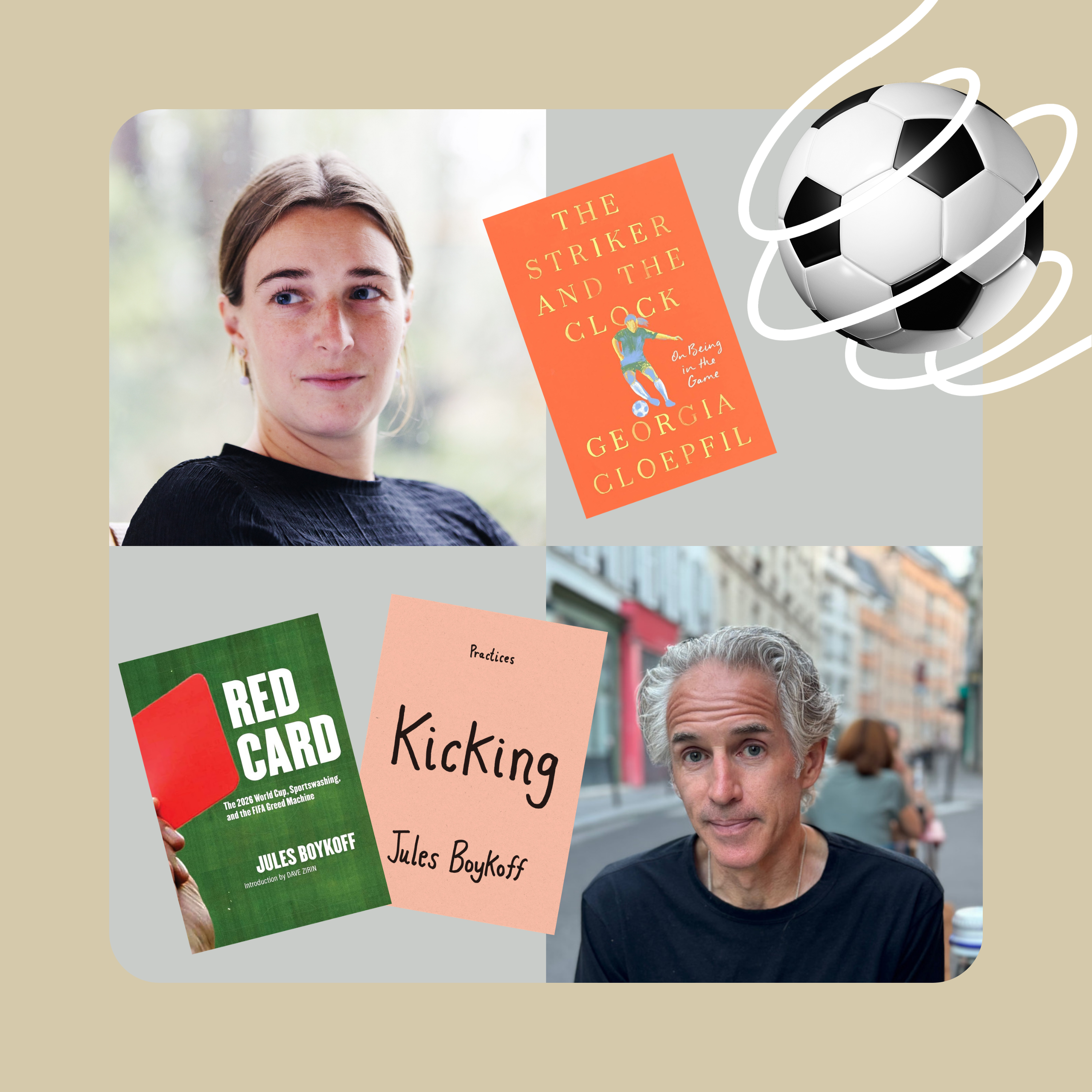
With the 2026 Men's World Cup right around the corner, we're thinking about soccer and sports: What does it feel like to play? And what does it take to play at a high level? We're thinking about not only the playing of sports, but also the business and the politics of sports, and about how sports—played, watched, and worked at—affect our bodies, our attention, and our communities. We talk first with Georgia Cloepfil, author of The Striker and the Clock, on being in the game, and then with Jules Boykoff, author of Kicking and Red Card: The 2026 World Cup, Sportswashing, and the FIFA Greed Machine. Both Georgia and Jules have played at a professional level, and both speak and write thoughtfully and beautifully about the game and what it might mean in and for our lives.
Show Notes
About Our Guests
Georgia Cloepfil is a writer and former professional soccer player from Oregon. Her work has appeared in The Yale Review, The New York Times Magazine, n+1, and elsewhere. She holds an MFA from the University of Idaho and is currently the Phillip Renshaw Visiting Author in Residence at Linfield University.
Jules Boykoff is the author of two books on the politics of soccer—Red Card: The 2026 World Cup, Sportswashing, and the FIFA Greed Machine and his memoir Kicking. He has written six books on the Olympics and two on the suppression of political dissent, and co-authored with Kaia Sand Landscapes of Dissent: Guerrilla Poetry & Public Space (Palm Press, 2008). He is also a poet. He currently teaches political science at Pacific University in Oregon.
Futher Detours
Other Oregonians who have written seriously about soccer include Andrew Guest, author of Soccer in Mind: A Thinking Fan’s Guide to the Global Game, and George Dohrmann, author of Switching Fields: Inside the Fight to Remake Men's Soccer in the United States.
Want more sports memoirs? Check out Brian Doyle's Hoop, Lauren Fleshman's Good for a Girl, Antonio Russo's Don't Cry in America, and (very loosely), Lidia Yuknavitch's The Chronology of Water.
For more about soccer in the US, try the Vice Media series Soccer's American Dream.
More writing about sports, identity, community, and politics from Oregon Humanities:
- "From Teacups to Volleyball Courts: How Afghan refugees in Salem are building community in their new home" by Mohsin Jamal
- "Links to the Past: The Kinzua Hills Golf Club helps maintain human connections with Wheeler County’s vanished timber town" by Bennett Hall
- "Dropping In: Three female skateboarders on overcoming fear and stereotypes and loving the sport" by Amelia Bjesse-Puffin
- "Boxing Lessons" by David Axelrod
Transcript
Georgia Cloepfil: The job of the athlete is not to mythologize her own life. Instead, she confronts mortality directly, unavoidably. The job of the athlete is to navigate unrelenting decay.
Adam Davis: Hello and welcome to The Detour from Oregon Humanities. I'm Adam Davis. With the biggest international sporting event, the Men's World Cup, right around the corner, we're thinking about soccer and sports. What does it feel like to play? And what does it take to play at a high level? We're thinking about not only the playing of sports, but also the business and the politics of sports, and about how sports–played, watched, and worked at, affect our bodies, our attention, and our communities.
We talk first with Georgia Cloepfil, author of "The Striker and the Clock," on being in the game, and then with Jules Boykoff, author of "Kicking" and "Red Card: The 2026 World Cup, Sports Washing, and the FIFA Greed Machine." Both Georgia and Jules have deep roots in Oregon and deep experience with the game of soccer.
Both have played at a professional level, and both speak and write thoughtfully and beautifully about the game and what it might mean in and for our lives. Here's Georgia, who talked with us at Oregon Humanities' downtown Portland office in May 2026. Can you describe what it feels like to score a goal to people who don't play and, and maybe not even don't play, but aren't goal scorers?
Georgia Cloepfil: I mean, it's just such a pure adrenaline rush. I do try and write about this in the book. The impossibility of writing about it is what fascinated me. I quote Wayne Rooney. He described it as being underwater and then coming up for air, and I love that image because it's this, like, totally muted moment, and then you move through a threshold, and there's people, and there's noise and everything like that.
But it's so hard to recall the actual moment. And you see so much video of yourself. It's like, you know how your memories get shaped by photographs, your memories of goals really get shaped by watching them play back, which is really strange. But the moment after, you know, you can remember, and that's just, like, a very pure euphoria unfound in other places for me.
Adam Davis: I'm thinking about the verb play. Like, what does it mean to play?
Georgia Cloepfil: I mean, I think it's really part of the question of what happens when you play professionally, you know, when your play becomes your work. I think joy is a really big part of that. Soccer was so joyful for me almost always. Didn't have a ton of injuries growing up, in college, like, just scored a ton of goals, loved my friends, loved my team.
Like, it was very simple. I mean, I can say that now. I'm sure I felt differently in the moment, but I was fortunate to just feel pretty much continuous joy coming to me from the sport, and that's the reason I wanted to keep playing. This is still really fun, and I felt that way through the very end, even though things got much more complicated and difficult.
But you definitely encounter people who are not having that experience, even though their whole lives revolve around soccer, you know, and that's how people end up in all sorts of jobs. So yeah, it's a very alive question for me, the relationship between play and work when it comes to especially professional sports.
Adam Davis: You played on a number of different teams in a number of different countries. Was there an atmosphere of joy, not just for you, but the teams you played on? Did it feel like a joyful space?
Georgia Cloepfil: Mm. It really depended where I went, and actually, you know, I was playing, like, on semi-professional teams and then more professional teams, and then I had a teammate playing in Korea.
That was my third year, and so I pursued getting an agent to get me the job in Korea because it was, like, a full-time gig, and I wanted to go all in while I was still playing and see how that was and be on a team of people who could all be in instead of working part-time and doing things like that. And that choice exposed me to a really different environment, and I think in general, culturally, the working environment in Korea is very different than elsewhere, and the attitude toward jobs.
I mean, it's such an American perspective to think your job should bring you joy or meaning. It's such a privileged perspective, and I think, you know, definitely my teammates definitely not all of them had, like, a love for the game, especially the ones that hardly played. But it's a pretty sustainable wage there, so it's just, like, the practical decision for a lot of them to keep playing while they can.
Adam Davis: How much do you think about the business of soccer?
Georgia Cloepfil: I try not to. With women's soccer, it's really cool because it's so new, right? There's so many new investments. I feel like every week this year there was, like, a new record-breaking transfer fee, you know, which is awesome, even though those fees are still so small, crazy, crazy small, smaller than they should be.
So in terms of, like, its inequity, I think about it quite a lot, but otherwise I, yeah, try not to.
Adam Davis: And are you, are you done playing?
Georgia Cloepfil: I got back to playing. I was living in a small town. I was actually coaching in college and then, you know, playing a little bit of really, really average pickup that was pretty hard to participate in.
But then here I did find some leagues that have people my age playing who played really competitively and are still really into it, and it was really fun. It took me some time, but it was really fun to get back in it. And I'm super pregnant, but I plan my comeback for the fall, so yeah.
Adam Davis: Well, you mentioned that you're pregnant.
Does it matter to you, do you know yet, does it matter to you if your kids play soccer?
Georgia Cloepfil: No. I mean, I would love that obviously. I'd prefer to be outside watching a soccer game than, you know, in an arena or doing anything else. But no, I've thought about that a lot. I, it really matters to me. I think that my children have some sort of, like, communal experience of creating and working together on something, so that could be any sort of team sport or it could be theater.
Those experiences I think are so important, learning to be a teammate, learning to keep going when things are really hard. Those sort of lessons I feel like are really valuable. So you can get that all over. I'd rather watch soccer, but...
Adam Davis: When you were playing, did you feel soccer forming your character?
Georgia Cloepfil: I think yes, but again, like, I had, like, an extremely privileged journey, you know?
So, like, what I'm talking about, overcoming obstacles and yeah, like, I made the B team one year when I was in, like, the seventh grade. I was super sad. I kept trying and I made the A team. Like, small moments like that that anyone has, and small injuries, you know. And obviously being overseas was like, not everyone has that experience who's playing, like, a youth team sport that comes with all sorts of really intense alienating struggles that definitely shaped who I am.
But I think a lot about my relationship to writing and publishing and soccer, and I think, you know, I don't know if I would be as driven or committed or have the belief in myself or to keep going with rejection and you know, the lonely days at the desk and all of that if I hadn't had the experience I had with soccer.
But again, I didn't really get, like, beaten down by it, and I know people that do, and I know that they carry resentment for their engagement with the sport forever. So I've seen that too. Yeah.
Adam Davis: Specifically, before you mentioned the sort of social or the team stuff, and then writing, that seems so solitary.
Do you still feel like there's transferable stuff?
Georgia Cloepfil: Yeah. Like, I write about the sort of alienation of soccer. As, you know, I think there's so many great books about tennis and boxing and swimming and sports where people are alone. It's so much easier to isolate the psyche. But I think there is a lot of alienation in playing.
You sort of feel and live alone with your successes and your struggles. Like, you're the only one going home to, like, relive the missed goal, you know? And yeah, or, like, a, a goalkeeper I can imagine has this the most- Yeah ... on the field, but everyone makes mistakes, and we can say it's, like, a whole team thing, but really it is in the end one person's mistake or success that has a huge impact.
So I think a lot of that experience and so much of my professional experience was, like, me, for me, you know, trying to make it and trying to get on a better team and maybe, yeah, maybe I'm talking about a bit of a more selfish experience and less about collaboration, more about, like, individual perseverance.
Adam Davis: In The Striker and the Clock, you, in vivid ways, talk about injuries- ... and also just the trials that your body goes through. Can you describe to people who don't play, like, do you feel like people can understand what it was like to play soccer professionally on your body? I mean, what's that feel like?
Georgia Cloepfil: I mean, I think the thing that most people probably don't understand is that, like, watching a professional game, like, almost no one out there feels 100%. There's so much that you have to push through if you're going to play at all. It's a lesson we try and teach young people, knowing where to, like, take care of their body and rest and say no, sub themselves out, and I would say those rules get a little bit disregarded on the professional level if the stakes get high enough.
You know, we're in a playoff game, like, you're gonna just go out there and try, and I think I made so many of those decisions in the moment to just do whatever it took to keep playing, even though my future was not at all held by soccer financially or otherwise. I think it's hard to understand when you watch someone decide to neglect their body, you know, play with, like, a minor concussion, get mysterious injections in Korea and go back on the field.
You know, get steroid injections in your knees to just keep playing through. Whatever it is, I can look back with full understanding on the person that made the decisions to just ignore and keep playing at the risk of things becoming worse or really hard in old age or pregnancy, as they are, and I try to give that person a lot of respect, even if I wouldn't make the same decision today.
Adam Davis: Today you wouldn't make that decision, but when you look back on your 19 or-
Georgia Cloepfil: Yeah ...
Adam Davis: 24-year-old self-would you have made the same decision?
Georgia Cloepfil: I would, yeah.
Adam Davis: Can you say more about why? What were you deciding for?
Georgia Cloepfil: I mean, I think to play at that level and to keep going, you have to sort of like, I'm speaking a little bit metaphorically, be willing to, like, die on the field.
It's like a level of insanity coming from, like, love that I think Is just part of continuing. You know, I actually just wrote about Lindsey Vonn's decision to ski down the hill with her torn ACL and, you know, which ended in this horrible injury, and I was talking to friends, you know, "Can't we encourage people to listen to their body?” And this is not the greatest example, you know? And I'm like, they all sound so reasonable and right, but I just, I don't think they are. You know, I think at that level, like, I fully, fully understand her decision, and I think she would live happily with that decision again. I think she said that. That's sort of like, you know, really dangerous to say that mentality is required to be at an elite level, but it's just, it's different.
You know, I compared her to, like, a self-flagellating saint in that essay, and I think it's different for a layperson who's, like, going to church versus a saint who's given up their whole life. We make different decisions, and one of them isn't better than another, but one of them might get you closer to God. I'm not religious, but I think it's an effective analogy.
Adam Davis: What's the god you're getting closer to when you make that decision, when you're playing sports?
Georgia Cloepfil: Yeah. I think just one of, like, transcendence, of, like, using the body to transcend language, reality, the moment you're in. And I feel like if you sense that, if you've even got a taste of that experience, which I think I did even though I did not play at, like, the highest, highest level, then you give up a lot to keep feeling that way, keep experiencing it.
And there's only so many bodies on this planet that get lucky enough to stay healthy enough to be skilled enough at their craft, at their sport to get to experience that.
Adam Davis: That feeling of transcendence–how much of that feeling of transcendence do you think is related to the level and the relative level at which you're performing?
Like, can a 12-year-old who's okay at soccer experience that feeling of transcendence in some way that's close to what a 25-year-old professional playing at a high level experiences?
Georgia Cloepfil: Yeah. I mean, I'm playing at D3 soccer, scoring on a golden goal overtime winner. Like, that was one of those moments, and that's absolutely not at the highest level of soccer and the highest stage by any means.
So I think it's sort of like, yeah, it's about how your body is working with your mind, and you could probably access that on a lot of levels. But the level of sacrifice that you'd be willing to make in order to get there, I think changes a little bit with the scale. Like, is there a scale of transcendence?
I don't know.
Adam Davis: Yeah. I, I actually think you are arguing for a scale of transcendence. That's... And at first when you were talking about–you
Georgia Cloepfil: transcended a little bit. I did a lot.
Adam Davis: Yeah. But also- I don't know ... put more in.
Georgia Cloepfil: Yeah. Yeah.
Adam Davis: Like, risked your life for years. And that should churn out something more- on the other end. It also makes me wonder about soccer as a thing that people participate in, and soccer as a thing that people watch.
And how much did you feel your experience of playing, how much was that changed by the presence or absence of spectators?
Georgia Cloepfil: I mean, I would say very little because there were not very many spectators at any of my games at any level.
I think I loved being watched by my parents, my partner, people I loved that mattered to me. But I don't think... Yeah, I don't think you really even regard the surroundings that much. You probably would if you walk into, like, Wembley with 70,000 people, like, that's very cool. But I don't know about in the moment if it really matters.
Adam Davis: What did you love about having people who you love watch you play soccer?
Georgia Cloepfil: I mean, probably something just about, like, achievement and being witnessed and feeling that, you know, success and validation. It's like my relationship to soccer was from youth through the end very much tied to that feeling, I think, of people being proud of me and celebrating me, and I, yeah, I don't think that changed, so I think that's part of the reason.
Adam Davis: I mean, it's a rare thing to be able to do stuff in the world that other people delight in. What it's making me think about is back to our early touching on play, that, like, that there's something about the idea of play as an activity- ... that seems to be entirely good in itself.
That within the terms of the game, you lose yourself, and you don't think about any external goods. Did soccer continue to have that as you got more serious and it became more... Did it always retain some of that?
Georgia Cloepfil: I think there were moments when it didn't... Yeah, this like sort of external validation, having to score, having to prove yourself, very, very much not related to the purity of playing.
I think I was, like, always able to just sort of tell myself I was doing this for fun, like, one more year, you know? I was obviously very ambitious and trying to play at the highest level, but I specifically remember in the end, I was playing in Seattle, trying to get a contract there, driving down to Tacoma every day for practice, and my breaking down in sobs.
And I was like, "Wow, I just really love practice, and I love getting the opportunity to play with the best players in the world." And that moment for me was so different because practice is not visible, and I was, like, truly, deeply enjoying that experience so much. But that felt like a real shift, and I think that's when I sort of felt like maybe the end was near.
But I think just recognizing the joy in that, that I was able to enjoy it even though it was totally separate from any sort of real achievement recognizable by the world.
Adam Davis: You talked about sensing the end of your professional career coming. How, how did it arrive, and how did that feel?
Georgia Cloepfil: Yeah. So unceremoniously.
I think, like, a lot of what I... why I wanted to write about it was because I was seeking, like, I was anticipating the end from the very beginning playing. When is this gonna be my last time, season, team, contract, game? And, like, when do I hit my limit in terms of, like, how high I can go, in, like, which league, which team?
Like, when do I give up? All these questions were very present. I'm, like, lucky it wasn't a devastating injury. That is one end. But I was pretty young when I stopped playing. Now I think back, I felt old all the time. Mm. You know, 27 or 28. I had applied to an MFA program and gotten in, and that also felt like a pretty rare opportunity, like, a fully funded three years to write, and that was what I wanted to do next.
And so I kind of forced my hand. There, I was with the Reign all summer, training. And I remember telling the coach at the end of the summer, I was like, "I'm going to grad school next week." And he was like, "What?" So I sort of just ghosted away in that regard, and some of it is just, like, the sustainability of living out of a suitcase, of leaving my partner and life and job with, like, two days notice, and, you know, really scraping by to think, like, what am I getting back, and am I still getting better?
You know, these questions that I think just started to tip the scale toward time to move on.
Adam Davis: Were you still getting better when you decided to move on?
Georgia Cloepfil: Oh, yeah. I think I'm better now than I was then, even.
Adam Davis: Well, first of all, I love to hear that. And it's also interesting to think about leaving something while you're getting better.
Georgia Cloepfil: Yeah. Yeah, I mean, I think that was my only choice really, because if I had been on the decline, you know, then I really wouldn't have been getting the opportunities that I was getting. But yeah, I don't know. It takes so much luck. Also getting chances in soccer is a lot like writing. You have to keep doing it, you have to be good at it, but you have to get really lucky.
Your timing has to be perfect, and when I knew, like, an athletic career is something that's gonna end no matter what, right? Even if I kept playing till 35, like, it was not going to sustain me for the rest of my life. I would have to stop. So I think I was also always preparing for that second life and a little anxious about what that life looked like when I had committed so much to this first life.
I think of it as sort of two different lives, so...
Adam Davis: It was interesting 'cause we've been talking about soccer, but in some way we've also been talking about time.
And the book-
Georgia Cloepfil: Yeah ...
Adam Davis: even in the title, has time, and I want to ask you to read this one short paragraph.
Georgia Cloepfil: Sure. "But a belief in immortality is only available to the spectator. Halls of fame and records and medals and posters are most meaningful to fans. The job of the athlete is not to mythologize her own life. Instead, she confronts mortality directly, unavoidably. The job of the athlete is to navigate unrelenting decay." Tough. Not the cheerful book that I could have written.
Adam Davis: But you're laughing a little.
Georgia Cloepfil: Yeah.
Adam Davis: Like, how's it feel coming back into confrontation with those words?
Georgia Cloepfil: I don't know. It's a little bit sad, I guess. But that is how it feels. Like, again, what I said, when the ending confronts you sort of right at the beginning, that this will be over. And I think I just watched so many people struggle to, to shift gears that really on- I wonder if it was a method of, like, self-protection to not care only about soccer.
I do think it was some of who I was. I was never only about sports. I was always about two things. But I also think some of that was a little bit of self-protection because I knew this one thing would leave me in terms of, like, a total pursuit. I mean, I remember writing in the third grade that I wanted to be a writer and play soccer at the University of Portland, which there was no professional soccer, so that was the highest level I could think of.
And that sort of changed shape when I'm like, "What does writing look like as a career?" It's very complicated now. But yeah, words, books, art, thinking about the questions of life through books, that was always definitely the other thing.
Adam Davis: And are there things you most miss now about the professional soccer world?
Georgia Cloepfil: Yeah. I really think I miss, like, the sensory experience of it. I really miss, like, the smells and the rituals, like the locker room and the cleats and the feeling of those things and the mud and the sweat smell and the rain smell and, like, grass and everything about it that is of the senses. This place where I'm playing now in Portland smells so strongly of, like, rubber turf balls when you walk in, and I'm so comforted by that.
I just don't encounter, like, that world of smells which gives you just access to your memory in a different way. So I miss all that. Yeah.
Adam Davis: If someone were to, like, push you to let a question come to your head about your relationship to soccer, what would that question be?
Georgia Cloepfil: I mean, I think it's sort of unique that I keep playing.
I know people that have a really hard time playing not at the highest level after they've played at the highest level, and I haven't really found that struggle to be true for me. I don't know what that is. If it was like that shift at the end of my career that just made me really enjoy it. I think I really, really value also, we haven't talked so much about the, like, absence of language and those moments of euphoria and playing and having your body work well in the ways that you want it to and the way things disappear.
Like, I really value that. And as an adult especially, it's very unique to have that space. As a kid, I think you can find it more easily 'cause you have fewer things on your plate and mind. But I think those things sort of outweigh the desire to, like, be the best. I don't have that desire. It's funny, I watch people I love at this age, my partner being one of them, trying-- is, like, so good at cycling and, like, really into cycling, and I just like-- I'm like, "I'm really mediocre at swimming."
And, you know, run my little five miles. I just don't have the drive in me to, like, go do an ultramarathon or do the next, find the next sort of, like, thing. I guess it's 'cause I... Yeah.
Adam Davis: Well, you just gestured towards the book. Yeah. But that's what I was wondering. Like, are you after excellence in writing?
Georgia Cloepfil: Yeah, you are. Yeah, I think that's it.
Adam Davis: Okay.
Georgia Cloepfil: It's staring right at me.
Adam Davis: And I asked you before what play is, but can I ask you maybe as a way of closing, like, what's excellence?
Georgia Cloepfil: Hmm. I don't think it's anything you can ever achieve, which is, like-
Adam Davis: Mm ...
Georgia Cloepfil: part of its important part of its nature. I think the striving part is, like, what is really, really present in my life and personality.
But I think you can also feel when you've had a moment of excellence. It's similar in writing, like something goes well, or like one beautiful sentence. I think you're also... Like, when you're open to feedback and getting better, like, that's a big part of it, too. Like, people will push you to sort of be better, and being open and having the opportunity to get feedback and to be pushed by people who know what they're doing is a really important part of that, too, which is why I appreciate, like, the publishing journey versus the actual act of writing.
Adam Davis: Cool. Well, Georgia, I wanna say a huge thanks for the conversation, also for the book, which is a really beautiful book about a beautiful game, but it's a beautiful book.
Georgia Cloepfil: Thank you.
Adam Davis: And so thanks for committing to both.
Georgia Cloepfil: Thank you so much.
Adam Davis: You're listening to "The Detour." You just heard from author Georgia Cloepfil.
Let's turn now to my conversation with writer Jules Boykoff, who spoke with me remotely from Helsinki in April 2026.
Jules, I'm just gonna ask right here at the start when did you realize you cared about soccer, and how did you realize that?
Jules Boykoff: Wow. Well, it happened really young. Honestly, I think I realized it when I was four years old, and my mom dropped me off as a four-year-old at soccer practice, and it was an under 18, so I actually wasn't eligible.
And she kinda just kept forcing her way until finally they relented and let me on the team even though I was very small and very four years old. And then once I got out there, I absolutely loved it, even though I was getting mauled, drubbed, and otherwise beaten down by these big kids. So yeah, I actually realized it pretty early on that soccer was important to me.
Adam Davis: What did you love about it when you were getting drubbed and beaten up by... Like, what, what was it you loved?
Jules Boykoff: Well, you know, I just loved the physical action, honestly. I was a kid with a lot of energy, and when I look back on it, I almost feel bad for my mom trying to corral me. So it was a great escape hatch for her for a little while while I was running around out there.
I just like the physicality. I like being around other people as well. I like the social side of it, I guess. Two elements that really sustained throughout my time playing soccer. I was part of maybe the last generation of people who didn't really play competitive soccer until under 14 level. I mean, that's unheard of today.
You get stuffed in a competitive league once you show a little bit of skill and drive. That wasn't the case when I was growing up, and so for a long time, I just got to enjoy the game. And at a certain point, I realized I was, I was okay at the sport, and I guess some other people did too, and they took me on one of these more select teams, and that's when it kinda kicked up for me at the under 14 level.
And I guess I never really looked back after that. It was kind of a quick, quick change toward taking soccer really seriously. And yeah, it became a huge part of my life from there.
Adam Davis: It's interesting, that phrase you just used, "taking soccer really seriously." It seems like you're someone who has taken it seriously both as an activity and as a force for good and bad in the world.
Jules Boykoff: No doubt about that. I mean, part of it was, Adam, that I wasn't fast, I wasn't tall. I was, I guess, okay skill-wise, but I sort of needed to become a student of the game and take it seriously in that way if I wanted to advance in any kind of way. And certainly more in recent years, once the scales kind of fell from my eyes and I realized that soccer was such a big business and that I was actually contributing to it in particular ways by the way I was going about my soccer life, like the teams I was playing on, you know, the shoe contracts that I agreed to and so on, then yeah, it took me a little while to get there, but once the scales fell from the eyes, it's been a stance I've taken since then that I wanna engage with the world and hopefully, you know, try to change some of these systems that, you know, quite frankly I don't think are all that great for soccer players or for the world more generally.
Adam Davis: In your recent book, and there are two recent books, but in the recent book, Kicking, one of the epigraphs is, "Let's tear up obligation in the way we pay attention." Sounds to me like when you said the scales fell from your eyes– that that was a version of, like, attention shifting around the sport.
Jules Boykoff: Yeah, I mean, that's incredibly perceptive of you to notice that, and that was exactly my intention. I also just feel like obligation is an interesting thing to think about a little bit because it can have positive and negative connotations. Sometimes you feel obliged to do something that you really don't wanna do, and it might not have positive outcomes for society, but sometimes you have to do things that you don't wanna do, like listen to someone who you vehemently disagree with, but it actually could have bigger picture positives for society, you know?
The democratic process, and I think right now with the rising tide of authoritarianism around the globe and certainly in the United States, I think about those things quite a lot, about obligation, but also about responsibility.
Adam Davis: I'm thinking about your description just a minute ago of moving from, like, loving the game, even loving getting kicked around as a smallish person on the field, and then as you became recognized for being better at the game and playing it at higher levels, you also started to see not just the game you were playing, but the whole larger fabric that it existed in differently.
Just thinking about where you focused a lot of your writing over the past many years, are you trying to help other people who play soccer, think about soccer, watch soccer? Are you trying to help the scales fall from their eyes?
Jules Boykoff: Well, you know, just as background, I do a lot of critical writing about the politics of soccer and the politics of the Olympic Games, which of course includes soccer as one of its sports, and I do my research and writing really from the ground up, so thinking about athletes, thinking about communities that are affected by these big sports mega events and try to bring their voices into the conversation.
They're often left out. They don't get the microphone put in front of their face. I don't know. I think a lot of athletes these days, especially professional athletes, athletes who are representing the United States in international competition, they have a pretty good sense of what's going on around them.
It's just that they don't often have agency in that situation. You know, I think of an example of Timothy Weah and Weston McKennie, two of the best players in the United States, both play for the United States men's national soccer team right now, and they also play for Juventus FC in the Italian Serie A.
And they were in town in 2025 for a tournament, and Donald Trump brought a bunch of players, including those two, into his office and did a press conference. They basically became the political wallpaper for Donald Trump, and afterwards, Timothy Weah got asked, like, "What was that like?" And he's like, "I didn't even really have a chance to say no to that."
So my point in that story is just that I think a lot of athletes don't have the agency that we might think they do when they achieve fame and glory inside of the sport of soccer.
Adam Davis: The highest level of competition for you, you were playing on the national team and professional soccer?
Jules Boykoff: Yeah, I mean, those were the two highest levels I ever achieved.
So I played for the under twenty-three men's national soccer team and got to play in international matches. I played against Brazil. I went to head-to-head with Cafu, for those that are soccer heads, you know, the great Brazilian player playing opposite me. This marks me as old. I'm fifty-five years old.
We played against the Soviet Union, Adam. We did. We also played against Yugoslavia 'cause that existed then and so did Czechoslovakia. But, you know, since you're mentioning scales falling from eyes, I mean, actually, that really opened my eyes because I was just nineteen years old, and I had been weaned on a pretty steady diet of pro-USA propaganda, and I honestly kind of expected that everywhere we went, we would get cheered for, and that just definitely wasn't the case, you know?
And I was like, "Wow, okay. There's a lot more going on here." And I think it was seriously inflected by kind of the moment geopolitically. And so I actually went back. At that time, I was a student when I was playing for that team, under twenty-threes, and started studying political science more intensely.
That was one of my drivers for that.
Adam Davis: Did you feel then while you were playing at those levels, the lack of agency that you attributed to Weah and McKennie?
Jules Boykoff: Oh, yeah. I mean, I certainly did. I mean, look, you were obligated, if you will, to go to team appearances. Some of them were fun. I went up in a hot air balloon.
That was awesome. Sometimes though, you know, you had to show up to these, like, corporate things that I really had no interest in and didn't really chime with my values, but I was assigned to that appearance, and I had to do it. If you wanted to have good shoes to play in, you had to figure out who you were gonna sign a shoe contract with.
I signed with Nike, and that meant all the shoes that I could possibly want. You know, if I-- my shoes burnt out, I got another pair. But, you know, when I signed, I started to figure out pretty quickly that there was a real underbelly to Nike's manufacturing practices. But I didn't have a ton of agency. I guess I could have, like, tried to find some local guy to, like, make one pair of shoes at a time, but I was burning through, like, a pair of shoes every two weeks.
But yeah, no, I definitely can understand how players don't necessarily feel like they have agency today, and they're probably making a lot more money than I do, but sometimes that can be sort of golden handcuffs at the same time. I might have had a little bit more agency than they have even today, I sometimes think.
Adam Davis: You just used the phrase "chime with your values" a little bit ago, and it's interesting to think about the relationship between sports and values, sports and political commitments, and I think, you know, that when you talked earlier about the scales falling from your eyes, it feels to me like largely that's what you're talking about, is that the particular field you might be on, the particular game you're playing, that exists within a larger ecosystem, which is much more than a game and which may be much less clean than we at least take some of the games we play in to be.
I'm thinking about how soccer, like for you, clearly, even in this conversation but also in the books and in conversations we've had over the years, soccer is fundamentally political the way you see it. And there's a sentence in the book where you say maybe sport, and there you're talking not, not just soccer, might be more politically effective by being less explicitly political.
Jules Boykoff: Well, first, I mean, I just think soccer is politics by other means, whether we want to acknowledge it or not. And
Adam Davis: You just substituted ‘soccer’ for ‘war’ in the usual-
Jules Boykoff: I know, I know. Okay. A little detour, if you will. Yeah. I mean, so soccer, for starters, you know, soccer is politics by other means.
I'm a political scientist, so I see politics thrumming through everything. You know, there was a political scientist way back when, a guy called Harold Lasswell, who wrote, like in the 1940s or something, a little shorthand idea that, you know, politics is about who gets what, where, and when. And if you just think about that, anything that fits in that little mold is political.
So, so much of our lives is political, and I don't think it's something you need to shy away from. Again, I'm flashing my political scientist card here, but I think it can give you sort of a handle for understanding, you know, getting your hands around the way things work in society, is by sometimes they are explicitly political, but sometimes they're not explicitly political, and yet there's that kinda current of politics zinging through them.
Adam Davis: So I'm thinking back to where we started, this question of attention tearing up the obligation in the way we pay attention. I'm thinking about young people playing soccer or casual fans coming to the World Cup this summer soon and thinking how to move people towards noticing more about the political elements that are there both behind soccer and running through it.
Like, what's, what's the best way to do that if it's good to do?
Jules Boykoff: Well, I think there are many ways to answer that question. I mean, first, I would just say that a lot of people are already using soccer to engage in political talk. I mean, in the book, Kicking, that you mentioned before, I lay out how numerous activists in Portland, who are huge fans of the Portland Thorns and the Portland Timbers, bound together to fight against some of the injustices that they were seeing coming from the ownership in Portland, and they used soccer to their political advantage to make some real changes around Portland, changes for the better.
This summer's World Cup is a political thicket, and I honestly, I hate to say it, Adam, but I'm very concerned for what could possibly happen because we're living in a moment where basically xenophobia and racism is being condoned from the top. And I watched a video online the other day that kind of blew my mind and actually scared me, too, and it was of Iraqi soccer fans who were at Dallas Fort Worth Airport en route to Mexico to cheer on Iraq.
They were in a qualifying match, which they won, so they'll be at the World Cup now. And they were waving their flags, and they were singing their song, these Iraqi fans were, and they had this big banner there, and just having fun like soccer fans know how to do. And partway through their cheering, all of a sudden, this white guy from the United States just, like, bursts through their sign and starts yelling at them, yelling invectives at them, screaming at them, and saying basically to them, I'm paraphrasing, but, "You can't do that kind of thing here in the United States."
And it really shook me, Adam, because I thought, oh my gosh, you know, what's gonna happen when you have all these celebrating people, Black and brown people even, all around the United States in these various communities? I'm, I'm sort of... I'm a little fearful for what could happen. And it makes me sad because, you know, as much as FIFA's slogan is total tripe, ‘Football Unites the World,’ there's actually truth to it as well.
And so I was kind of hoping that maybe the World Cup could be something that could bring people together. I know it might sound a little hokey, but I had my high hopes. But right now, with Immigration and Customs Enforcement running rampant through different cities and neighborhoods, looking like they just arrived from robbing a liquor store to show up for work, wearing masks is what I'm saying, this is a scary moment for people who are both visiting from out of the country, but also just people who, residents who already live here and want to cheer on their team, maybe from their home country or from their ancestry.
Adam Davis: Yeah.
I'm thinking about whether sports... Like, should we expect that world to be better than the world we often find ourselves in? It starts as a game. There's something about it where we think, "Ah, there's something pure about a game." And then that may be part of what makes it feel so disappointing when it's infused with some of the components that you've already begun to talk about and more.
Should we hope that soccer is, in some sense, the world of soccer better or freer from the kinds of political pressures you just pointed to?
Jules Boykoff: Well, my view on soccer is that it reflects the realities around us. It reflects the political economics of our world. It reflects the cultural machinations of our world.
So it might be asking a little bit much of the sport to sort of transcend those sort of structural realities that are all around us. But on the other hand, soccer is special. Sports are special. There's something magnetic about them. There's something that brings people together. There's something that just loosens the space.
If you're watching a men's professional soccer match, there will be times in the game where a player falls down and his teammate picks him up and, like, gives him a kiss on the cheek or something like that. I always love those moments. But, like, if you did that in other workplaces, that would be kinda zany and maybe even illegal
But there, it actually is sort of a form of camaraderie. So it shows that sports space, soccer space in that case, can kinda stretch the boundaries of the possible, can kinda get us to see things from a different angle. So I wanna answer that both ways. You know, like, one, it's a lot to ask, but in another way, it kind of already is happening if you open your eyes in, in particular ways.
The boundaries of ‘acceptable’ action and discourse, and I put acceptable in quotation marks there, is stretched by sports, and I think that that's generally a good thing.
Adam Davis: This is gonna feel like it's a departure of a question, but I don't think it is. Who are one or two of your favorite soccer players, and why?
Jules Boykoff: Okay, let's get down to business.
Adam Davis: Let's get down to it.
Jules Boykoff: Yes. Well, I would start with the great French six, which is to say sort of like a defensive line midfielder, Marcel Desailly. He had a tremendous work rate. He also had style and panache off the field.
Kinda one of those unsung heroes that you really need to do the dirty work on your team. I think of, like, the analog with the Portland Timbers, it's like Diego Chara kind of position, for those that follow the Timbers. Does a lot of the hard work, but doesn't always get the glory. I just like the way that he moved around the field.
I also have long been a big fan of Megan Rapinoe, both on the field and off, but I was watching Megan Rapinoe when she was playing at University of Portland and enjoying that moment, and then of course to see her get on the very biggest stages of the sport and excel. I mean, I'm thinking particularly of the 2019 World Cup, where she won the Golden Boot, won the player of the tournament, and was getting flak from President Trump at the same time and figuring out creative ways of responding.
So, I mean, those are two of my favorite players that were on the field. But you can already tell, like, some of it was 'cause it extended off the field, some of the things they did, and I think for me to kinda reach that higher echelon of the player that I really, really appreciate, they sorta have to have a little bit of both, that on-the-field magic, but also maybe that off-the-field courage as well.
Adam Davis: Yeah, that's part of why I ask, because I think there's ways of playing soccer or any sport that reflect, or at least we project onto them, a kind of set of moral commitments. I do remember growing up in Chicago watching Craig Hodges on the court and knowing what Hodges did in the rest of his life that changed how I thought about him on the court.
I guess I wonder how much of people's off-the-field life are you thinking about as you're watching these sports and, and figuring out who you most care about?
Jules Boykoff: I would say first and foremost, I just watch and just enjoy the match. I'm one of those people who really enjoys the little things. For me, that sort of muffled clapping that you can sometimes hear from fans while they're watching a match, when someone pings a 60-yard ball across the pitch and it lands right on the person's foot, or the goalkeeper, you know, throws the ball out perfectly to land right on his defender's left foot right where it should be. I can appreciate that all day long.
But when it's paired with somebody who shows courage off the field, yeah, I mean, that's definitely what's going to take it to the next level. And on the flip side of that, and not to be negative, but if somebody's an awful person off the field, it makes it much harder for me to root for them on the field.
You know, if they're a total money grabber who decides to upend their career and head to Saudi Arabia, I'm not ta- talking about anybody in particular, Cristiano Ronaldo, if you happen to be listening, but like, if you do that with your career instead of like trying to do something more productive and social with it, then yeah, I probably am gonna like you a little bit less and probably root for you a little bit less.
So yeah, those two things are massively intertwined in my mind. And I don't think I'm alone. I mean, it's been fascinating to me over the course of my life to see how sports media has changed so much. I mean, gone are the days where you just get the strictly sports analysis at all times. I mean, politics and the social elements and the cultural issues are constantly moving in on the actual sports and I like that personally.
I think that's just a more realistic look at the way the world actually is. But yes, I mean, you gotta be both a footballer who's fun to watch for me, and someone who's standing up for some sort of principle that I can appreciate in the public sphere.
Adam Davis: It does sound hopeful that the media coverage now includes more of people's commitments off the field than just actions on the field, though there is still, because sport is sport, our attention mostly goes to what's happening on the field or on the court, and not into the economics behind it or the politics behind it.
And, and so I feel like that, again, is something you've started to talk about a little bit, but I wonder if that's something that you wish all of us saw more clearly. Like, what, what would you like us to see more of when we watch a game than most of us generally see?
Jules Boykoff: Wow. Well, I'm not super prescriptive about the way I think other people should be.
But I guess if you do love a sport, I do think it sort of behooves you to figure out who is making money from that sport in real money. I'm not just talking about the salaries from the players, but thinking about the owners. And if you really love a community, you should figure out, is the money staying in the community from the ownership?
Is it moving elsewhere? You know, like just to take one random example, Adam, from the Chicago area, the Chicago Bulls, Jerry Reinsdorf, the owner. You know, you could think, where does he donate his money? And you might notice that he has been donating money to Republicans almost exclusively to Senator Tim Scott and many others that are Republicans.
Like, what does that mean to you as a fan, that your owner is taking your money and basically laundering it through the Chicago Bulls and giving it to right-wing politicians? I hope people start to open their eyes to that. The tools to figure that stuff out aren't always at our fingertips. But I have enormous belief that people are smart, and if you give people the tools and put them in front of them, they're willing to have difficult conversations like the ones really that we're having today, is just kind of scything the space out of this hyper-polarized moment that we're living to actually have those meaningful conversations in kinda low-stakes ways.
And for me, it's always-- sports has always been a great way to do it. You know, Adam, you know, before I started writing about sports, this is a long time ago now, but before I started writing about sports, I wrote about the suppression of political dissent in North America. You wanna talk about a conversation killer at dinner, you know, with the family, the uncles who don't wanna talk politics.
But, you know, when I start talking about the Green Bay Packers, which my uncles happen to support in Wisconsin, and then we start getting into, "Well, who does own the Green Bay Packers?" Actually, my uncle does. You know, he's got, like, scripts because he paid in, and it's, you know, a publicly owned team. We can actually jumpstart a pretty darn interesting conversation where we have a foundation of agreement upon which to talk about other issues, and what's happened to me so many times in life is that it starts with sports.
It might even start with just what did Diego Chara did on the pitch, and then it kinda moves out. He's from Colombia, and then it moves out from there, and it moves out from there. So, you know, for me, soccer and just sport more generally can be a wonderful trampoline for deeper discussions about important issues of our time.
Adam Davis: First of all, that's-- it's beautiful to think about the way sports can function as that opener and the shared concern, the thing we care about. It's also concerning how apt your example of Jerry Reinsdorf was. I don't know if you did that on purpose, but, like, I've lived in Portland for thirteen years, but I'm gonna die a Chicago Bulls fan whenever I die.
I know that, even though they're lousy and I don't have tremendous respect for many decisions that their management has made and all these things, and now even less. Thank you. What to do with that? What to do with the kind of pre-rational, abiding commitment that so many people have to teams?
And all the reasons to rethink our attachments. How, how do you hold those together?
Jules Boykoff: That's a really nice way of asking it, but let me just first say that was not random. That was for you, Adam Davis. Thanks. I know you're a Chicago Bulls fan. Trying to make it a little bit real for you. I know... I don't think there's any one easy answer to that, that excellent question there.
I think each person is going to approach it slightly differently, and that's why I sort of hesitate to be prescriptive because the Boykoff way, my way of doing something might be really grating for another person to do something. But what I've certainly found, if someone doesn't wanna approach it exactly like I do, like foregrounding politics, ‘okay, Mr. Political Science Guy,’ I have found that over time people will still engage in it, but you just have to figure out how to bring it into the conversation in ways that don't necessarily feel heavy-handed. And I think that takes back to the comment that you were making before. Sometimes you can be more politically effective by being less explicitly political, and this is kind of this idea that I've been grappling with and trying to bring into different situations, and I think that's something I'm gonna continue to try to do here, is to wrestle with that sort of conundrum as to how that actually plays out in specific situations.
Adam Davis: You were talking before about some of your fears about what could happen during the World Cup this summer. I guess I wanna ask you the flip side of that. What do you hope happens? What would be good if it happened during the World Cup this summer?
Jules Boykoff: Well, it would be really good if France won. No. I'm actually, and Bosnia got second. That'd be amazing. But more seriously, for me my expectations are kinda low right now, so I would be happy if Immigration and Customs Enforcement played zero role around stadiums, despite the promise of the ICE acting director that they would play a key role around the stadiums.
I would be happy if fans were able to travel to the United States safely, and to be celebrated once they got here for their difference, for cheering for whatever team they want to cheer for. I would be happy if Iran actually made the trip. There's some doubt as to whether Iran is going to be able to participate in this event and certainly President Trump hasn't helped when he posted on social media that he couldn't necessarily guarantee that they would be safe if they did come.
So I'm hoping that they do come and they try to do their very best. They've got a good team. And honestly, the sort of impish side of me, Adam, is wanting the United States to finish second in their group and Iran to finish second in their group, and for the two teams to play each other on the pitch in the knockout stages, which would happen if that scenario unfolded.
I think that that could be a really powerful moment for us to have deeper conversations as the United States and Israel continue to attack Iran. Hopefully, that will be stopped by the time the World Cup begins. But if not, wow, can you imagine the geopolitical tension and, and the possibilities for honest and serious discussion from fans around these stadiums if it were to play out in the way I've described?
So, those are some of the things that I'm hoping, but I also just want people to come to this country and have some fun. I want people who can't afford to have tickets still have avenues to be able to enjoy the matches, whether it's in public spaces around the cities that are hosting or local coffee shops and pubs and so on.
And I want people to just be able to enjoy coming together with their friends, and watching some of the greatest players in the world do their thing.
Adam Davis: That was a good off-the-cuff list of hopes. That was, that was pretty good. Are you gonna be back in North America for the World Cup? Are you still over in Europe?
Where will you be?
Jules Boykoff: I'll be honest, Adam, I decided a long time ago that I was not going to purchase any tickets to the World Cup because I did not want to support FIFA. For me, FIFA has become a greed machine, and it's really hurting the sport that I love so much. And so the longer answer is no, I will not be in the United States for the tournament but I will be in Canada in one of the host cities for part of it.
Adam Davis: You still kick a ball?
Jules Boykoff: I do not actually. Well, I shouldn't say that. I was here... I'm in Finland, like I keep talking about 'cause I love it here, and I-- there's a little soccer field down by where I'm living, and there's always just soccer balls sitting on the fields. No one even steals them. It's amazing.
And I just go out there sometimes. There's like five or ten balls just sitting on the field every time I go there, and I will knock it around by myself. But I don't play anymore. You know, honestly, most of the guys that I played with whether professionally or at other high levels, you know, they got a lot of serious injuries.
I got friends my age who got hip replacements, you know, knee replacements, and I feel kinda lucky that I got out of the game without huge, huge injuries. I mean, I've had some injuries, but I can still run, I can still ride my bike, I can still enjoy myself, and I kinda don't wanna sacrifice that on the altar of some sort of maybe potential ego quest.
And here's another thing that I will say that is kind of embarrassing, but I'm just gonna say it 'cause I trust you and I like you, is that sometimes I have a really hard time bottling up the competitive spirit when I get on the field, and it's kind of actually embarrassing that I cannot bottle it. Like, there's something visceral and deep inside of me, and there are some codes around the sport that I abide, such as if somebody cheap shots you, Adam, and you're on my team and I like you, I'm gonna make sure that they get theirs later.
And I have had a hard time erasing those from the hard drive of my mind. And so I like myself better, I think, when I'm not playing soccer, and I think it's probably best for the world if we keep it that way.
Adam Davis: That's... It's an interesting phrase, "I like myself better when I'm not playing soccer." What do you most miss about playing soccer?
Jules Boykoff: I think the only thing I really miss about it is just being with other people and doing things with your body that, you know, it kind of can even be sublime. In the book I write, in Kicking, I write about this moment when I would score a goal, which I will admit was a very rare occurrence, but when I would score a goal, my face would just sort of go to a blank slate of sort of, I guess, equanimity.
It was like flow, what some psychologists call flow, and it was just like everything was perfect. The world slowed down and my face just went blank and I could... Everything was slow motion and I would score a goal. Like, wow, that's an incredible feeling that I honestly have never felt in any other facet of my life, that idea of flow and the world slowing down.
And like, I guess I kind of miss things like that, but, you know, there's other ways of getting excitement in life. The excitement that I got out of the sport of soccer and the drive and dedication it takes to become decent at the sport, I think I've tried to channel that into this new life that I have, which is basically trying to seek out justice through sport and to call out the people that are ruining sport, quite frankly, with their greed and with their questionable ethics.
And so I like to think sometimes I bring the vim and, and toughness and drive and not-gonna-quit-ness to this new endeavor that I brought quite maniacally to the other one.
Adam Davis: Seeking justice through sport is a really pithy way to say a lot.
Jules Boykoff: Well, I've seen it happen with my own two eyes in successful ways and not successful ways in many parts of the world.
And so I, I believe in-- I believe it's possible to pursue justice through sport, and it's a great way to become comrades with people who are like-minded and to fight in the same direction at an incredibly important juncture of world history.
Adam Davis: Jules, can I say a huge thanks for your arc the way you're kicking at things in the world.
Just really deeply appreciative, and thank you for making time today, too, from far away to talk.
Jules Boykoff: Well, thank you so much, Adam, for the invitation. I'm a big fan of your work and the work of Oregon Humanities, so this is a tremendous honor for me. Thank you.
Adam Davis: Jules Boykoff is an author and academic whose most recent books include Kicking and Red Card: The 2026 World Cup, Sportswashing, and the FIFA Greed Machine. Georgia Cloepfil is the author of The Striker and the Clock: On Being in the Game. You can learn more about Georgia and Jules in our show notes at oregonhumanities.org.
Thanks for listening to The Detour from Oregon Humanities. Anna McClain is our producer. Allie Silvester, Karina Briski, and Ben Waterhouse are our assistant producers. This is Adam Davis. See you next time