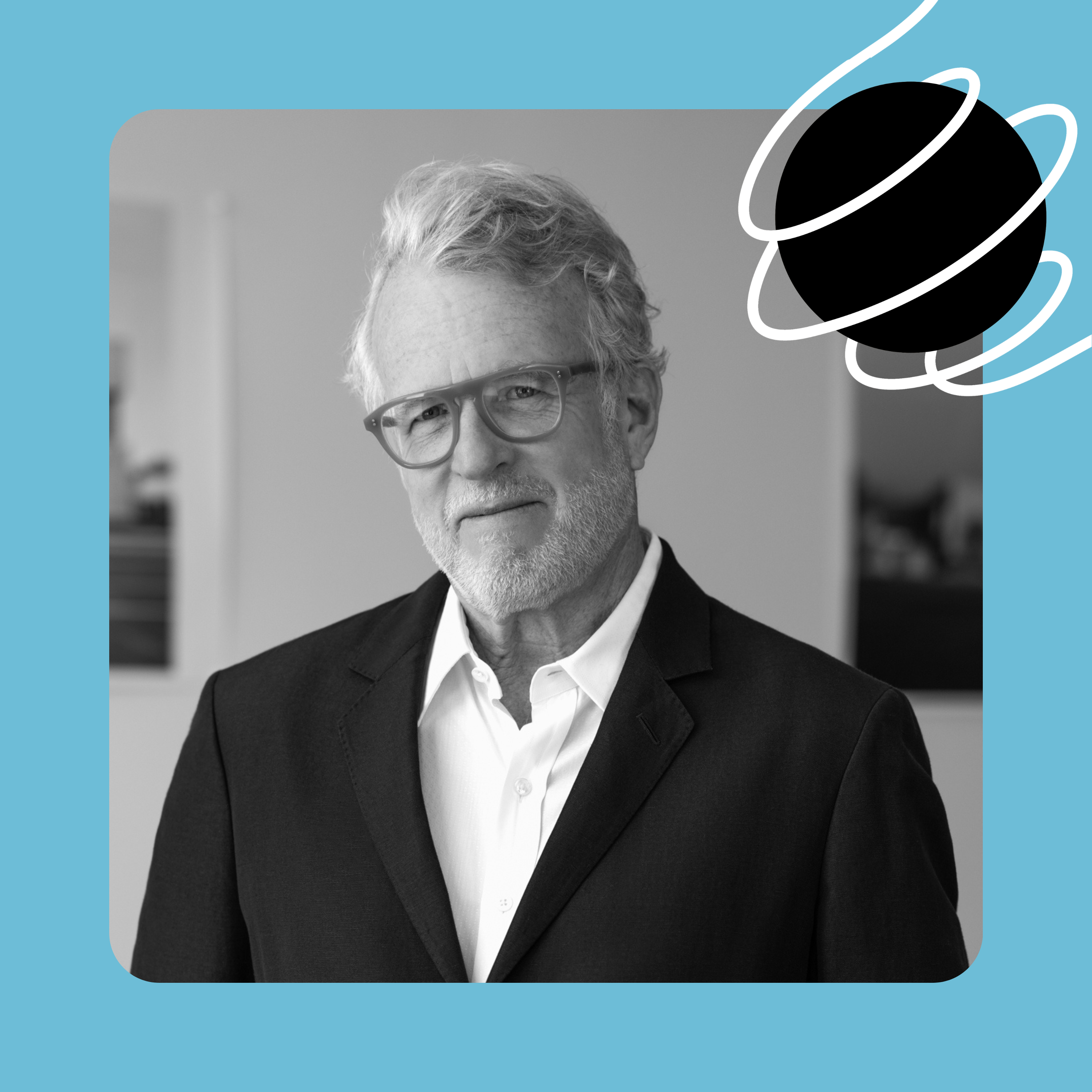
In this episode, we talk with Oregon architect Brad Cloepfil of Allied Works. Brad grew up in Tigard and has designed beautiful buildings all over our state and the world: art museums, private homes, a sports stadium expansion, and even a US embassy. Brad is someone who thinks about and then dreams into being the spaces where we live our lives—especially the parts of our lives that include silence, listening, and a sense of the transcendent. We asked him to explain what he thinks about and notices, as a person who designs buildings. What do our built spaces open up for us, and what do they say about us?
Show Notes
This interview was recorded at the Allied Works office in Goose Hollow, Portland.
Brad Cloepfil's buildings mentioned in this episode include:
- Maryhill Overlook at the Maryhill Museum of Art in Maryhill, Washington (completed 1998)
- The Wieden + Kennedy Agency World Headquarters in Northwest Portland (completed 2000)
- The Pixar Animation Studios Brooklyn Building in Emeryville, California (completed 2011)
- The National Music Centre of Canada in Calgary, Alberta (completed 2016)
- The US embassy in Maputo, Mozambique (completed 2021)
- An in-progress design for an art museum at Middlebury College in Vermont
Brad and Adam also discuss Pioneer Courthouse Square in Portland, designed by Willard Martin, and the Kimbell Art Musem in Fort Worth, Texas, designed by Louis Kahn.
A couple other references:
- "Hirschfeld" refers to Jane Hirschfeld's book Nine Gates: Entering the Mind of Poetry
- The Martin Heidegger line Adam quotes, "The world worlds its world," comes from his essay "The Question Concerning Technology" (trans. William Lovitt).
About our guest
Brad Cloepfil is the founder and creative leader of Allied Works. His body of work is informed by his native Oregon landscapes, a deep sense of place, and love of craft, making, and tectonics. Brad’s architecture pairs an intense focus on the specific character of each project with an understanding of the transformative possibilities of space, light, form, and material. His firm has received numerous design awards, and he is a National Academy of Design Academician and a 2018 American Academy of Arts and Letters Award winner. He has lectured and taught widely throughout Europe, Asia, and North America.
Further detours
- "Distance as an Illusion" by Kevin Nute, on the architectural work of John Yeon
- "Designing the Good Life" by Lisa Radon
- "Into the Woods" by Dionisia Morales, on seeing the world with fresh eyes
Transcript
Brad Cloepfil: That's a 300 foot long two story wall. It doesn't get much more fun than that, does it?
Adam Davis: It is a strange fact about people in the 21st century that a lot of us spend most of our lives inside and just about all of the buildings that we spend so much time in are designed and built by other human beings. What are they thinking about and noticing and trying to do? These people who come up with the plans for the buildings we live in, what do our built spaces open up for us and what do they say about us?
On this episode of The Detour, we talk with Brad Cloepfil, who grew up in Oregon, became an architect based in Portland and New York, and has designed beautiful buildings all over our state and the world. Art, museums, embassies, private homes, stadium expansions, and other kinds of dwellings and more public structures.
Brad, in other words, is someone who thinks and dreams about, and then brings into being the spaces where we live our lives, especially the parts of our lives that include silence, listening, and a sense of the transcendent. This is what we talked about with Brad in the high-ceilinged book-filled, sketches-on-the-walls office of his firm, Allied Works in downtown Portland in late November, 2025.
I wanted to start by asking you, as a kid was there a building or two, a structure or two that made an impression or that are memorable and why?
Brad Cloepfil: You know, I grew up in the suburbs, in Tigard. It wasn't known for its architecture. I mean, I would come downtown and love the old department stores. We would hang out with the escalators that would go up the atriums, and those were very romantic kind of small cities.
So I loved those. But as far as beautiful, like evoking awe and wonder, not really here, and Oregon in general, I think my recognition of the power of awe was the landscape 'cause that we have in Oregon. I mean, that's still probably our most powerful cultural asset.
Adam Davis: Well, let me just ask– what you said was that you were aware and still are aware of the physical beauty. The natural beauty. Why try to, if that's there and it's out there, why try to bring it inside?
Brad Cloepfil: What I think buildings do is they concentrate forces. I mean, buildings kind of filter things, so when they're attuned to their surroundings, they can kind of select and isolate and focus your understanding of place and activity. So when you place a building in the landscape, it's like a lens. It's a powerful way of helping you see certain things.
Adam Davis: More than you would see without a building there?
Brad Cloepfil: Different than you would see. You know, it's just like a beautiful aperture frames
a view. And somehow that view gets elevated. Right? I mean, if you just think of that simple thing of framing. It somehow elevates it just by what it excludes and then what it shows. One of those beautiful gates in a Chinese garden, you know, the circular openings that frame. Yeah. It elevates your sense of everything. If it's done well. And done with the intention to do that.
Adam Davis:With the intention to focus and draw out and frame.
Brad Cloepfil: Right, right. All of those things concentrate forces and select different things.
Adam Davis: Can you think of a place where that is done exceptionally well? Either that you've worked on or that you've been in?
Brad Cloepfil: Oh gosh. You know, the Maryhill Overlook. Adam Davis: One of the first things that I was thinking of.
Brad Cloepfil: Yeah, that was the whole premise of that was to, I think six different sites in Oregon, different landscapes and, and make a built intervention that somehow heightened your sense of place. And the Maryhilll Overlook, you know, was a, was a kind of open wall in a landscape without one.
I mean, it is such a beautiful thing. It's like when you make a wall, you make a here and a there. When you're standing on the, you know, bluffs above the Columbia Gorge, part of the wonder is you lose your sense of scale as a person. And I think that's part of why we love the power of landscape and nature.
But then when there's a wall, it kind of tethers you in a way. You begin to see yourself relative to the landscape in a different way.
Adam Davis: Yeah. I mean, you said intervention. You used the word intervention. That's a strong word.
Brad Cloepfil: Well, I mean, aren't they interventions, aren't buildings interventions? Adam Davis: Yeah.
Brad Cloepfil: Yeah.
Adam Davis: It’s kind of where we started. I think why add that intervention?
Brad Cloepfil: Okay. So there's this, uh, little chapel called [indistinguishable], I guess it's north of Leon in France. Southwestern, sort of central. Western France and by a couple of very famous architects, right? A little tiny building that everyone studied and it's on the side of a hill
and you know, you think you know it and you go there and it's transcendent.
So something that buildings can do with the light and the scale. And again, how they engage the space around it or hold it out and focus it, it's just magical. I mean, they're, they're kind of magical acts when they're done with that kind of intention and care.
Adam Davis: So when you're working on a project and you go to a place and the place is part of what's core to what you're gonna work on, can you describe what's happening in your head that's gonna move from the place as it is to the place that you're gonna intervene in and create?
Brad Cloepfil: Mm-hmm. Mm-hmm. Rather than intervene, it's a concentration. Okay. You're concentrating forces. That's what it is.
Adam Davis:Okay, great.
Brad Cloepfil: That's a better way to think about it. You're gathering up what's there and concentrating it. So every project I do, it doesn't matter if it's a city or landscape or wherever, it's all about, you know, looking and trying to see what exists, what's there, like sort of deep looking and you're looking at the physical qualities, you're looking at the nature of the activity, but not from a merely functional point of view.
Like what? What's the nature of the activity? What do they really do here and what do they really aspire to do here? And how can the building help that? It's the same thing, what the building does for place and its surroundings. It also can do for how it's occupied in the activity. Right. Because it's, it's interesting 'cause people come with a list of needs, right.
Which are mostly, and usually based on what they know. So they're somewhat helpful, right? Adam Davis: Like what would be some of the needs of people, you know?
Brad Coepfil: I mean, we need six galleries. And we don't, you know, want natural light because we have only drawings and photographs. And then you realize, well, if we build this gorgeous building filled with natural light, now you're gonna have $20 million paintings that people will be giving.
You know, it's hard for people to think beyond what they know. Adam Davis: Hmm.
Brad Cloepfil: I think as a general rule, and even in the most visionary cultural institutions, it's still hard.
Adam Davis: So how do you pay attention to that or listen for that, ‘beyond what you know?’ How do you do that?
Brad Cloepfil: I know what rooms do. I think in the discussions with whoever the people commissioning the work, you try to just filter through what is aspirational, what would help them become what they're capable of, or, what's the most possible thing that can happen there?
Adam Davis: Somehow that pushed me back to the department stores and the escalators. What do you think department stores were aspiring for when they created those structures?
Brad Cloepfil: Isn't it interesting? Yeah, because they were civic. They had those giant atriums. Adam Davis: Yeah.
Brad Cloepfil: With the escalators going up though. No, they were monumental spaces.
I do. I do think part of it was the awe and wonder. I do. That's interesting. I've never thought of it that way. I actually am old enough. I went to Lippman's department store and we would buy chocolate-covered peanuts and we would drop them five floors down through the gap in the escalators and try to hit people's hands on that escalator rail.
That's what we did.
Adam Davis: So why awe and wonder in the same space where people are buying button-down shirts and chocolate-covered peanuts?
Brad Cloepfil: I think they were just trying to create a sense of magic, right? I think that's what it was in that case. You know, I would say in, in the newly deceased shopping malls that were the next evolution of that retail fantasy, I think of the big mall street and the indoor trees filled with natural light.
I mean, I think they were all trying to create an environment. It's interesting, isn't it, the role that physical environment played even in retail. And now, you know, we buy three quarters of everything online. There's no there, there.
Adam Davis: It makes me think about the difference between going to a video rental store and flipping through a screen at home.
Brad Cloepfil: I think people have lost culture. People don't talk about the culture, too, because in both cases they've lost a sense of what a physical or a built space can offer. It's just not offered anymore.
Adam Davis: What's your sense of why we've lost that or why that isn't offered anymore? Brad Cloepfil: Well, I mean if you just go through where we would encounter it, there's sort of
two things.
There was a generation of build…many, many, many generations of building that believed buildings could be that transcendent force or that transformative force. Whether it was the atriums of the department store, which I've never thought about. Right. Or the churches or the libraries. You know, you think of the main library in New York, right?
Great reading rooms. People would build those rooms because of the power of them, and they drew people to them. Part of it was people, you know, they never saw spaces. They were beyond the day to day. And there was a sense of beauty and wonder and associated reverence or whatever the activity was that was happening, and they've all gone away.
Adam Davis: Why do you think that's happened?
Brad Cloepfil: I mean, people don't go to libraries, people don't go to churches, people, yeah. I mean, they just quit going to those spaces because of the cultural evolution of things.
Adam Davis: Less religious practice, therefore less time in religious spaces. Brad Cloepfil: Yeah. I just, well, religious practice that wasn't relevant to people.
Right. And then, you know, the access to information, you know, is so vast. I mean, I still know young people that love to go to libraries, so it's, you know, there's still a power to it, but I, I think we've lost the muscle memory of powerful spaces. And I think when people encounter them, they're still moved.
Tremendously moved. You know, you always associate it with Europe and the older cities and, and a couple of our projects have had that effect on people, you know, of kind of surprising them with the power of it. But when you don't encounter it, you don't ask for it. And then when so many aspects of our cities are just strictly commodified. You know, they're about image and narrative and sales, not power and beauty and wonder. Right. So I think it's just gone away by and large.
Adam Davis: We're talking about places that inspire something like awe or wonder that move you. That move you. It seems like most of the– maybe all of the places you've worked on, that's one of your chief goals.
Brad Cloepfil: I do think it is. 'cause that's what buildings can do. It's our metier as architects. Right.
Adam Davis: Do you ever have people push back and go, I hear you. Actually, we want this to be mostly useful in the following ways.
Brad Cloepfil: I know, but they're not exclusive. Meeting the uses is so easy. Okay. Especially the way most people define them.
Like I said, you know, they're kind of a list of needs rooms this big and this small. And of course the building could be so much more than that. The users are almost every time just completely inspired about what we did with that list of uses. And how they can be so much more than the list. Um, it's just the power of space.
It's just like with painting. The power of a canvas and the medium and color. Words with the poets. I mean, it's, you know, our, our medium is the space.
Adam Davis: Can we go there a little bit? You just said paintings. You talked about poets and in your writing about your work almost every section begins with words. Words from a poet or a philosopher, and a wide range.
And earlier when you said, concentration is better than intervention, that made me think of Hirschfield talking about concentration.
Brad Cloepfil: I love her so much.
Adam Davis: What do you love about Hirschfield so much?
Brad Cloepfil: I just, I mean, again, I've just read pieces that I think it's true, isn't it? Here, I'll back up.
When I started studying architecture, I mean, I wanted to be an artist first, but I was afraid, you know, from my background, to tell my parents I was gonna be an artist. So I said, well, architecture's kind of the same thing, right? And it ended up being, for me anyway, it ended up being definitely an applied art.
So I was drawn to visual art in the beginning, and visual art would do that for me, that discerning and concentrating. I mean, you know, buildings take six years, right? Where a painting, I mean, even if they revisited a year or two at the most, you know, or could be a month, right? So they're more iterative.
They can explore things that each painting can be about one thing. And so I would look to the paintings to learn and to be able to see those things about experience and light. And whatever else they were exploring and form. And, that was inspiration to design and to find the language of the physical spatial building.
Right. And then when I started to have to explain the work is when language kicked in. So importantly, and when that search or finding, you know, ideas like concentration, it helped me so much to learn from the poets. Because of this, those words can unlock someone's perception.
No one understands architecture. Adam Davis: I agree.
Brad Cloepfil: Yeah. I thought when I started doing art museums, well, these people I work with, visual artists, they're all in a visual realm and you know, and generally no.
Adam Davis:Do you feel like you understand architecture now?
Brad Cloepfil: I, it's in my body. I know it in a subliminal way. It really is kind of everything I am. Adam Davis: So when you approach and enter a building. What is your body taking in?
Brad Cloepfil: Well, I would say when I approach and enter a place, great. It's like every pore of my body opens up and tries to understand what the power of that place is. What it's telling me and what its potential is. I'm trying to find out what a building can do, even if you're doing a renovation or an intervention in an existing building.
I'm trying to listen and see and learn and hear what this act can help bring forth or help amend, you know,
Adam Davis: Do you know what you're listening for? Brad Cloepfil: No. No idea.
Adam Davis: And that's better that way?
Brad Cloepfil: Oh, it's the best. That first walk when you get a project, it's like really every pore of my body is open, trying to understand and see what's there. It's an amazing, amazing, amazing, amazing thing. It's like it's in the atmosphere.
Adam Davis: So what's the relationship between the first walk and five and a half years later?
Brad Cloepfil: Oh, that's so interesting. So Cliff, it's still a small building next to a very large building, the Deborah Art Museum in the middle of a city.
So being small and being so focused, it was hard to understand what its voice would be, right? I knew how it would serve the work 'cause I knew his work and what we could do for it. But the place was really, really, really, really challenging. And so I did a drive out into the prairie and just tried to feel the presence of the sky on the surface of the earth.
The first sketches I did were the light coming down into the earth and the building kind of rising from the surface of the earth. And that sense of the earth is why it's concrete. And the thing that
building does that brings the concrete to life even in a way that none of us really understood, is the light.
And then when the building was finished and it was empty, I thought this is a disaster. We totally missed it. Proportions are crazy. It feels terrible. I mean, I was mortified. And then like a month or two later at the opening when the art was installed, it all snapped into place.
I mean, everything made sense, Adam Davis: But it needed the art in it
Brad Cloepfil: Absolutely required. The building had no voice without the art. And then the last part is when I go back, like 10 years on, right? I can see it. The authorship drops away. You know, you get distance from it. So, you know, I don't go in there looking at my building. I go in there just looking at this building. And so it's fun to see what the building tells me, right?
And think, goodness, mostly, mostly good things. You know, I love that part. I had never thought about that part going back 10 years later and allowing the building to talk to me. Not my voice in the building, but the building itself.
Adam Davis: But it took that kind of time for that to happen.
Brad Cloepfil: Yeah. Yeah. It kind of takes five or six years minimum to distance yourself from the struggle.
Adam Davis: You're talking a lot about things like awe, beauty, wonder, light, silence. I wonder about other things that people sometimes associate with buildings, especially public buildings or public spaces, and so like community, or even a word like justice. And I wonder, do you see those as relating to important…?
Brad Cloepfil: Yeah. Let's see. When you make inspiring spaces, it brings people together. People wanna be in beautiful, powerful spaces that have a strong presence, let's just say squares, right? And in great halls, right? You know, they rarely happen just on the street or down on the corner. So I think that that sense of community, it is the building or the place that draws them together.
And then, you know, elements of justice. I don't know. I mean, buildings having a sense of invitation and open access is critical. You know, going through the, I can't remember if they're Doric or Corinthian, columns of the Met, but going up the stairs into the portico– through the portico into the Grand Rotunda.
I'd say probably until I was 35, I was totally intimidated by that place. As much as I love the art in there and everything else, right? I mean, that language of architecture, that kind of imperial
presence is, you know, not the most inviting. Most people are intimidated by that. So part of the challenge of what I do doing civic institutions and what a lot of architects do, is how to extend that sense of invitation, open invitation.
Adam Davis: So when you're working on an embassy in Mozambique, is that meant to be invitational or what is that supposed to feel like?
Brad Cloepfil: When we were invited to do that, they had just come off of 30 years of the standard embassy design.
I think the whole State Department venture was run by an ex [indistinguishable]. And so it was, you know, pragmatic. Same embassy here, you know, Mozambique, I see, um, you know, Brussels, uh, Delhi, but we'll modify it for local conditions and that's what they did. And so there's a lot of really horrible buildings out there.
And they started this new program at that time called Design Excellence. And so they brought in a lot of good architects, some of the best American architects to do these things. And for me, when we got the Mozambique piece, it was very moving, frankly. And you know what, what are we trying to say to the world in these embassies, right?
You're trying to celebrate a place and therefore it's culture, right? And then in my case, I wanted it to be open. I came up with a landscape design where you didn't see the walls, they were hidden in hahas.
Adam Davis: What’s a haha?
Brad Cloepfil: Isn't that the greatest term? It's a landscape device where you can see the vastness of the landscape and you make a dip so no animals can cross it, so there's no fence required. So you can have beautiful sheep in a pastoral landscape and they can't ever get out because of the haha. And so we developed a haha so you wouldn't see the security fence. So there'd be a sense of invitation and access, but still secure.
And that was part of the goal for me at least. And then I think there were 450 people in the embassy and something like 250 were U-S-A-I-D-S.
Adam Davis: Okay.
Brad Cloepfil: I was so inspired by what we offer and you know, why embassies are there. They're there for their own national and economic agendas and everyone's is.
But the fact that we had that many people there working on water projects and agriculture projects, it was really powerful. It was a really powerful thing. So that really is another example of your point and your question of like, what are you trying to manifest? So how are you trying to
communicate the kind of best ideals of a nation is a powerful task.
It's like when we did the National Music Center in Calgary, you know, it's a national institution and we talked about that in the office. It has to have a presence that aspires to representing a nation. Right? It's not just let's make a nice, you know, Calgary museum. It's different. It's different when you're carrying that responsibility.
Right? And I think in the old days, that's why they slapped some columns on it and impediments and you know, they have this language of Imperial Rome, so they could elevate those things with that language. With contemporary architecture, you don't have those tools. So it's a bigger challenge because columns are out.
Adam Davis: So columns are out. Pillars are out.
Brad Cloepfil: Well, it was a pretty horrible precedent. If you think Roman architecture is a precedent for our national institutions, I don't know. I wouldn't choose it. But it is interesting because now without that code, you know, it's kind of a free for all, and I think that's why there's a lot of novelty architecture, because people do fancy things trying to represent something unique and aspirational.
Adam Davis: So as you talk about going different places, everything from Mozambique to Calgary to New Haven to Middlebury, and this list could go on, I'm thinking about the challenge of when you earlier said, let's talk about place more than structure. How when you go as a visitor or as a new person to a place do you let that place show up in a way that's gonna be as true to it as for someone who's lived there their whole life?
Brad Cloepfil: I'm not sure that's what you're trying to do, actually, because it's the same thing for most of us. When we live in a place and it becomes familiar, our vision kind of closes down.
I mean, we like that, the comfort of patterns and ritual. We all love that. I don't think we're. looking to have our mind blown every day. You know, when I'm going to get my coffee at Sterling, or you know, all the little rituals. So, I mean, so many projects you'll meet someone after we're hired that says, I really wanted to hire someone local because they really get the place.
And I would contend that's a rare, rare thing when someone local gets the place 'cause they lose their ability to see it. I think a lot of times, again, not everyone, but a lot of times. It's also not about blowing people's minds all the time, it's just helping them see things. It can be quieter, subtler, it could be the simplest thing,
Adam Davis: Like concretely, how do you help someone see a thing or hear a thing? Brad Cloepfil: I mean, the materiality of a facade and how it changes color in the light. So
suddenly you sense the seasons, right? You're there in the morning, you're there in the evening, right? And it just changes. Yeah, you just see things differently. I mean, one of the nice things about Neoclassical buildings is that they have all that relief, and so they have all this shadow they cast.
I mean, in New York, it's about this time of year when the winter light goes straight down the streets.And rakes the, you know, the shadow of the fire escapes and the relief on the buildings. Oh my God. And so those neoclassical fabric buildings heighten your sense of the seasons because of what happens in the winter when it comes right down the streets.
So that's a very subtle thing. They weren't intending to do that, but it does. Just having buildings there makes you see the light. That's a perfect example of what buildings do. Would you recognize it the same way when it was coming through a canopy of trees? Well, yeah. You might recognize it from the casting of the shadows of the branches and things.
The buildings certainly amplify it In that case,
Adam Davis: You're listening to The Detour with Brad Cloepfil recorded at his downtown Portland office.
At Oregon Humanities, we create conditions for people to understand each other and be understood. Through conversations in small rooms and large auditoriums, by sharing stories in our publications and on this podcast, and by offering resources through fellowships, grants, and training people to lead conversations, story by story and conversation by conversation.
Oregon Humanities helps people think through difficult topics and challenging questions together. Your financial support helps keep these statewide efforts free and accessible, even in the midst of federal funding cuts so that all our neighbors feel welcome, heard, seen, and valued. You could become a sustaining donor by giving $10 or $20 a month or make a one-time gift that strengthens relationships and builds trust throughout our state.
Visit Oregonhumanities.org to donate now or find us in the Willamette Week Give Guide through December 31st.
Adam Davis: When you were a kid, did you pay a lot of attention to light?
Brad Cloepfil: When I was a kid, I paid a lot of attention to nature. What in nature were you paying attention to? Well, I wanted to be a botanist. I was a naturalist. I was a kooky, little, nerdy naturalist. I spent all my time in woods and fields and streams and ponds and brought stuff home and collected everything you can imagine: feathers, plants, flowers, fish, frogs. So I just was out there seeing things. Out there looking for things. So I don't remember light specifically then.
Adam Davis: But collecting things,
Brad Cloepfil: Just looking, looking at things. Seeing things,
Adam Davis: Yeah. And then moving at some point from seeing things to making really complicated things.
Brad Cloepfil: Yeah, I guess so.
But I think it's seeing things, and that's what I do when I go to the cities or sites or landscapes. You're just trying to see as deeply as you could possibly see. And I think growing up in Oregon, there was so much just sort of beauty and mystery and curiosity and what was out there. You know, everything that was growing in the fields and all the different things that were blooming at different times of year.
I got totally transfixed by moss and lichen. There's a nerd for you, right? But when you look that closely at rocks and things, and you see how many species of moss there are on the bed of a forest. I think I learned that the closer you look, the more you see and then that skillset or that practice, I think it was more like a practice of my youth that became that a practice in my work.
I do think that's a rare thing in our culture, isn't it? And I'm not trying to elevate my practice by any means, but it's just looking and listening as deeply as you can. Trying to have no preconceptions. I mean, we all do, but trying to set those aside and just see what's there, I probably do it much more poorly with people than I do with places.
Adam Davis: It’s funny. That's where I was just going in my head. That's part of the question is what are you, where are you directing your attention? And you're in the business of actually helping all of us direct our attention almost without our knowing. some
Brad Cloepfil: Some clients, who are just, you know, really curious and open, can say things that really inspire the work, and they don't know they're saying it, but they'll talk about what they hope for or the way an activity is happening or struggling. It'll create an insight that then propels the work in a, in a different direction. When I was working on Wyden and Kennedy with Dan Wyden, it was the first time that really happened to me.
Adam Davis: What happened?
Brad Cloepfil: He would just talk about what he wants, you know, that this place is just a factory for ads and people are just, you know, they're just factory workers. You know, it's not about one individual or this is a workshop. I mean, he just used language that was so uncommon for the workplace that allowed us to kind of take risks and develop a pretty different model that became precedent-setting in the workplace design.
Adam Davis: But it all came from him, which you were listening to.
Brad Cloepfil: And it's so interesting 'cause it's that listening practice again where you don't, you're not listening for anything. You're just listening and then all of a sudden a word will just snap things and you'll see it in a totally different way. It's amazing.
Adam Davis: So what, what's the phase that follows listening?
Brad Cloepfil: This is so fun because reflecting the words back to me makes me think of things in a different way. My job is to initiate the conversation. So I start with these charcoal sketches. I go, you know, I, I look and listen, and then I start making these drawings with charcoal, trying to just make the most elemental marks to start a conversation.
Like for instance, the Middlebury College Museum of Art. We're in a phase called design development now. So it's the concept phase. You kind of refined it and the building has its presence sort of going. And in this phase you're really trying to learn from the building, you know, 'cause you've gathered those forces together.
You compose something that you think reflects those forces and modifies and redirects and all those lovely words that buildings do. Then there's that plane where you're just trying to let the building be what it wants to be and you have to listen to the building. And that's really exciting because then it's, that's when the building really gets good and really gains its voice and it's, it is really one of the most thrilling things 'cause you create something that then starts telling you what it wants. And that's what is so fascinating. Every creative practice works this way as far as I can tell. You start something you'll think you have a preconception about, you know, what should happen and what needs to develop, right?
And then all of a sudden you grind to a halt and you just go, you know, it's wrong and you have to start over. You get caught in your preconceptions of forcing something on it, forcing your will on the thing and the, and it'll eventually tell you, Nope, it’s not gonna happen.
Adam Davis: And that's a kind of an aesthetic feeling? Or what happens that tells you, I've been forcing this and it ain't right? I don't know. You just
Brad Cloepfil: I don’t know. You just know. You can see it. It's not working. Whatever it is you thought would work or whatever you thought the outcome would come. You know, the nature of the sequence of spaces or the scale of the walls or quality of light or whatever it is you're trying to refine.
You just finally can't fool yourself anymore. Adam Davis: Are other people involved in that?
Brad Cloepfil: Yes and that's what's really fun. It's so interesting when we did Pixar's headquarters years ago, all those famous Pixar movies start with two people, two creatives. And then suddenly there's four developing it, and then about 12, and then it gets green-lighted.
And then at the height of it, there's 250 people working on a film, and it takes four to six years. It's just like a building. It's exactly the same as buildings. So I do these sketches. I bring in one of my partners or project leads, we talk about it. You get an intern to kind of test it a little bit to see if it works.
You generate some more and then suddenly it's two or three people and it's four. And then, you know, from the architecture point of view, 10 or 12 people working on a building, sometimes more if it's a huge building. But then when it's under construction, there's 200 workers working on it. It's the same thing. And it takes four to six years from that first sketch. I thought that was fascinating.
Adam Davis: It is. And it's so interesting to think about. The initial walk. And what might be a direct apprehension of the place and a kind of sensitivity to it, and then trying to help other people have some version of the same experience, I guess their own version. How do you do that? That's actually quite hard to do. I think we often run into challenges when we go from here's what I think this is to what do you think this is?
Brad Cloepfil: I mean, yes, that first act is coming from my hand. There's no question. It's what I see in here and then the starting marks I make. But the marks are kind of like questions.
They really are like it's seeing something and then trying to discern if it can be manifested in a building or if it can guide and inspire the building because what you identify the building is serving has to carry it through a year on something of design and another year of drawing and then, you know, two or three years of construction and those two or three key perceptions have to carry the building. And that's where bringing other people in– I'll try two or three different approaches.. And I'll explain to my key people I'm working with, this is what I think, what do you guys think? You know, this is what I think we can do.
I think the building can do this. And then from the very beginning their eyes are informing the project. And helping develop it. I need that. I mean, we all, we all need that. Right? You see what I see? Because also if, if the collective can see it, then we can develop it. I mean, that's, that's the thing.
It's like if they can't see it in the project, then it doesn't work. That's just it. It's obviously wrong. Because if they don't see it, then it's not real, or it's just personal.
Adam Davis: Right.
Brad Cloepfil: And that's, I think that's the mistake that so many architects make. They think that
they need to manifest a personal vision, and it's not personal at all. It's never personal.
Adam Davis: And is that not being personal about an inclusive process, or is it more about that the vision is somehow more inclusive?
Brad Cloepfil: The vision has to speak to people. If your job is to develop this idea, you have to see it, and you have to add to it and listen to it. The insight you bring back is fantastic and propels it forward.
You know, the many voices thing, but if you're all talking about the same thing, right? Which doesn't mean someone can have a breakthrough too. That's always thrilling. You know, when someone brings something back to you that you hadn't seen before. It's a conversation though. You sort of see it in the same conversation, and it's a different take or a different way of understanding it.
It's thrilling. It's really thrilling.
Adam Davis: Yeah. I'm thinking again about the words that often begin the sections of writing about the structures you've worked on. And again, that, that they're from poets and philosophers largely. And I'm aware that up on the shelf behind me, there's uh, there's a Heidigger book and I have stuck in my head while you've been talking, this keeps popping up. Heiddeger has this sentence, translated, “The world, worlds its world.” Which is this totally obscure sentence, but it seems to me it's about emergence in some way. And if I were gonna try to get two people on board, or 12 people on board, or 250 on board, and I said, look, the world here on this hill is worlding its world, I wouldn't have them.
But that may be what's going on. So I think what I'm asking is about the relationship between emergence as it feels like you're becoming aware of it. And the attempt to articulate it in ways that will bring people along or invite them in.
Brad Cloepfil: Well, and that's where you use every tool imaginable, right?
So when we start the work, there's my sketches, then there's like photographs of the site. There's that continued deep looking to see if you miss something or if you see something a different way. Then you're aspiring to a quality or a character, right? And so you find photographs of anything, paintings, dirty walls, you know, sticks.
I mean anything, textiles, anything that represents the presence or a quality of what you're trying to find. And then obviously language. I started about 10 years ago, putting words on the wall.
And those words evolve, like that's not right before. Adam Davis: Like what kind of words?
Brad Coepfil: Sometimes they're things like processional, you know, and ritual and just like presence.
What's the presence? What is the presence of this thing? So yeah, it depends on the project, but I started using words to try to, again, as ways to guide the work. This is the thing we're trying to do. We haven't figured it out yet. And these images aren't it either, but they're kind of all there to help us find it.
And we did theory and Helmut Lang's design studio, you know, fashion brands. And the creative leads in those studios work exactly the same way. Every inspiration of color, surface texture, they have these boards. It's so interesting.
Adam Davis: We're in your office at Allied Works.. In sort of Southwest Portland.
What are we looking at? What do you see as these on the wall. (At this point Brad turned and looked at his sketches from a current project hanging in his office.)
Brad Cloepfil: Well, those are studies of the facade of the museum at Middlebury, so it's just looking at the nature of the openings and the scale and how it's made.
The kind of perception of the thing that's a 300 foot long, two story wall. It doesn't get much more fun than that, does it? It sounds fun. Football field wall. I mean, how do you scale it? You know, how does it not be intimidating? What is it defining on a campus of just pretty much traditional buildings?
Yeah, so. Facades are like the last thing I think about. Appearance is the last thing I think about. Scale, relative size of things, composition of openings. But then the nature of material joints, you know, stone coursing and concrete joints, that's the hardest thing in the
world.
Adam Davis: Will you say another sense about that? You started that by saying, you know, and I don't know what's the hardest thing in the world about those? It's just.
Brad Cloepfil: It’s just beautiful composition where you're using your eye to do something that is pleasing and has the right scale, and it also breaks down in scale as you get closer to it.
That's one of the things I learned a long time ago. I mean, part of the problems of contemporary architecture is it didn't have intermediate and intimate scales. You know, it worked from a distance. Big, high rise, beautiful thing, right? Glistening object or whatever it is, right? First you try to find yourself in it. You know me, a human five or six feet tall, where's that scale in it? And then ideally it's like, where can I put my hand? And that's where craft comes in. If there's no craft, if a building is just assembled from industrial parts, it doesn't happen. There is no hand. I would say that the lack of diversity of scale and increasingly [indistinguishable] scale is why
most people hate contemporary architecture.
I mean, I think rightfully so. I mean, you're not offering 'em any way to engage other than ‘that's a cool object’ or ‘that's a nice shiny thing,’ and then its meaning is gone. There's no there, there.
Adam Davis: I just was thinking while you were talking about this, of my image of you at the department store as a kid riding the escalator, because there's something about that that's both putting your hand on a thing and moving closer.
Brad Cloepfil: Yeah. That's really formative.
Adam Davis: I love the idea of the different distances or the different scale that you're approaching a thing. We have, (I'm now pointing back behind me to Courthouse Square in downtown Portland.) What's your sense of that space?
Brad Coepfil:Portland's main square, Adam Davis: Portland's living room.
Brad Cloepfil: Portland’s main square. I mean, archetypally, the shape of it kind of works, right? The form of it kind of works. The thing that doesn't work is how it was too much of a style. The language of it was too much of a moment. So it was imposing the architect's interest in a style at the time, which you should never really do in civic space, but the form of the space itself, if you just get rid of the bad colors and strange iconography of the columns and things, the form of it and the elements of it are really successful,
Adam Davis: Sort of open and the little amphitheater feel…
Brad Cloepfil: Right, the amphitheater feel, the edges of it are occupiable. I mean all kind of, they're all kind of iconic space making. So the knowledge of the urban and civic space making I think was good and thoughtful.
Boy did it not hold up over time from a stylistic design point of view.
Adam Davis: When you walk through Portland or New York, are you trying to listen or trying not to listen? Trying to see or not to see?
Brad Cloepfil: I'm always trying to see things like that rake of light, you know, down the, down the streets, right? So there's always something surprising to see.
I don't generally look at the buildings because a lot of times they're so disappointing. It hurts, it kind of hurts. Architects were trained in, in the old days, they had Beaux Art training. They went off, they studied the classics, they learned a code in the language. And that code in language
actually makes pretty good streets, right?
So, you know, there's a scale, there's a detail, there's all those scales. We talked about the intimacy of craft–cast, limestone, you know, window sills, and of these different components that contemporary architecture generally doesn't have. Right. So, you know, with modern and contemporary architecture, I rarely look because it's painful.
It's painful for me to see 50, 60, a hundred million dollars wasted, and something that doesn't really bring value other than from a real estate point of view. You know, it doesn't bring value to the city or the people that live in it. It doesn't weather well, doesn't age well.
Adam Davis: What are a couple of structures that you feel like, man, these are the structures that really show what's possible?
Brad Cloepfil: I mean, there's an architect, Lou Kahn, I would say timeless archetypal buildings beautifully made that age well, because that's the intent, and he's listening to history in a way that took the elements of that learning and brought them into, at that time a contemporary language that has endured because he was listening for the things that endured to begin with.
And it was interesting too, because he would propose buildings that you wouldn't necessarily think would fit the purpose and then somehow became these amazing amplifiers of the research activity or the religious activity or you know, museums, like the Kimbell Art Museum is so strange. If you describe that building, the scale of it, people will go, oh my God, that can't, that must be a terrible place.
These huge long vaults that kind of press down on these low walls of limestone. And you just think, how in the world can it happen? And it's magnificent. So. There's something he could see and bring from his knowledge and understanding and his looking.
Adam Davis: Yeah. And you said amplifiers..
Brad Coepfil: Which is the same thing.Yeah. Architecture.
Adam Davis: Is there a question in your thinking about your work these days in a general way? A question that is persistently coming up in the back of your head somewhere.
Brad Cloepfil: I mean, it's a continuation of a conversation of place where we're offered these different opportunities.
So, I mean, it's kind of all one big question. What can we elevate? What can we elevate in this project? Right? I mean, if you look for, for instance, at the Middlebury campus, you know, beautiful campus, Vermont, incredibly beautiful place. It was begun with stone, very stoic stone buildings as rectangular objects set on the grassy lawn.
They were boxes. There was no, they didn't even have porches 'cause they were so, so tough in those days. No nonsense. You know, you go outside, you go to work, you go inside, you eat and go to bed, right? There's no lingering on the porch kind of thing. Also the weather I suppose. But anyway, there were these very bounded things.
So you're in this beautiful landscape and none of the buildings on campus engaged landscape. None of even the ones between, you know, I forget when it all started and now–nothing. So our first mission was to engage the landscape. Imagine that you're in this beautiful, beautiful place. So the building is seen as a series of landscape walls that gather together courtyards.
Like I really wanted a walled garden facing south because it's cold, right? And so it's protected from the wind and it gets the south light and people can be outside. So that's how it kind of started. And somewhere the galleries emerged and the other communal spaces emerged. You kind of find those in the landscape then. I don't know if that helps.
Adam Davis: It helps a ton actually. It just made me think about how much time we spend in buildings as human beings, especially modern human beings. And you could think about those as meant to be separate from the natural environments in which they occur or you can think of them as continuous with, and it sounds like you're really pushing us to think more and more of connectedness.
Brad Cloepfil: That's an interesting thing. I've never thought about this. It really is about the connectedness of it all, but it all feels a part of the same system. And I think about cultural systems, like how to think of people engaging in art museums. There was a time when there were elevated places, which I love.
You know, again, there's so few things that are elevated. It's nice to have something elevated, right? Not everything has to be the common element in our culture, but anyway, but, but the act of, of making the art and the experience of the museum feel connected to your life and the city and the region and the place– that all one thing.
Is what our culture has lacked and still lacks and, and it's learning from information systems are the same as natural systems and a building is a form of information, right, in a way. And it's conveying information and experience and it really should feel like it's just a part of that kind of ongoing conversation of place.
And the same with activities. It makes me think, I've been trying to write about this. The idea of creating an empty room is something I've just come back to time and time again. 'cause that's what I do. I make empty space. And you're encouraging occupation. You, you want it to be inhabited and you're anticipating a form of, you know, habitation, but you don't really know.
And so. And it makes me think about home. You know what makes us feel at home is usually
we're just gathering things together. Nevermind family, right? And the people we live with. But you gather together things, known things, things that help you see the world with you and me. It's probably a lot of books, right?
Too many books, right? But you gather together these things and furniture and objects from travel and memories, and you kind of collect this thing and all the rooms that we make that they're intended to be occupied like that in obviously different ways, if it's a museum or a symphony hall or whatever it is.
But that form of occupation you're setting in motion is so fascinating, and I think that's one of the inspiring things for me, that you're creating these vessels for life, right? And you're setting life in motion. Active building. So back to some of your earlier questions. That active building helps focus your understanding of place and the world in some way, right?
And that focus applies then to how it's occupied, but then in the end, I don't control the occupation, which I love watching it have its own life, and how the life changes over time. The use. That was the part I never thought of either, is that, yeah, you're as an architect, you're focused on the artifact and creating this thing, and then what's the most fascinating is how it becomes, it's like an instrument.
You're creating an instrument for life is really what you're doing, right. Adam Davis: That other people will play.
Brad Cloepfil: Yes, exactly. And it's so exciting and inspiring, and again, if it inspires people, then they'll really learn to play it and take it places that you never imagined before. Right. Maybe if they don't care about it, it's different.
Right?
Adam Davis: Maybe we'll leave it there with the instrument that other people will play. Brad, thanks for being game to talk. Thanks for the work you're doing in the world, the beautiful ways you're opening up the world and listening and seeing.
Brad Cloepfil: It's so fun. Thank you for the opportunity to talk about all this. I love it.
Adam Davis: Brad Cloepfil is a Portland and New York based architect and the founder of Allied Works. You can learn more about him at alliedworks.com and in our show notes at oregonhumanities.org. Thanks for listening to The Detour from Oregon Humanities. Anna McClain is our producer, and Alexander Silvester, Karina Briski, and Ben Waterhouse are our assistant producers.
This is Adam Davis. See you next time.