This year, in observation of the 250th anniversary of the Declaration of Independence, we're exploring the core values and ideas our nation claims to be committed to. We're calling this yearlong effort Beyond 250. For our first episode, we're focusing on equality: what we mean by it, where we live up to our hopes related to equality and where we fall short, and how understandings on equality have changed throughout our nation's history. To that end we'll hear from Akhil Reed Amar, author of Born Equal: Remaking America's Constitution, 1840 to 1920, The Words That Made Us, and many other books in articles on the Declaration, the Constitution, and other key aspects of the United States. We'll also hear from many Oregon high school students who gathered at the Alberta Rose Theater in Portland in October 2025 to hear Akhil speak.
Show Notes
About our guest
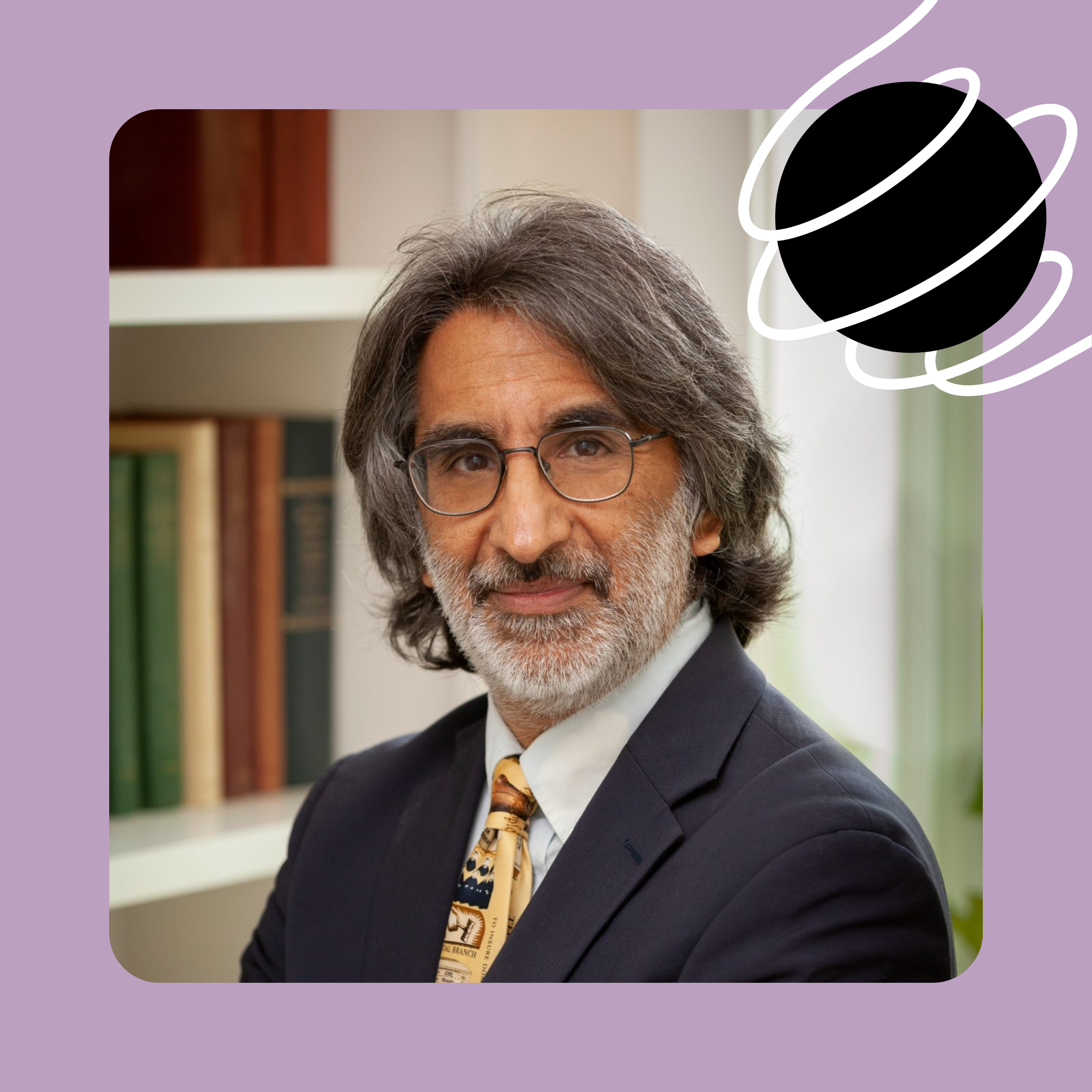
Akhil Reed Amar is Sterling Professor of Law and Political Science at Yale University, where he teaches constitutional law in both Yale College and Yale Law School. Amar’s work has won awards from both the American Bar Association and the Federalist Society, and he has been cited by Supreme Court justices across the spectrum in more than fifty cases. He regularly testifies before Congress at the invitation of both parties. He was an informal consultant to The West Wing and has appeared on The Colbert Report, Morning Joe, Constitution USA with Peter Sagal, and many other programs. Along with Andy Lipka, he cohosts the podcast Amarica’s Constitution.
Amar has written more than a hundred law review articles and several books about the Constitution, including The Bill of Rights, America’s Constitution, America’s Unwritten Constitution, and The Constitution Today. The first volume of his ambitious trilogy on American constitutional history from the Founding to the present, The Words That Made Us: America’s Constitutional Conversation, 1760-1840, came out in May 2021. The second volume, Born Equal: Remaking America’s Constitution, 1840-1920, was published in September 2025.
Further detours
- You can watch the full video of our program with Akhil Reed Amar on our YouTube channel.
- The students you hear in this episode are participants in We the People, a national civics curriculum and compatition, and attended the program with Amar though Oregon Humanities' partnership with Civics Learning Project.
- For more on law and the constitution, listen to our episodes with Danielle Allen, Dahlia Lithwick, and Bobbin Singh, Rene Denfeld, david rogers, and Monica Mueller
Transcript
Ben Waterhouse: What's the first thing that comes to mind when I say the word equality?
Students: Everybody having the same rights. I think of different people on the same level.
I think of everyone being uplifted to be able to have an equal opportunity.
Well, to be honest, the first thing that came to mind was inequalities and inequalities in math, although I'm not a math guy, so everyone has access to the same things.
Not really advantage or disadvantage.
I kind of think of like everyone at the same level and having the same rights, I guess. I don't know. It's kind of hard to like explain, but yeah.
Adam Davis: Hello, and welcome to The Detour from Oregon Humanities. I'm Adam Davis. This year, 2026, is the 250th anniversary–that's right, the semiquincentennial of the Declaration of Independence. Here on The Detour and in many Oregon Humanities programs throughout 2026, we're exploring the core values and ideas the Declaration and our nation claim to be committed to. We're calling this year-long effort, Beyond 250, and we're excited to focus our first Beyond 250 Detour episode on equality: what we mean by it; where we live up to our hopes related to equality and where we fall short; and how understandings of equality have changed throughout our nation's history. We're particularly excited because this exploration of equality features a conversation with Akhil Reed Amar and thoughts from many Oregon high school students who gathered at the Alberta Rose Theater in Portland in November 2025 to hear Akhil speak and to engage in conversation with him and with one another.
You just heard from some of those students, and you'll hear from more of them throughout the episode thanks to the navigational efforts of Ben Waterhouse, Oregon Humanities' communications director, who made his way through the crowded theater to ask questions and record responses.
One more note on the voices you'll hear: Akhil Reed Amar is the author of Born Equal: Remaking America's Constitution, 1840 to 1920, The Words That Made Us, and many other books in articles on the Declaration, the Constitution, and other key aspects of the United States. Akhil is also the Sterling Professor of Law and Political Science at Yale Law School.
Here's Akil talking about a recent experience in which our nation's commitment to equality showed up for him.
Akhil Reed Amar: I've been on the road a lot, so I've gone through a lot of TSA portals. And if you think that the only value in the constitution is privacy, you'd wanna minimize the number of these intrusions.
But if you think that it's also equality, then you're given a certain comfort actually that they're not singling you out because you have dark skin, you know, or a beard. So as mean as it sounds, I actually, I'm kind of comforted by the fact that everyone else has to go through this and they're not singling me out, and that's
equality. Our laws don't say, oh, you get to go through that portal 'cause you are White–a special portal–or because you are male or because you're first born in the family because you're born straight rather than gay. So there are all sorts of inequalities in, in, in the world. But when government exalts some and demeans others because of the accidents of their birth, that's when we should be most, I think, troubled.
Adam Davis: And the two accidents of birth that it feels to me like you're most talking about are related to race and gender.
Akhil Reed Amar: Yes.
Adam Davis: Yes.
Akhil Reed Amar: That was a good ‘yes.’ He told me to try to be Lincolnian, by which I said, I'm not tall. And he said, “No. I mean, ‘terse.’”
Adam Davis: I did actually say that out loud? I know I was thinking it.
Akhil Reed Amar: Abe had a great sense of humor too.
Adam Davis:Thinking again, primarily about racial equality and gender equality. And you just mentioned Abe and you used Abe's first name.
Akhil Reed Amar: I feel as if I know him well.
Adam Davis: Let me just ask it this way, why first names, and is that also a part of your trying to get us thinking about equality?
Akhil Reed Amar: So I talk about four people more than anyone else in the book.
One reason that I use first names is this is an era that I'm talking about in which women rise to the surface, they become central to discourse. And if I use last names, it can be a little confusing, it can be very gendered. Oh, slaves were known by their first name. And one of my four was born a slave.
So in some ways it felt more equal to use first names, less patriarchal. It's a period in which there was more informality. No one ever called Washington George or Jefferson, Tom or Thomas, but I promise you they talked all the time about Honest Abe Lincoln, uncle Abe Lincoln. They did. And so the book begins– the first two sentences actually–are the following: “The words resound through the ages, ‘Four score and seven years ago, our fathers brought forth upon this continent, a new nation conceived in liberty and dedicated to the proposition that all men are created equal.’” That's Lincoln at Gettysburg. Of course, he's speaking in 1863. If you deduct 87 years, that's four score, seven years.
That's 1776 if you do the math. He's talking about the Declaration of Independence and he thinks the central proposition is all men are created equal. And he's quoting. He's one of my four characters. Another one of my four characters is Elizabeth Cady Stanton. She's riffing on the Declaration and a thing called the Declaration of Sentiments–rhymes with Declaration of Independence.
It's the main document that emerges from the Seneca Falls Convention of 1848, the World's First Woman's Rights Convention, and it has the following language: We hold these truths to be self-evident that all men and women are created equal, and one of the men at Seneca Falls is actually a third major character of mine.
His name is Frederick Douglass and he's born a slave. He's America's most famous black man. He very much believes actually not just in racial equality, but female equality as well. Three of the four big characters in the book are Abe Lincoln, Frederick Douglass, and Elizabeth Cady Stanton.
Adam Davis: So you just referred to Lincoln's specific words dedicated to the proposition that all men are created equal. I feel like Proposition is doing some work and it feels quite different from a description.
Akhil Reed Amar: Yes.
Adam Davis: I like when you say yes like that. So what are you thinking?
Akhil Reed Amar: I'm thinking that Lincoln actually, who has less than a year of classroom education in his life, thinks very mathematically.
He becomes Abraham Lincoln by reading books. And reading newspapers. And some of his favorite books are great works of fiction. Aesop's Fables, for example. Oh, he loves Shakespeare, but he also loves Euclid. He's very logical, he's very analytical and he's very interested, in effect, propositions. And one of the reasons he's so funny, and he is funny, is logic can sometimes be funny because human beings aren't always logical.
And when you point out the illogic, it's hilarious.
Adam Davis: I mean, there's something hilarious about saying it's self-evidently true, that all men are created equal.
Akhil Reed Amar: Indeed, in the middle of one chapter I give you when I'm describing the Lincoln-Douglas debates, 10 different ways in the middle of the eighteen hundreds, the 19th century, 10 different ways in which those five words are construed, and one or two of them are it's a self-evident lie.
It's not true. And another one is, oh, that doesn't apply to black people. It's only about white people. There are all sorts of different riffs on those five words. We are still today trying to think about the entailments, the scope and the limits of those five words, “All men are created equal,” or all persons are created equal, all people are created equal.
Ben Waterhouse: Is there a clause of the Constitution or an amendment that is particularly important or inspiring for you?
Students: One, of course, is the 14th amendment. The idea of everyone is born equally.
I know it's probably kind of basic, but the First Amendment's really important.
I feel like habeas corpus, you know, procedural due process. I think it's major in keeping equality and I think it's a major issue today.
I really like the Fourth Amendment, which is searches and seizures because I feel that it's very relevant today in pretty much every current event.
I think the first amendment's the most important. It allows us to believe and do
what we want within reason, obviously without worry of being persecuted. [applause]
The 16th Amendment is the single most significant amendment we have had since the Bill of Rights because everyone like wins or loses based off of like how the government handles general welfare.
The most meaningful amendment to me is just the First Amendment. I think that being able to like express your ideas is one of the most vital things in a democracy. [applause]
I mean, I could joke and say the 21st Amendment,
The 14th Amendment, because of the way that that amendment does have an opportunity to protect rights that are not specifically listed in that amendment or in the Constitution at all.
Adam Davis: So, as you understand it, what are the most important ways that the federal government is trying to live up to making us or helping us be equal.
Akhil Reed Amar: So at the center of this book are four amendments. I call them Lincolnian amendments. The big idea of the period 1840 to 1920 is, in my view, a riff on “All men are created equal,” and the riff is an idea widening and deepening of birth equality.
We're all born equal, which is a riff on created equal, and Lincoln is saying this at Gettysburg, but at Gettysburg he's talking about his interpretation of the Declaration of Independence, which is from 1776–four score and seven years before 1863, “All men are created equal.” But shortly after Gettysburg, we will get a series of amendments.
I call them Lincolnian Amendments codifying the born equal idea. The 13th Amendment, ending slavery everywhere immediately and without a cent of compensation. Wow. That's radical. It affirms that we were all born equally free. No one's born a slave. No one's born a master. That was Lincoln's original idea of birth equality, born equal in life, liberty and the pursuit of happiness.
But Lincoln grows, the country grows. The 14th Amendment is gonna be actually a more expansive idea in some ways, and a more limited idea in other ways. It's no longer universal, “All men are created equal,” is around the world, everywhere. But now the 14th Amendment's gonna be different. It's gonna be about Americans. And people who are born in America under the American flag
are born equal citizens’ more than freedom, citizens with civil rights of speech, press, petition, property, and religion and the like. And they're born equal. Whether they're born citizens with equal civil rights, whether they're born black or white. Or male or female, it's not just about race. If we're just about race, they could have used the word race in the amendment and they didn't.
So that's the 14th Amendment. The 15th Amendment is gonna say, whether you're born white or black, you should be allowed to vote equally. Voting isn't a civil right. It's what they called a political right. So it's above and beyond speech, press, religion. Only some people are voters. 15th Amendment says you're born
equally a voter if you're, whether you're born black or white. Oh, but what about women? That's why we're gonna need eventually a 19th Amendment, 50 years later, that's the end of the book, the 19th Amendment saying whether you're born male or female, you are born an equal future voter. So the conventional view is there's sort of three Reconstruction amendments, 13, 14, 15 after the Civil War.
I say that it's really a tetrology, it's really there are four key Lincolnian amendments. And the 19th is very much a Lincoln-inspired amendment. Just as are the 13th, 14th, and 15th, even though the 19th actually finally gets added to the constitution half a century later.
Adam Davis: So that talk about amendments somehow has me thinking that ‘amendment’ has come to feel like a quaint word.
I think in the book you talk about there being these periods of drought…
Akhil Reed Amar: Yes.
Adam Davis: when amendments are concerned and now it feels a little bit like famine and it's hard even to imagine that there might be another amendment or other amendments. And I guess I want to ask you, is that because the hard work has been done, the work that the amendments needed to do or why is the drought persistent?
Akhil Reed Amar: So the droughts can last for a long time. It can feel like the Sahara. We're due for perhaps another drench, but we've gone through 50 year periods before without amendments. Now why don't we have amendments right now? I think now might not be the best time for an amendment just because. we're deeply and closely divided, and half of the country, or almost half, wants to pull us in one direction and the other half in the other direction.
And until a little bit more consensus emerges, it might not be the most propitious time for amendment. So yeah, it could be a lot better, but it could be a lot worse. And so maybe at least for now, we stay with what we've got. But this generation, when it actually comes of age, is gonna need to decide what, if any changes need to be made.
And I want them to learn about previous generations that made change, that remade the Constitution. That's the subtitle of this book, Remaking the Constitution. How are you gonna do that if you don't know how it was initially made? The words that made us in the founding period and how a later generation remade it.
How are you gonna think about what things you want to add and how you would go about adding them if you don't know that story?
Adam Davis: You've spent so much time immersed in this story and what you just said about, we may be due for more amendments down the road. What do you think we're due for?
I know that there are young people here who are gonna have ideas and do have ideas, but having just immersed yourself so deeply in ideas of equality and how we moved closer to ideals, what's still in front of us to take care of?
Akhil Reed Amar: So there are some people today that want to take away birthright citizenship from those of us who were not children of citizens when we were born. I, myself, I'm born under the US flag on American soil in Ann Arbor, Michigan. My parents are not citizens. They happen to have been here legally. They were doctors saving American lives invited by the American government, but they weren't citizens.
They weren't green card holders. But I am still a citizen. That's what the 14th Amendment says, and you're gonna learn about it in this book. Some people wanna take that away by interpretation. I don't think their interpretation is very plausible, but fine. So we say to them, no, as of now, people who are born in the US, whether their parents are citizens or green card holders, or even here illegally, if they're born here under the flag they're citizens. Oh. But they could say, oh, but we are surely allowed to amend the constitution. And I say, yes, you are. Let's. But you should know why we have it in there before you change it. That's on the one side. On the other side, some folks might say, you know, here's something that's not quite fair.
If someone wasn't born a citizen, but became a citizen thereafter, they're not eligible to be president and that's not very fair. The birth equality principle should be broadened. Not limited by a future amendment. And so, you know, that's possible to imagine just… if I can hear some noise, I can't see anyone.
Is there anyone here who wasn't born a citizen who later became a citizen? Just make some noise, please. Okay. So right now, truthfully, you're not eligible to be president, but we might amend the Constitution to make you eligible. Now, I'll blow your mind that such an amendment was actually proposed in my, in this century, in my lifetime, by a very serious senator.
And the senator was a Republican. And I testified on behalf of that amendment. The senator wasn't just a Republican, but the longest serving Republican senator in US history at that point. His name was Orrin Hatch from Utah. He was a friend of Mit Romney's, who was a friend of David Nierenberg's, who's right here in the front row.
And I could imagine Republicans going forward saying we are gonna be restrictive in some ways, but we're gonna actually open the door in other ways. If you come to America legally, and you've been here a long time and played by the rules, you should be eligible for the presidency, but that will require a constitutional amendment.
I could imagine such an amendment passing.
Ben Waterhouse: If you could propose an amendment, is there one that you know that is something we should change about the Constitution?
Students: There should definitely be a limit, at least to the number of executive orders or in the way that executive orders should be issued.
Just because they create such an imbalance of the power of the branches, which just allows the government to like overpower the other branches. I wouldn't add an amendment per se. I would rewrite parts of it to make them more timely.
Ben Waterhouse: Does anything particularly come to mind?
Students: Probably the second amendment. I don't think the founding fathers had assault rifles in mind. They were thinking of muskets that take like a minute to fire again.
I would propose probably an amendment to protect Congress from being so polarized.
I feel like adding an amendment that would ban partisan gerrymandering would change a lot of the decisions being made and protect us from ultimately a tyranny in that sense.
Adam Davis: You're listening to The Detour with Akhil Reed Amar and students from across Oregon. What does equality mean to you? Tell us at 5 0 3 6 0 7 8 5 9 2 or detour@oregonhumanities.org. We may include your voice in a future episode.
I guess as I think about the possibility of an amendment passing it seems like there would be some, the need for some sort of large cultural shift, which makes me want to ask you two questions. One is about the fourth main character in your book who we haven't spoken about yet. Harriet Beecher Stowe, who it seems like culture, not legislation, is where Harriet was working and about your understanding of the relationship between cultural shifts and shifts in the law.
Akhil Reed Amar: So America's most successful by sales novel is Uncle Tom's Cabin. It sells more copies than any other book of the Century and American Book of Century, more than Huck Finn, Tom Sawyer, Moby Dick or The Scarlet Letter. So that's one thing. Oh, and it's written by a woman. Wow. Everyone, millions of people in America and around the world are actually reading this book, and they know that the author is a woman and a mother. She's not writing under a pseudonym. This year is the 250th anniversary of Jane Austen's birth. I'm a huge Jane Austen fan. She's discussed in the book, but Jane does not…Oh yeah. Jane, as if you know, I'm on a first name basis with Jane too…
Jane doesn't write as Jane Austen. She writes as a lady and the Bronte sisters write under male pseudonyms and George Sand does, and George Elliot does, and Louisa May Alcott writes under an androgynous pseudo. Harriet writes as a woman. As a mother, she writes about women, slave women, slave mothers and so I say she's America's first female superstar.
Harriet Beecher Stowe is the first woman in American history that everyone is talking about simultaneously. So before Taylor Swift before Beyonce, before Hillary Roddam Clinton or Kamala Harris, or even Eleanor Roosevelt, there is. Harriet, and yes, she's not a politician, she's a cultural figure, but she's writing very much about political issues, the most political issue imaginable, slavery, and she's reminding her audience slavery isn't just a labor system and it's not just about men in the fields, it's about women who are being raped. As women who are being made wet nurses against their will and breeders against their will as women who are having babies ripped from their embrace and they feel it, especially as women. And the world will never be the same.
Yes, you're right. The people that are the architects of the future aren't just the politicians. They're also the poets and the novelists. Yes, they are. And Harriet reminds us of that.
Adam Davis: Absolutely. So the contemporary cultural figures you just named– there was laughter and recognition of their names.
It's not clear. I mean, first of all, they mostly skew left politically, yet it feels like in some ways we're moving right. So again, I think I want to ask a version of the question about the relationship between culture and legislation.
Akhil Reed Amar: Complex relationship. Yeah, Hollywood is coded left, I think, and Hollywood is a big part of our culture. So is reality TV a big part of our culture. And there was a reality TV star who actually got himself elected president twice and is talking about a third run. So culture is interesting and complex.
But I agree with you totally, my friend, that you can't ignore culture. Oh, and here's another thing you can't ignore that we should talk about. You can't ignore religion. And you may think about, many of you, a religious right today, but I'm telling you a story since you're talking about right and left, about a religious left in America that was huge.
They are the abolitionists and they are very much moved by their sense of the Almighty. I introduce you early on to a woman named Lucrecia Mott. She's a female Quaker minister from a strong spiritual tradition, a religious tradition. Harriet is the daughter of a preacher, the sister of seven preachers, one of whom will be Lyman Beecher, her most famous brother.
Henry Ward Beecher, her father, is the most prominent clergyman in America and is the man who invites Abraham Lincoln to come east, to come to New York and show his stuff. And that we call that the Cooper Union address, where Lincoln actually impresses what we would call the Eastern establishment and shows that he's, you know, not just a cornpone, jokester from the Midwest, but a really serious and impressive lawyer and thinker.
Culture, yes. Religion, which is a, you know, maybe its own thing, but connected to culture. Yes. Hugely important. Even if you want to understand politics and left and right.
Adam Davis: And then can I ask about one other important area, which seems to be that is when we're thinking about advances in equality–war?
Akhil Reed Amar: Yes. Huge.
Adam Davis: Why war or major conflict is tied to jumps in equality?
Akhil Reed Amar: Because wars drive change. They upend a lot of stuff. They threaten liberty, but they often expand equality because wars give opportunities for people at the bottom to basically say, you need our help now against an external enemy and we will help you.
But in exchange, we want more inclusion. So Frederick Douglass says, ‘Aha.’ This is our chance. This is our chance to show, you know, that we are Americans loyal to America. There are these white people who are rebelling. They're the traitors, they're the, they're Treasonists, Jefferson Davis, and the Confederacy.
This is an opportunity for black people to actually join the Union Army. And win their citizenship. And he says stuff like that, and 200,000 blacks in blue will be the margin of victory. Some of them are former slaves. They're running away from plantations, so they're no longer supporting the slave economy.
So, and they're jumping onto the other balance pan. So if you have 200,000 that were actually supporting a slave economy and freeing up White Confederates to go to the battlefield, they leave the plantations. Okay. So now those Confederate soldiers have to go back home and then they jump onto the other pan.
That's a twofer. That's a huge force multiplier. And Frederick Douglass understands that and so does Lincoln, and they're working together to win the war. And Lincoln at the end will say… he, early on, he says, I don't believe in Negro citizenship even. I don't believe in Negro voting equality.
Those are his words, Negro. Okay. He says that in the Lincoln-Douglas debates. I think everyone is equally free. But not equally a citizen, not equally a voter. So he's early on gonna, in effect, be a 13th amendment guy, but not a 14th or a 15th. Oh, but at the end of his life, in the last speech he ever gives, he does not know it's the last speech, only we do, on the White House lawn.
He actually says, Blacks fought for the union, they deserve to vote in the union. And a person is there in the audience hearing it only a few yards from Lincoln. Some of you are probably as close to me as this guy was to Lincoln. His name was John Wilkes Booth, and as soon as he hears Lincoln saying, I am in favor of black suffrage for black soldiers, at that moment, he says to the guy next to him, his partner of crime, we're going to kill him.
And he… within a week, Lincoln is dead. So wars, they accelerate all sorts of change. Like you know, gasoline, they're an accelerant and they put a premium on loyalty. They give an opportunity for people who are low to rise. Alexander. Hamilton, he's 14 years old and he writes this letter to his friend, Neddy Stevens, Edward Stevens.
And he says, I'm stuck here in the middle of nowhere. I hate this. Oh, I have grand ambitions. I would risk my life, but not my honor, in order to do something great. And then here's this last sentence 'cause he's, you know, very low born. He says in short, Neddy, I wish there were a war. Because he understands, oh, in a war, you know, he, that it's like The Journey song “Don't stop Believing,” paying anything to roll the dice just one more time, because if you're on the bottom, you know you want a spinning of the wheel. That's a revolution of the wheel of fortune. You wanna roll the dice one more time because you got nothing to lose when you're on the bottom. Wars often take people on the bottom and raise them, so in the revolution people who don't have property get to vote because they fight in the Civil War. Black men actually who fight, get the vote in World War I, women who are part of that war effort, actually get the vote. That's the end of this book, and I'm telling you it's a World War I story and in my lifetime, those who are 18, 19, and 20 who are old enough to fight in Vietnam, got a constitutional amendment saying, you know, if you're old enough to fight, you're old enough to die. You're old enough to vote on whether we should have that war in the first place. So yes, wars often threaten liberty and expand equality.
Adam Davis: Thank you for that. You used the phrase low born, which is, which rings, I think, very strange in this country now in many ways, but so does the phrase no kings.
Like that feels like an anachronistic phrase in some ways. And as I was reading your book, I was thinking about why “no kings,” why go to that phrase as the phrase to stand for protest right now? And in part it feels like it's doing what you said the winners of the first 15 presidential elections had to do, which was tie themselves closer to the founding.
Akhil Reed Amar: Yes.
Adam Davis: That's another one of those yeses.
Akhil Reed Amar: The founders loom very large in the American imagination, and successful politicians often connect themselves to the founders and founding stories. Abe did it in 1863. He's talking about 1776, and he's got a particular interpretation of 1776.
He says, here's the key idea. All men are created equal. Elizabeth is actually gonna go back to the founders. She's gonna riff on it. She's gonna say it's not really all men, properly understood. It's all men and women are created equal. Yes, in American politics, I do believe you're likely to be more successful if you can connect yourself to the American story.
And that American story does include these founders. Now there have been these important amendments as well, and you're gonna need to connect yourself, not just to George Washington, in effect, but to Abe Lincoln and the amending, the Reconstruction generation, or to Elizabeth Cady Stanton, the suffrage generation.
So Barack Obama, I think, was a very successful politician, in part because he could sing the song of America. And I think Abraham Lincoln was able to do that as well. And so sometimes though, if that's what you're trying to do, you actually, you try to fit some things into a narrative, whether it's true or not.
Adam Davis: You used the phrase, ‘sing the Song of America' when you were talking about some presidential candidates, and it feels like in some way, that's what your work has been about.
Akhil Reed Amar: I feel it viscerally, I'm not doing it just for tactical purposes. Since we're talking about how people are born, Abe is born in the dirt.
But he reads and reads and reads. And he reads books and newspapers, and he improves himself and oh my gosh. And Frederick Douglass is born even lower if it's possible. Imagine, he's born a slave–unfree. He doesn't even know the day he was born. He never knows his birthday, who his father was. His father's a white man.
He has some guesses, but never for sure, and he rises to meteoric heights 'cause again, he teaches himself to read and he escapes slavery and he's an astonishing reader and writer and thinker. These are low born folk and women. You know, if you're born a woman in that period, you're born with huge disadvantages in life.
Even if you come from a relatively well off family like Harriet Beecher Stowe or her father's, a real educated preacher, or Elizabeth Cady Stanton, whose father is one of the most wealthy people in the state of New York, but you're still born a woman and you're at a huge disadvantage. Yours truly. When I am born, it's true that my parents actually are doctors, but they're very impecunious doctors at the time.
They're not even citizens. They're not even green card holders. Their status legally is rather precarious. We don't have a lot of resources. When my dad arrives in the United States and sees the Statue of Liberty, he has less than a hundred dollars to his name and. Oh my God, I feel so damn lucky that I was born a US citizen, that the Constitution, the day I was born made me a US citizen equal to everyone else.
Born in Ann Arbor, Michigan that day. 'cause I was born under the American flag, the American Constitution on American soil. So yes, I feel it very viscerally and I do sing the Song of America because I know how lucky I have been in my life to have been born an American. I have two dozen first cousins and the ones who are born outside the United States who weren't lucky enough to be born citizens, many of them wanna come here.
And so growing up, I thought what is it about this country? And I come to think that special one thing has to be the Constitution. Maybe I should study it some more and then when I study it some more, I think, Hmm. People like Lincoln say that the cornerstone is the Declaration of Independence.
Maybe I need to study it some more too.
Adam Davis: It's interesting. And also moving to hear you talk about the visceral feeling and the thought that follows about the Constitution and the Declaration. And as we start moving towards inviting questions from audience members, I guess I want to ask maybe just one or two more questions.
And the first is about this, which is that the song, the song around equality, the song around the Declaration and the Constitution, it feels like it's not in great shape. And I say that I feel that more on the left. I think there's the sense that, what do you mean talking about equality? This country has never been about equality, so there, that feels to be the song is false.
And on the right it seems to be something like equality's not what matters most. We're interested in other things and if you're singing about equality, you might as well be singing about socialism or something like that. So I guess I wonder what you think about the condition of the song and what continues to give its strength for you.
Akhil Reed Amar: Yeah, I think you, that's an acute diagnosis. I'm left of center, but I do think many of my friends who are left of center are making a political mistake in burning flags rather than waving them. And I think they're making an historical mistake because they do not understand the true greatness of America— 'cause they haven't read my books and the books that they have read bluntly. Many of them, I'm gonna be really honest, here are crap. Howard Zinn's books are essentially false. They do not tell you about the greatness of America. And they do tell you things about America that aren't so great, but also aren't so true.
So I'll give you two or three examples 'cause wow, that was a big thing to throw out. Now, what is special about America, not slavery. The whole world has slavery. And the whole world, even before America has the idea of freeing individual slaves, emancipation, manumission, but does not have the idea, does not, of ending slavery, abolishing slavery everywhere as a system.
That idea is born in Philadelphia in 1775. Ah, the World's first abolitionist Society. Howard Zinn didn't tell you that, did he? Okay. And he didn't tell you. And this is the first chapter, the introduction of this book, that immediately after saying ‘All men are created equal,’ Ben Franklin in Pennsylvania is gonna champion a Constitution in what we call Independence Hall in the same building, a Constitution that begins with the words a state constitution.
'cause these are independent states now. All men are born equally free and independent, and that will be immediately the beginning of abolishing slavery in Pennsylvania. And John Adams, who's there in the room in July, 1776, is gonna preside over a Massachusetts constitutional convention in 1780 That begins with the words, “All men are born free and equal,” and immediately slavery will be abolished in Massachusetts.
By the way, those are the same words that Margie Marshall used in 2003 to say same-sex marriage is a constitutional right in Massachusetts, 'cause if some people are born straight and others are born gay, they should have equal marriage rights. There is an Abolition project in the world and it begins in America at the time of the American Revolution.
And it's places like Philadelphia. Religious reasons. Quakers are important and Boston and Howard Zinn didn't tell you that, did he? Okay. And they put the Constitution to a vote up and down a continent, and that had never been done before. It's right there in front of your eyes, We the people of the United States do ordain, they establish we're doing something.
The Athenians never put any constitution to a vote. Neither did the Spartans or the Romans or the Swiss or the Brits. Americans are the first people in the world to put a constitution to a vote, and they did so in 1787-88. Up and down a continent, and the world would never be the same. More people were allowed to vote on the US Constitution than ever been allowed to vote on anything before in human history.
And yes, from today's perspective, it sucks because women aren't voting and there are property qualifications in some places, and there is slavery, but you can't measure it by today. You have to measure it by the world before then, and nothing like that had ever happened in the history of the world. We give the world democracy on a continental scale and Abolition.
And we give women the vote way before most other regimes. So we begin an Abolition project before anyone else in the world is doing it. We have much to be ashamed of. And I will tell you some of America's greatest sins, and some of the amendments have made amends for these lapses. So you have obligations.
As Americans, we inherit debt because we did things that weren't right. Not me personally, not you personally, but our forebearers. If we are gonna inherit the assets, we have to inherit the liabilities. So I'm gonna tell you about the debts we owe because things were done that weren't right, but we also have much to be proud of.
There is American greatness, and if we on the left don't understand that. I think we play into the hands of Trump and allies that talk about American greatness, but don't know what it is. American greatness is birth equality, and we have to sing that song, wave the flag rather than burning it. I think that's a better politics and a truer history.
So it is authentic for me, this singing of the song, because I do not take for granted everything that I have as an American because I've got cousins who don't have that, and I think, oh, there but for the grace of God and the Constitution, go I.
Ben Waterhouse: Is there a thing, something that you think a lot of people misunderstand about the Constitution?
Students: It was written 250 years ago. I find that people think that it's always very one-sided and there's one interpretation to the Constitution when really I like to think that there's no right answer. There's a lot of interpretations for certain laws that can be taken certain ways, but I feel like if you actually read into it, you get more of the defining part of it, so what that particular part of the statement means or something, it can be reinterpreted as like generations go on and on and it's kind of like a living document almost.
Adam Davis: I think I want to open it for questions. Yes, please do keep in mind that Akil will eventually have to run to catch a plane, and so please keep your questions Lincolnian, pithy and please lead with your name. Thank you.
CM: Hi, my name is CM and I'm a queer American and a queer Oregonian, and I am also a public servant and an elected official actually, yes, and I'm actually asking a question in regards to that because there was an article in, I think it was Time this week, that more trans Americans are fleeing the United States because they don't feel safe here. And I was in an elected official group for queer people where they don't feel safe even serving.
And I just wanna know in your book, if you were to write a future chapter. What it would look like for queer folks knowing what the Supreme Court the composition is and how anti L-G-B-T-Q it is. Thank you for being here.
Akhil Reed Amar: Thank you for that question. Thank you for your public service. So this idea of birth equality, oh, it's a profound one.
It's a contested one. We're still debating its contours. I told you at its core the idea was that no one should be exalted or demeaned because of the accidents of their birth. Because they were born White they shouldn't be treated way better than because they were born Black, because they were born male.
They shouldn't be treated better because they were born female. The 14th Amendment doesn't use the word race. It goes beyond race. It's a deep idea of birth equality. If you're born first in your family, you don't get by law more inheritance than if you're born fifth. If you're born out of wedlock, you have to be treated just as well as if you're born in wedlock.
Remember, Hamilton was born out of wedlock. If you're born to citizen parents, you shouldn't be treated better than those of us born to non-citizen parents or even people whose parents weren't here legally. If you're born gay, you shouldn't be treated worse than those who are born straight. And if we think that actually with Gaga, that people are born this way, that's culture, then that means if you're born gay, you have every bit as much a right to marry as if you were born straight.
And that's what Margaret Marshall, Chief Justice Marshall, a Yale Law School graduate, by the way, in the Massachusetts Supreme Court in a case called Goodrich. I think it's 2003. So the same words that came from the 1780 Constitutional Convention presided over by John Adams. ‘All men are born free and equal’ ends slavery in 1780 and will lead to same sex marriage in the two thousands.
The very same words, the same birth equality idea. Now, you asked me specific about transgender individuals. I have a free column. My brother and I. On a website called SCOTUS Blog. We have a five part series on the Skitty case from last term about transgender issues. We've posted the first four of those five.
We still have yet to post the fifth, but if you want to see more about the complexity of the birth equality idea as applied to transgender issues, check out SCOTUS blog.
Augustus: Hi, my name is Augustus. And you mentioned that like a lot of the things that Howard Zinn didn't tell you, but couldn't, like a lot of the things that Howard Zinn says coexist with the greatness of America because I believe that they could.
And I believe that many of the things he says are accurate. And I also believe that America is great.
Akhil Reed Amar: I am glad you do believe America is great. I tend to think that his errors are all skewed. I want my epitaph to read his errors. Were symmetric. They're on both sides, and I think his errors tend to be, in general, what he doesn't tell you and what he does tell you that's very misleading.
He tends to be all against American greatness. That's my reading of Zinn. Other people might have a different reading of zen.
Ian: Hi my name is Ian. I wanted to ask a question about income inequality because that's a big issue today. And even though we may all be born the same legally when it comes to race and gender, those with more wealth can buy better schooling, travel more, more better universities, better healthcare.
How do we contend with that as a society?
Akhil Reed Amar: That's one of the big issues of your generation. And I don't have a thirty-second answer, but I think you're asking, my friend, just the right question. Even if formally everyone is born equal, inequality seems to set in very early in life. I can tell you what Lincoln did among other things.
Lincoln championed an idea of public education, land grant universities so that people who were born on the bottom like him would have more of a fair chance. Let me actually just read to you, you know what he says about this in one of his addresses. This is on July 4th. Note, the date, 1861. “America must maintain in the world that form and substance of government whose leading object is to elevate the condition of men, to lift artificial weights from all shoulders to clear the paths of laudable pursuit for all to afford an unfettered start and a fair chance.
In the race of life, this is the leading object of the government for whose existence we contend.”
Now, here's what he says at Independence Hall as President-elect a few months earlier, “In due time, the weights should be lifted from the shoulders of all men and all should have an equal chance.” This is the sentiment embodied in that Declaration of Independence, and I think he cashes that out, especially with the Homestead Act offering land to the West.
We don't sell it to the highest bidder.The Land Grand Act was designed to even up some of the unfair inequalities in life.
Ian: Thank you so much.
Adam Davis: Thanks for the good Big question.
Isabel: Hi, I'm Isabel. My question is about voting rights.
From what I've learned in the, like beginning of the country, there were a lot more restrictions on voting rights and the reason, or at least the justification, was that they wanted voters to be like smart and they wanted to avoid stuff like demagoguery or tyranny of the majority. Do you think that the expansion of suffrage has enabled those things more?
Akhil Reed Amar: You're absolutely right, but let me tell you, for example, and I, I'm gonna re-litigate Zinn. Okay? Here's what Zinn doesn't tell you. He doesn't, and it's huge. In eight of the 13 states that actually vote on the Constitution, ordinary property qualifications that ordinarily apply don't apply to the special election on whether to have a Constitution.
Here are the rules. In New York, not ordinarily, but in adopting the Constitution, all adult free male citizens get to vote. So in that election, no property qualifications, no literacy tests, no religious tests, no race tests. Those weren't the ordinary rules, but they were the rules for the Constitution itself.
And Wow. And that seems important. And Zinn doesn't tell you that there were property qualifications in many places and other restrictions, many of them fell away for White men during the era of. Jacksonian America. At the same time, actually, restrictions were raised for blacks.
And that's why you're gonna need the 13th, 14th, and 15th Amendments. Which promise? Race equality. Oh, and then I'm gonna tell you in this book that those promises weren't kept for the longest time, which is why I want you to be originalists like Martin Luther King who says, let's keep the promises that were actually made.
So you're absolutely right. Voting rights in America have ebbed and flowed and all sorts of ideas have emerged and been put in practice to restrict them. Over the long run, though, more people have been allowed to vote. And if you look at the Constitution and not just American history. The Constitution again and again, and again in its amendments, adds to voting rights.
It doesn't take away from voting rights. Voting rights are not mentioned. The right to vote is not mentioned in the founding document 'cause of slavery and other things. But five times in your amended constitution, the words the right to vote, appear and they appear. In the first instance right after Lincoln, but you're absolutely right.
In actual practice, voting rights have ebbed and flowed.
Wolf: Hello, my name's Wolf. You mentioned earlier how like war can bring out a lot of equality from lower statuses. I think as many of us know, there was a lot of. Inequality and division in pre-Civil War America. Do you think that the conditions today are ripe again for a second civil war?
And if so, do you think it'll be different?
Akhil Reed Amar: Heck of a last question. No I don't think, I don't think we're yet on the verge of a civil war, in part because we don't geographically divide in quite the same way. Overwhelmingly, yes, there's Red America and Blue America, but Abraham Lincoln gets zero popular votes south of Virginia.
Okay and the coalition that was opposed to Lincoln was geographically contiguous. Actually our coalitions aren't quite geographically contiguous. That said, we have to come together as Americans, and the way we do that, I believe is having a common historical narrative that's neither left nor right, but simply comprehensive and true.
And that's what I'm trying to provide in these books is something that a conservative could read and a liberal could read and they say, yeah, he's identified the key facts and there is American greatness and there's also stuff still left to do because we have fallen short in so many ways. Great. Thank you so much.
Adam Davis: Please join me in saying a huge thank you to Akhil Reed Amar.
Applause: Thank, thank you.
Adam Davis: I hope that the thoughts about equality in the United States voiced by Akil and others in the room provoke thoughts about equality in this country for you, and I hope you'll consider sharing these thoughts with us. You can do so by leaving a message at 5 0 3 6 0 7 8 5 9 2 or emailing us a voice memo at detour@oregonhumanities.org.
We may include your voice in a future episode. Akhil Reed Amar is the Sterling Professor of Law at Yale University. He's the author of several books, including Born Equal. Remaking America's Constitution 1840 to 1920. Published in 2025. You can learn more about Akhil in our show notes at oregonhumanities.org.
Throughout this episode, you heard students from Sprague, Cleveland, NAYA Many Nations Academy, McDaniel, Roosevelt, Grant, Lincoln, Riverdale, and Southridge High Schools, as well as Pacific University. Many of them were at the event thanks to Oregon Humanities Partnership with the Civics Learning Project.
Thanks for listening to The Detour from Oregon Humanities. Anna McClain is our producer. And Alexandra Silvester, Karina Briski, and Ben Waterhouse are our assistant producers. This is Adam Davis. See you next time.