He picked me up shortly after 5:00 a.m. on the second Wednesday of September. I was grumpy and still half asleep, annoyed that his voice seemed louder than normal inside the quiet final hour before daylight, annoyed by what I heard as an eye roll in his tone of voice as he responded yes, yes, yes to my questions: Did he have six days’ worth of breakfasts, his bicycle pump, his life vest? The green ramparts of the bridge between Portland and Vancouver were rising on the cadmium-striped horizon by the time we realized he’d forgotten the paddles at his place. We turned around, and then turned around again. We drove for six hours. And then we arrived at Pitt Lake.
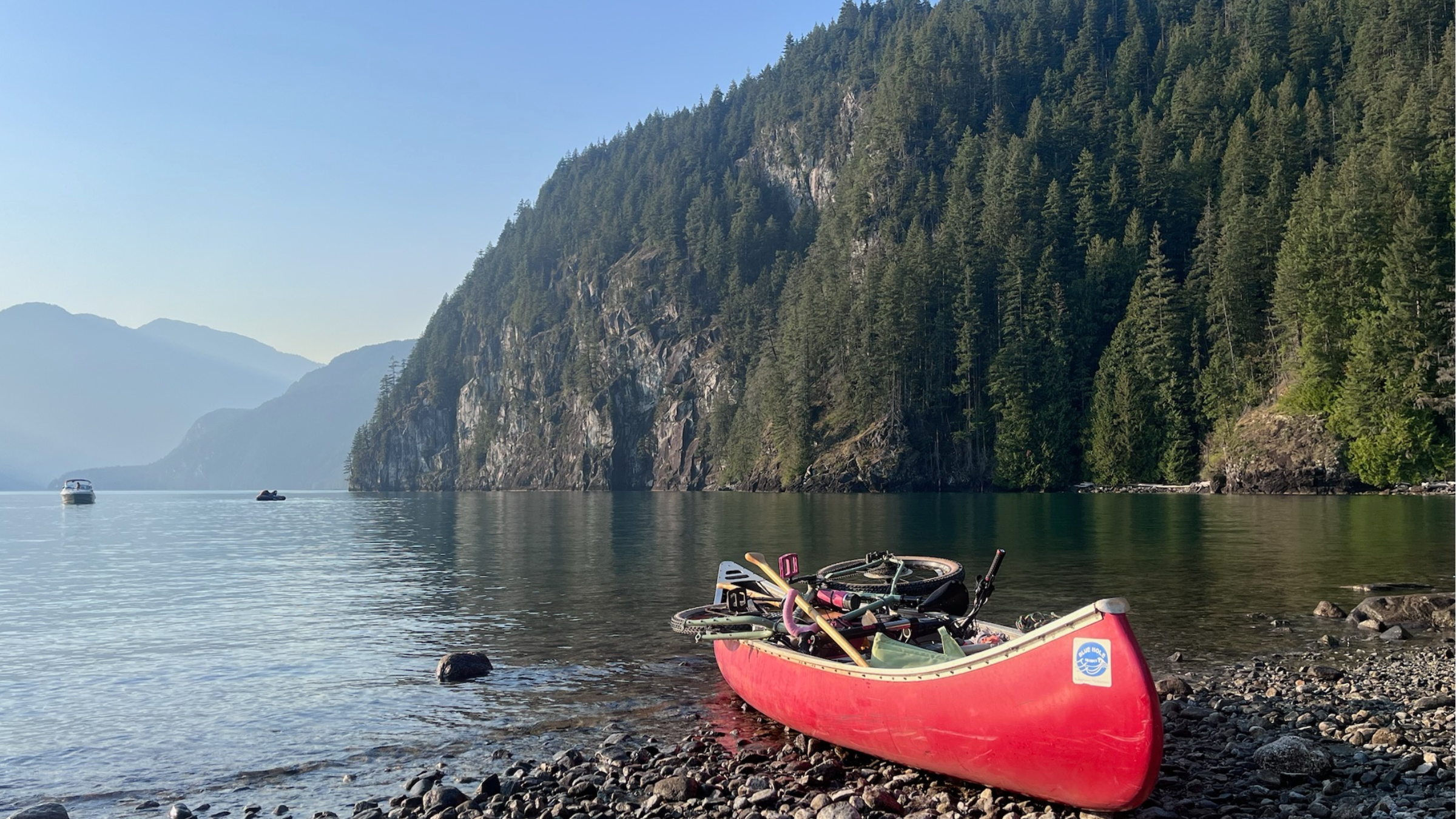
In the parking lot, I paced and huffed and smoked two cigarettes while he clipped dry bag after dry bag onto the canoe’s thwarts, and then we laid our bicycles’ frames at crooked angles over the gunwales. When we boarded, his bike’s fork angled into the convex muscle along my spine. My rear wheel pinned his knees down like he was squished into economy-class behind a reclined airplane seat, no matter which way he sat. Like this, we pushed off into deeper water.
We were still flush with new affection when he had first asked me that May to go on vacation together, the spring leaves barely broken free from their bracts. A late-summer holiday had seemed forever away. I knew that what we were building was far too new to test by traveling. And he was still married to a woman he loved. And we had promised each other that we really wanted to just be friends.
It was a promise we relished breaking. We traded links to love songs, voice memos every evening to asynchronously wish each other good night. He meticulously foraged plums and figs from Portland’s sidewalks, showed up at my doorstep with hands full of fruit, and looked at me like I was an apparition, his chin cocked to one side as though I was too bright for him to look at directly. The fruit we’d boil down into honey-sweetened jams, cooked recklessly and without a recipe, stored in jars we hadn’t sanitized. We took bets over how long what we made would keep from rotting. All of it was dizzyingly dissonant with what we were telling each other with words. This can only ever be a small romance, we always said.
It was humiliating to imagine myself falling for a man in an open marriage. But I couldn’t help but try to buffet my chances, consumed as I was by his sweetness, as well as my fear of what it might come to mean to me. I grew superstitious; I began to compulsively track our astrology. For the first time in my life, I started pulling tarot cards. I never drew the Fool, but I obsessed over him. The archetypal Fool is a type of “wonderworker”—someone who practices abstract magic, or experiences states of madness in order to affect the material world. In some tarot decks, the Fool has a small bundle of possessions, representing the untapped collective knowledge. But others show him walking toward a precipice, as though to say that there are moments a person must forfeit everything they once knew and abandon steady terrain in favor of freefall. The outsiderness of this divine madman shows the layman that society itself is a game—anything can be subverted, invented, rendered anew. Through even a temporary state of insanity, the Fool invites a radical change in perception that can illuminate a way of moving from what is toward what could be, long before the contours of what’s coming have begun to flicker on the far edge of one’s awareness.
And so, when my lover suggested, six weeks into our courtship, that we might plan a holiday together, I balked—but I was greedy to find out what I could get away with. I pitched a trip to Pitt River Hot Springs, British Columbia—a trip that had, for years, been the crown jewel of my bad-idea bucket list. It would have been a ludicrous undertaking even with someone I hadn’t recently begun to date: thirty-four miles of round-trip paddling across Pitt Lake, followed by a twenty-eight-mile bike ride through an active logging area, and finally, a forty-foot climb down a perilous cliff, all to access a tiny pool of warm water cut into the glacial river’s bank. He was only several weeks out from a badly broken collar bone. I had just been diagnosed with a tear in my shoulder’s labrum. He didn’t know I’d never paddled any type of boat before, or that I was chronically seasick, including occasionally on land. None of this seemed to matter. He agreed to the trip immediately.
Pitt Lake is one of the largest tidal lakes in the world, I learned once we finally looked it up. It has a ten-foot tidal range. I didn't know quite what this meant, and the internet forums I eventually scoured were no help—the tide gauges were too far downstream to be useful. But I did learn that the lake basin was ferociously windy, and that its depths (459 feet) and length (17 miles) meant it had massive waves, and that because of this, and the mysteriously rising tides, it is a notorious Search and Rescue hotspot. Plus, I had read the lake was haunted. In the early 20th century, someone had published a treasure map that promised gold deposits along the lakeshore. Year after year, prospecting men, consumed with a desire for wealth and glory they must have known they'd never have, struck out for the lake and then vanished. Over the span of a century, nearly every miner that took on the treasure hunt was lost to the trees or the tides.
It was difficult to know how to account for these bad omens as we made plans, but we tried. We budgeted food and fuel and wine for twice as long as we figured we needed. We made a shared Google Doc containing excessive emergency management plans. But it’s hard to know what to do with the unknown unknowns when you don’t yet understand what you’re dealing with.
Before him, I had never dated a married man. I told him at the beginning I wouldn’t stay if their marriage were to end. He assured me it wasn’t going to. Each of us was wrong. By August, their vows were unraveling. Tending his new wounds, my affection only amplified.
We were fools. And like fools, we worked ourselves up into our first relationship-defining fight days before we were due to leave for Pitt River. He and his wife had finally agreed to divorce just two weeks before our scheduled departure. Her idea, and not because of us. It was an ordinary unhappiness that they’d tried to resolve with extraordinary relationship structures; never mind that opening their relationship had seemed to everyone but them clichéd and bound to fail. His flushed face on my lap days after they had decided, he said between sobs he thought he needed to be single while he grieved. But there was something here worth sheltering. I can’t lose this relationship, too, he repeated, like a spell, until eventually I agreed.
Until then, I had always held the more fragile position in our courtship. For years, I had been sick with a cocktail of chronic symptoms that eluded being named. In our pre-first-date text exchange, he had told me he was a doctor; his specialty was in the kind of condition I thought I probably had. On the April Fools’ Day that we met, he had traced his finger along my ruined muscles while reciting the polysyllabic names of the treatments he said he could guide me through, his nail dragging up my lower trapezius, my levator scapulae, and the sternocleidomastoid in my neck, until his hand was cupping my face, and he leaned in to kiss me.
"If you treat me like this, you're going to turn into someone I need," I remember whispering to him from across his mattress on our second date, after I had partially dislocated a rib and had a panic attack. He held my face between both of his hands and breathed in slow rhythms with me until my heart rate settled, and then he asked me to stay the night, his unexpected answer inverting everything I had come to understand about love’s incompatibility with sickness.
My body registered his diligent witnessing as a threat, until it didn’t. Where at first it felt like he wanted me as a hunter wants its prey, I eventually gave in to the thrill of being wanted. I learned to reciprocate the steady routine he made out of his care for me. As my armor eroded, I became insatiably hungry—for his adoration, for the me that it revealed. In spite of our mediocre efforts, the relationship had ballooned in importance, and neither of our lives were equipped to contain it. We hurt each other just by turning into people capable of hurting each other, and we were fools for having done this, too.
We agreed that our relationship was doomed. But we decided we could go on lying for a while, as though it wasn’t: We would stay together. We would learn to live with our uncertainty. We would carry out our scheduled canoe trip.
“The genius of the fool,” Enid Welford writes in The Fool, “is manifested by his power of deluding us into the belief that he can draw the sting of pain; by his power of surrounding us with an atmosphere of make-believe, in which nothing is serious, nothing is solid,” and the otherwise iron network of consequence “seems—for a moment—negligible as a web of gossamer.” I believed that while one hand was tugging at the loose end of the gossamer thread, the other was busy stitching a new web. Maybe the best way to protect myself was by sticking my neck out, I reassured myself again and again.
Heartbroken as he was, the summer had left us feverish with fear and heat. I flushed when he cupped my face with both hands and told me over and over that he only wanted me, even though it was a claim I’d had to beg for, spoken in words I had offered up like the lines of a play before demanding he repeat after me.
We set out from the south shore’s boat launch just after noon. The headwind was tremendous. The paddling was hard, and the cortisone shot that had numbed the pain in my shoulder through the bulk of the summer had very recently worn off. A sharp pain that felt like a nerve had snagged on a splinter coursed across my ribcage with every oar stroke. For over an hour, we struggled through the wake of jet boats, yet the boat launch seemed to remain a stone’s throw away. At one point, we watched a pair of seagulls match our pace as they walked the nearby boardwalk. Finally, we turned the corner around the broad sandbar that punctuates the bottom bracket of the L-shaped lake from the rest of it. The winds vanished. The tide changed, or else became less prominent. The water glassed over, aerated waves giving way to indigo ripples, clear as cut crystal. We eased our rowing and cruised into the wide blue yawn.
We were mostly silent as we paddled. Because he sat behind me, steering the boat from the stern, I could not obsessively track changes in his expression for flashes of what I usually liked to imagine was happening inside his mind—how he could look straight at me when he was sorry or scared, but was unable to make eye contact if there was something that he wanted, his avoidance stitched in just over the place where his smile lines softened. A few times, I pulled out my phone to take a selfie; every time, I saw him blurry in the background, looking away. All day, he never took even a momentary break from paddling. I chose to read his restlessness as care for me, and not pent-up resentment over everything.
We had heard that it was best to hug the east side of the lake, and that eventually, after eight miles of paddling, we would arrive at an established marine camp—although we did not know what it would look like, or whether there would be any visible signposts to assure us when we had arrived. But the shoreline, we saw now, wended horribly eastward into a gaping bay. It seemed more judicious to cut closer to the middle. We agreed we’d probably save time this way.
An hour passed, and then another, as we slowly zigzagged from right to left, unable to mitigate the drag and redirection caused by the hundreds of pounds of gear we had lugged into the canoe. Our pre-planned campsite was a mile or so beyond an island near the middle of the lake. We had been aiming for the island for more than two hours, and it looked hardly closer than before. But we were ignorant to our eyes’ terrible failure to acclimatize to the lake’s size. We believed we were two hundred feet or so away, tops, from the shore, when in fact we were more than a mile from either side.
Eventually, the light tipped behind the mountains. We had to bail toward land, and fast. But now the section of the east shore closest to us was strewn with cliffs. It was clear that there was nowhere for us to dock there. The more distant west shore had smudges of gray that looked like beaches—within the tidal range, surely, but good enough for us to drag up the boat and find a lumpy place between some trees to rest our heads for a few fitful hours, we agreed. We turned left, and paddled hard. Now that the day was dimming, we could see the full extent of our foolishness. Neither of us said what I knew we both were thinking: we had been idiots to believe that we could pull this off.
The light faded. The wind picked up. As the air grew cold, what had at first appeared as watercolored greens and browns began to sharpen into a cedar-lined shingle beach. After an hour, in the final moments before daylight gave way to night, the canoe’s bottom scraped the lakebed. Bow-legged from straddling the bike for so long, my lover climbed out into the knee-deep water and pulled the canoe by the hull handle until it was in shallow-enough water that only my shoe soles would get wet when I disembarked.
I stood and scanned the tight-knit trees for any opening. My eyes caught on an unexpected red, like a slash of paint across the dim dusk light. I laughed. “It almost looks like a sign,” I said, pointing. He squinted and then shouted. “Holy shit.” We looked at each other, wild-eyed, then jogged a few paces along the shore. It was a sign: Dark Creek Marine Camp. Little did we know, it was one of only two campsites anywhere along the lake's eighteen-mile-long west shore.
We ran, stumbling over rocks and roots. Behind the sign was a trail, its duff surface springy and perfectly smooth. We galumphed through the old growth, totally dumbstruck, as the trail contoured back toward the water and then opened into an expansive campsite, one side backed by the woods, the other open to the quietly lapping water. As we stood shoulder to shoulder, watching the final beams of the bruise-blush sunset explode above the mountains on the far side of the lake, everything was suddenly scrambled, and in the same instant, recongealed, an electric thrill humming over everything as though I was coming up on psychedelic drugs. Dumb luck, I understood then, is when luck makes you feel stupid. I felt like a planetary novice, an infant, a first-time participant in the world. My disbelief at this unexpected outcome imbued our surroundings with a sense of extravagance, everything more terrific than whatever I’d thought I had been waiting for. In my not-knowing, I had carved out a great space that could now be filled with surprise. This delight was greater than it would have been if I had acted out of confidence. The necessary magic had occurred: our self-romanticizing, our delusional thinking, our feigned innocence combined with our actual naïvetés, our plotting and practicing, our wrongness that was also an openness to being wrong—it had recontextualized the world, and in its recontextualization, I could now push off from what I thought I knew to what I had not yet thought. Maybe things could turn out better than even we, in our stubbornness, had expected them to be. There were possible endings that neither of us knew how to expect.
The rest of the trip was as easy as a dream. The steady pace of the canoe turned out to be more pleasant than punishing. It allowed me to pay exacting attention to everything—stacked granite all around us, maples just starting toward autumn, green light shafting through the water, tides turning and then turning back.
On a notoriously choppy lake, we had four days of glassy water. We never mistakenly tipped our bikes out of the canoe. We met a family of mink scooting along a cliff, then found several hundred sockeye in Pitt River. For two days, we had the hot springs to ourselves. We had prepared to be out for a week, but instead had finished the mission in four quick days. We had been exceedingly kind to one another; best of all, both of our shoulders had felt mostly fine. He has never seemed as precious to me as he did when, eyes gleaming as the lake receded into the rearview and we pulled out of the boat launch parking lot, he said it was the best trip of his life.
We left the trip enduringly dewy-eyed. The structure of our relationship that had so recently been cracked open now seemed to have settled back into place. He told his parents about me. He moved into a new apartment on my street.
The illusion that we could overcome our odds did not falter immediately. Another season passed before neither of us could ignore the overwhelming evidence that our relationship had run its course.
I tried, in the altered-consciousness-days after we broke up, to write a narrative of our relationship that could hold its contradictions and complexities better than I could. As winter steeled and then softened, I came back to the draft again and again, desperate to find a way out of the real-life version of the ending. In doing so, I had entered into another Fool’s fantasy. For months, I cut, copied, and repasted, deleting every moment where I was still sidestepping reality, still refusing to learn my lesson, places I was pretending I wasn’t grateful to have been changed. Spring came again. By then, I had trimmed out all the paragraphs where I was still hiding from myself, and this is what I was left with.
Under his gaze, everything I had been afraid to look at was re-rendered, resplendent. In July, once, when we were hiding under his awning from a thunderstorm, I had asked him whether he thought I would ever get better. He folded his hands in his lap as he looked out into his sodden, sun-browned lawn, and told me no, he didn’t think so. And then he looked at me, smiling the same white-bright smile he always wore with me, like I was unbelievable, like the pain I was so ashamed of didn’t change his ability to care for me. I recounted the scene on his porch in my head like it was a benediction, like it was a way out of myself. Over time, under the weight of his unflinching witnessing, my intense pain slowly lost its fangs. It became diffuse in his presence, like bouillon watered into the background-noise of broth.
I had obsessed over the Fool for a full calendar year—had pulled the cards and read the stars, picked flowers and pickled fruit and paddled across a lake and back for him—but I had missed the crucial teaching. The Fool doesn’t promise clarity, but difference.
Susan Sontag wrote in Illness as Metaphor that the fever felt in tubercular consumption—the romantic’s disease—was a sign of the "inward burning" of ardour, a yearning forceful enough to lead to "the dissolution of the body by the disease of love,” as though one’s cells could be stretched and splayed by the magnetic pull of another. I had thought that all-consuming limerence was the closest I could get to sweetness; I had believed that my overwhelming sickness might preclude new possibilities for love. But I had been wrong, and wrong again; it seemed, when everything was over, that consumption was not the illness, but the cure.
Only now can I see the Fool’s importance for what it is: that even a temporary madness can trick you into changing in ways you might have otherwise liked to avoid. We didn’t know, couldn’t know at the beginning, exactly how our relationship’s inevitable demise would occur. And how courageous one can be when they don’t yet have an ending in mind.
Comments
1 comments have been posted.
Astra, what a wonderful essay! Love, Sarah
Sarah A Rushford | February 2026 |
Add a Comment