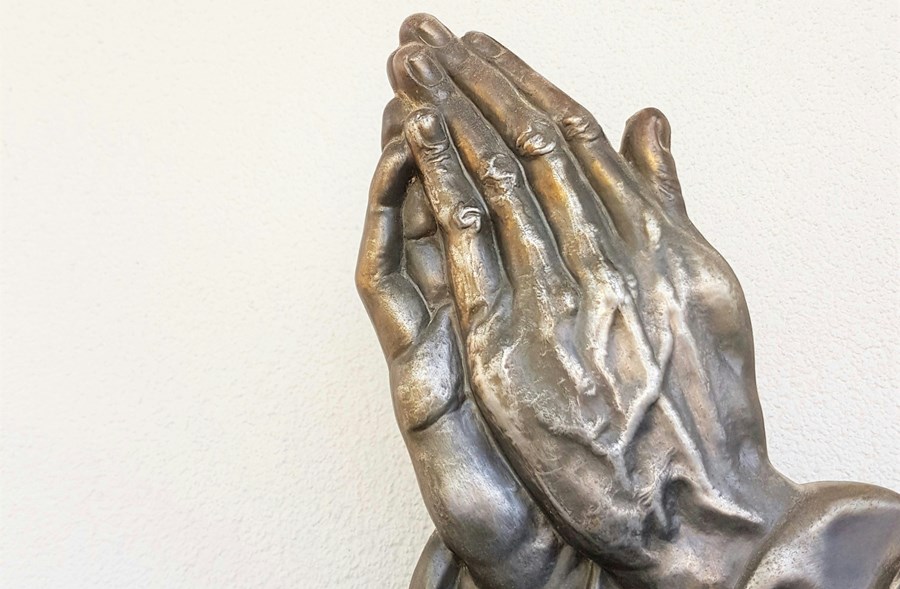
Let it be known that I wanted to feel God.
When I was young, and my grandmother would take us to church every Sunday, I used to take my shoes off, desperate to be closer to God. I was sure he was there—everyone else in the room seemed to feel him. I valued belief over most everything back then; not because I was overly interested in death or sacrament, or even heaven, but because I wanted so much to be a part of the group. I wanted to be so certain of something—of anything—as they were of salvation. For Christmas the year I turned seven, my grandmother gifted me an embossed Book of Mormon.
I’ll admit to being underwhelmed by the book right from the get-go. My name, embossed in what my grandmother still insists was “real gold,” sat prettily and awkwardly in the bottom corner of the cover, but the ‘i’ in my first name had already started to peel away from the boring brown pleather binding the pages. Even at seven, the gesture felt hollow and foreign, like when charities brought new dictionaries to hand out in my first-grade classroom. What we had needed and had asked for were snacks and scissors and new crayons to replace the broken ones in our craft buckets, but we were told that the adults knew best. I read my dictionary front to back, eyes glazing over colors I couldn’t imagine—cerulean and tangerine and amber—and I wanted the crayons more than ever.
Still, I pushed forward, sure that faith lingered just around every corner. Every Sunday, without fail, I would be in the pews, squeezing my eyes shut, sure that I could strong-arm God into enlightening me, feet bare and sprouting gooseflesh. And every week, as I searched desperately for his word, the hymns would start. I could feel the ground vibrating, beautiful voices rising on top of each other. I remember thinking that this—the feeling of voices so drawn together that they make the very Earth shake—was God.
But I knew that couldn’t be true. I knew that God was supposed to come to me, ethereal and mystical and only half-there, to make me feel small and humbled in his glory. God couldn’t be other people, even when their voices sounded holy. They somehow made me feel taller, like standing with them might make me holy, too.
I knew better than to voice these concerns to my mother. My questions tended to cause her distress—like the time I asked if bugs went to heaven, and why not, and whether I would still go to heaven were I turned into a bug. My teachers, well-versed in the right way to describe such dispositions, called me an “old soul,” which amplified my perpetual feeling of being out-of-place. My mother smiled when they said this, but often grew exasperated with my seriousness and moods, which could be unpredictable. I knew, even at eight, that there were parts of my personality that my mother found intolerable, and that this question—of whether I should be expecting revelations any time soon—would be considered another indisputable example of my oddness. Instead, I held my dread in my stomach like a cement secret, unsure how I would even describe my own wrongness if I had someone to describe it to.
Even now, years past deconstruction, I sometimes wonder what it was about me that made me unredeemable. Or, worse, what it was about me that made me not worth the effort of redemption. Vestiges of my religious socialization are sometimes so subtle that I miss them altogether. Over the years, I have replaced the word “holy” with “kind,” but the discussion I am having with myself remains constant. I am not enough of the one thing I’d like to be. I am too much of everything else. The choir is singing, but I am always out of tune. I have the rhythm wrong. They keep changing the words.
The first thing I ever really knew about God was that he was absent. My mother wanted to be a pilot. She knew how to fly before she got to high school, spending long afternoons in the cockpit with my grandfather. For her, a small-town girl from Rogers, Arkansas, the Air Force was a gleaming exit sign—a chance to see a world she had only read about. When she met my father—fresh out of the Navy, with the scars and stories to prove it—a different sort of exit sign materialized. In the end, when it was time to leave, she went with him. I came along not long after, while my mother was still younger than I am now. By then, she was beginning to see the parts of my father that were ill, but she stayed anyway. God was not in the room when they met. God was something my father chased and lost at the bottom of bottles.
In one house we lived in, the kitchen was rotting out. It was boarded up, useless. For an entire year, we cooked on hot plates in the living room. I don’t know if you’ve ever had a year of hot-plate-friendly meals, but it isn’t exactly a varied diet. When it got boring, my sister and I used to pretend we were camping, toasting s’mores by a flickering flame instead of by the sometimes-light of a sometimes-paid electricity bill. I didn’t have many friends at my school—one of dozens over the years—and the ones I did have were upset when I refused to bring them home for sleepovers. I did not find comfort in God in that house. By then, I knew God was a light that only sometimes came on. Instead, I read fiction. My mother would walk me to the library in town every single day, and I would pick out a new book, finishing the whole thing in one sitting. In those stories of resilience and hope and love, I began to look for the things that defined me—I began to seek out my own stories.
When the power went out for three days during a snowstorm and we didn’t have the money to buy a generator, I did not pray. Instead, I curled into my mother’s side and listened to the sound of her reading out loud to me, lit by a candle and warm to the touch. I didn’t feel God in the room, but I felt my mother and I thought of design. My grandmother believes that we are designed by God and in God’s image. Does that make my mother God? If all the people I love are also made in the image of God, then I suppose their features are merely his features, refracted like light through a shattered window.
When I was seven, I watched my father assault my mother in midday traffic. I held my hands tightly over my little sister’s eyes. I didn’t scream. I didn’t say a word. Even as tears welled up in my mom’s eyes, I didn’t move a muscle. Cars drove past, and drivers did double takes, but not one of them stopped. When my father finally stopped, laughing, I smiled, too. He said it was a joke, so I laughed. We all did—even my mother, her voice scratched and quiet.
A week later, riddled with guilt, I tattled on my father for the first—and only—time in my life. I was terrified; at the time, I believed wholeheartedly that my father was my God on Earth. I sang about it weekly in Sunday school, and I believed my soft-eyed youth leader when he said that my father’s power was absolute. Still, when my grandma asked if there was anything wrong, I broke down. I told her everything, and watched her knuckles turn white where they gripped the side of the sofa.
That night, when my father came to get me, there was a fire in his eyes that sent chills running down my spine. I knew I had broken our most important rule—silence—and that I was about to pay dearly for it. My father never hurt me, really, but there was always the unspoken threat: I knew what he was capable of. If he could punish my mother that way, I knew I was never entirely safe.
I was surprised when, instead of yelling or throwing something, my father smiled. He reached into one large coat pocket and pulled out a Butterfinger (my favorite, always). When I looked up at him, afraid and wildly confused, he grinned at me, conspiratorial. “You made a mistake, Mouth,” he whispered—that was my nickname then. “I know you didn’t mean it. Just remember, Hailey—our business is our business. It should never leave our house.” He paused, and his face shifted, just for a moment, as he grit his teeth, repeating himself. “Never.”
That night, hours after I’d been tucked safely into bed, I threw my Book of Mormon in the garbage. I thought that maybe God was dead, or blind, or stupid. I knew that he was cruel.
Ironically, God has spent the rest of my life appearing in rooms I didn’t invite him into. Refusing to believe in salvation did not free me from the fear of damnation. The night my father died, in a bar fight in Kansas City, I felt a dull relief radiate through my body. I prayed for his soul, but all I heard was my own heartbeat in my ears, defiant, screaming: I survived.
The first time I heard the word dyke, someone I loved was throwing it across a gas station parking lot. It tasted sour, coming from a usually kind mouth, and it struck dead to center. The two women—the targets of this unfamiliar fury—broke their momentary embrace, jumping apart as if pushed. I was wide-eyed in the backseat, my hands resting on the half-open window. I didn’t know what the word meant, or why it mattered, but I knew that these women were special. My heart, typically still and obedient in my chest, fluttered at the sight of their cropped hair and clunky boots, the way the meaner-looking one put one finger up in the air and spit.
After I kissed a girl for the first time—in the bathroom of my high school—I skipped my last class to go to the grocery store. God followed me out. I bought a variety pack of popsicles and ate all three cherry ones in the parking lot. I threw the rest away and stayed until the sun went down. I thought about Hell.
The first time I was called a dyke, I was in the ninth grade, crying over my best friend’s bruised cheekbones. He was in love with a football player and bad at taking advice. He had an infectious and enviable ability to see the world as something better than it was: a world where the gay kid slips a love note into the quarterback's locker and emerges unscathed. When they found us, I was dabbing the dried blood from under his nose. I planted my feet and scowled. The boys tossed the word at my feet, and unbidden, the image of the woman at the gas station flickered in my vision. I thought of God and all the rooms he never showed up in. I thought about the places I’d seen people go trying to chase him.
I thought of the places he’d left me stranded, and that I’d escaped from anyway. I wondered whether I wanted a love like his—a dead God cremated in Kansas City and an absent, violent father waiting in eternity. I thought of Mary, her feet bleeding in the desert for a thousand miles. I thought of Ruth, and of my sister. In a dream, I pulled the Book of Mormon out of my bedside table along with a jar of my father’s ashes, and I put them in a box. I brought my sacrament to the cemetery, and I buried my two Gods there, in the cold, hard dirt.
Comments
2 comments have been posted.
I honor you, Hailey, for sharing your story. I honor you for speaking what has been a reality for you. I so deeply apologize for the emotional and mental anguish you've experienced during your lifetime. I am well familiar with having expectations of others to only be let down and disappointed. As human beings, that shall always transpire. The greatest joy and the greatest pain come from the same place... people. The unfortunate reality is EVERY single last person on this earth's lived life is carried out from a place of hurt and pain. Those hurts and pains is what then shapes us into 'us.' Then behaviors and beliefs ensue. I look forward to one day meeting your acquaintance and hearing more of your journey. My own journey and experience has been the opposite. God is a VERY present and loving Abba (Father). He's not the One people projected upon me and told me I should glorify from their ideology. He's the one I've come to experience and know for myself..... 😘 I AGAPE YOU! 🩷
Tamika L Herbert | November 2025 |
Lovely read speaking to the problem of a generation stuck in the abusive maelstrom between God, Father and self. Where is God? Why is my father like this? Who am I? Thank you for talking about these things and opening up. I am happy to admit that this spoke to me. I can say with full confidence that what you have written here has changed my day. Those of us lost between these questions sometimes need to be reminded that we are not alone. For this, and from the secret place in my heart that I keep away from the world where I can speak without fear, thank you.
Jesse | November 2025 |
Add a Comment