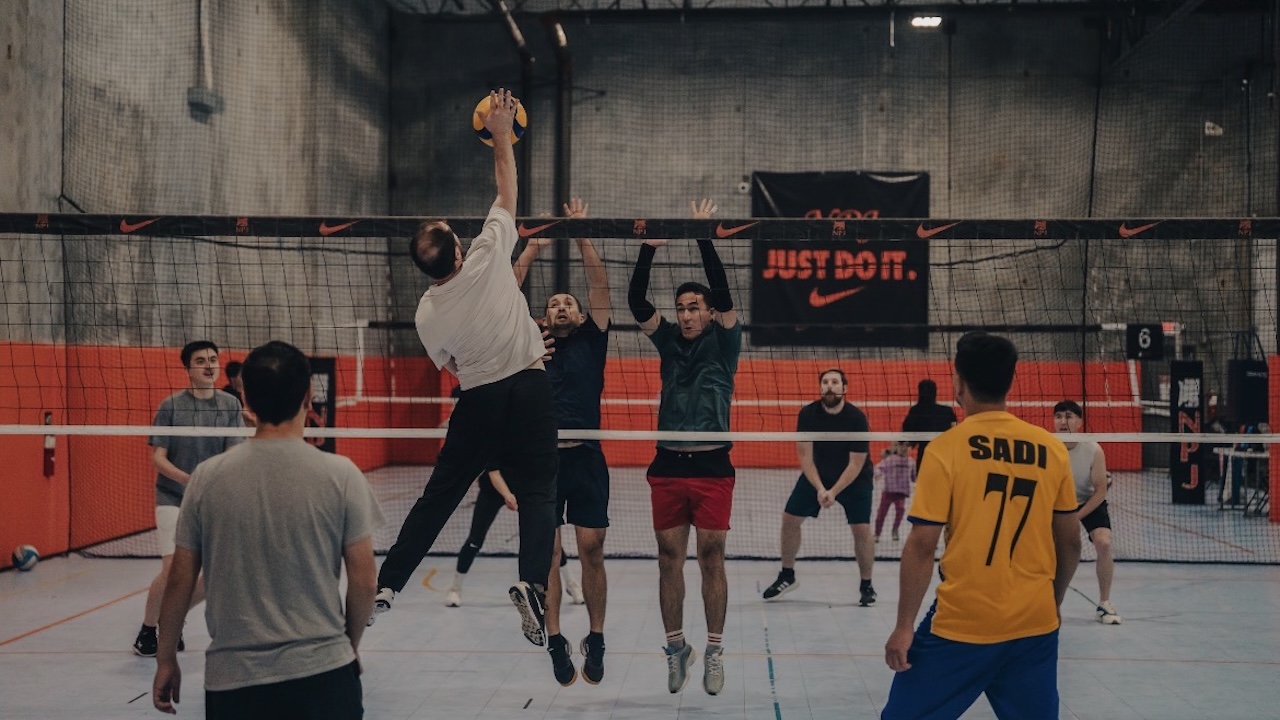
On a breezy afternoon at Bush’s Pasture Park in Salem, a group of Afghan men and women stands around a portable volleyball net, debating whether the ball landed in or out.
One player points toward the grass where he insists the ball touched the line. Another laughs and shakes his head. Someone jogs to retrieve the ball while a few others wait along the sideline, hoping to join the next game.
There’s no referee, no scoreboard, and no real urgency—just the rhythm of the game and the familiarity of being among people who understand one another. Everyone at this weekly game knows how it feels to be forced to flee your home and rebuild your life in a new place, many thousands of miles away.
In August 2021, Afghanistan fell to the Taliban in a matter of days. The news quickly spread among Afghans all over the world.
Videos and messages arrived one after another: Crowds running alongside airplanes, people pressed against Kabul airport gates, helicopters circling above government buildings, soldiers laying down their weapons, and people panicking. For many watching from afar, the scenes felt impossible. A country that had seemed stable appeared to collapse overnight.
Mahdi Joya was one of those watching. He moved from Afghanistan to the United States in 2014, but he still had family members there in 2021. He remembers the emotional weight of those days.
“Suddenly, the country where we grew up collapsed in one day, and everything was destroyed,” Joya says. “Our spirits were low. Mentally, we were not in a good place.”
In the days that followed, questions came quickly: Who made it out? Who didn’t? Who was still hiding?
Within weeks, refugees began landing in Oregon. There was little structure to support them at first. The new arrivals gathered where they could, in church buildings, parks, and borrowed spaces. They brought tea, stories, and grief. Joya and his wife, Fatima Amiri, did what they could to support the growing community of refugees.
“Fatima and I were among the first volunteers,” Joya recalls. “At that time, there was no organized support, and we gathered at Salem Alliance Church. We said we would volunteer and help in any way we could with the refugees coming from Afghanistan.”
The early days were heavy. Someone would mention Kabul. Another would talk about family members still being stuck there. News updates would interrupt the moment.
Mahdi remembers seeing former members of the Afghan Air Force and National Army, once respected and secure institutions, arriving displaced and uncertain.
“Everything was destroyed,” he says. “It was especially painful to see people we were proud of . . . now arriving here displaced and confused, having lost everything. Many of their families were still in Afghanistan.”
Amid the loss and confusion, refugees in Salem found structure sharing tea. Sitting together felt natural and familiar. It would bring smiles and remind everyone how tea was the center in their home country to celebrate togetherness, birthdays, and holidays.
For Afghan women in Salem, gathering around tea became its own form of restoration, but with intention.
The “محفل چای خانم ها”—Women’s Tea Party in English—meets in homes, clubhouses, and parks. What began as informal gatherings in the early days after families arrived in Salem has, over time, developed a steady rhythm. The setting shifts, but the structure remains: tea poured into small cups, plates of homemade food and dried fruits, and women seated close enough to talk without raising their voices.
At the party, women can speak freely in Dari and Pashto, share food from home, and exchange information without rushing. In the United States, gatherings are often structured around time: An hour here, a quick check-in there, conversations squeezed between obligations. But in Afghan culture, tea creates space to linger. No one watches the clock. Stories unfold slowly.
“These tea parties create a safe and joyful space where women can come together, step away from daily stresses, and simply enjoy each other’s company,” says Sediqa Amiri, a participant who fled Afghanistan during the 2021 chaos. “We play simple games, share laughter, and exchange resources and information.”
While the gatherings are rooted in Afghan culture and centered around Afghan women, friends from the wider community sometimes join, sharing in the conversation and hospitality.
“It was about sharing Afghan culture [and] sharing American culture,” says Anya Holcomb, pastor of refugee ministries at Salem Alliance Church and cofounder of Salem For Refugees. Holcomb helped organize the party.
The information shared in these gatherings is often practical and shaped by lived experience rather than formal instruction. Women talk through how to navigate daily systems that can feel overwhelming at first, such as employment, housing, healthcare, and how to make sense of letters from schools and government offices.
Just as important are conversations about independence, especially learning to drive, which for many Afghan women is entirely new. Some describe starting from zero, having never ridden a bicycle or sat behind a wheel before arriving in the US. Others share how they balance childcare while trying to attend driving lessons or English classes.
Fatima Amiri remembers when her family first arrived in Texas from Afghanistan about twelve years ago. “We faced many challenges . . . such as finding a job, renting an apartment without credit or employment history, or opening a bank account without sufficient funds.” Now, at the tea parties, she tries to make these challenges easier for other women.
For many new arrivals, the tea gatherings were their first trusted network in Salem. Women could ask practical questions without embarrassment, reflect on what has been difficult, and share what has brought them joy. In doing so, information becomes more than advice; it becomes encouragement, shared problem-solving, and a way to rebuild confidence step-by-step, in a community rather than alone.
Jennifer Skipper, a tea party organizer, describes it in personal terms. “I don’t want any woman living in my community to be sad or lonely,” she says.
Her hope has always been that Afghan women in Salem would find not only support, but joy, a sense of belonging that goes beyond services or programs. Over time, she has watched that happen, as women began organizing, leading, and welcoming others.
Holcomb has experienced that same shift, but from another angle.
“We wanted to welcome them,” she says, “and I got so welcomed by them.”
What began as outreach became relationship.
“It’s just amazing humans that my friends are,” she adds. “I wish everybody had the opportunity to get to know them the way that I do.”
For both of them, the invitation to the broader community is simple: come close enough to see what is actually happening.
Not just gatherings, but relationships.
Male refugees in Salem also gathered over tea, but although their conversations began lightly, it didn’t take long before the mood shifted. News from Afghanistan found its way into every circle. Someone would mention Kabul. Someone else would fall quiet. The same questions circled without answers.
“Every time we sat and talked, the conversations turned political and painful, and it made us more upset,” Mahdi recalls.
Something needed to shift.
One afternoon, as the group sat with paper cups of tea in their hands, someone tossed out a suggestion, half serious, half joking: “What if we play soccer!”
A few laughed. Some shook their heads. It had been years since most of them had played. Bodies were stiffer now, energy different.
Then someone else said, “Volleyball is easier!”
The idea lingered, not just because it was easier, but because it was familiar. Many of the men had grown up playing the sport.
Volleyball was invented in 1895 and was introduced to Afghanistan soon after through schools, and it eventually became one of the nation’s favorite pastimes. One reason it’s popular is accessibility: You don’t need much space or perfect equipment to play. A ball and a simple net—or even just a rope—are enough.
Games formed quickly in schoolyards, empty lots, or neighborhood streets. The rules weren’t always official, but everyone understood the rhythm: serve, pass, set, return. It was as much about gathering as it was about playing.
That familiarity made the idea stick.
Mahdi Joya decided he would take care of it.
“I went to a sporting goods store and bought a volleyball net,” he says. “I had no experience with volleyball equipment.”
He walked through the aisles, looking at boxes with pictures of nets stretched across perfect green lawns. He picked one that seemed right: portable, affordable, easy.
The following week, the group drove to Riverview Park in Independence, near the Willamette River. The wind was already strong when they arrived.
They carried the net, still folded in its packaging, across the grass. Someone joked about how long it would take to set up. Another guessed ten minutes. But it took much longer.
They adjusted, stepped back, adjusted again.
Eventually, something that looked like a volleyball net stood between them. Someone inflated the ball.
For a moment, they paused, looking at it, not just as a piece of equipment, but as the beginning of something. Then someone served.
The ball rose, caught slightly by the wind, and dropped toward the net, and made contact.
The top cord snapped, and the net collapsed almost instantly.
No one spoke for a moment; then came laughter.
After everything they had been carrying—the collapse of the country, the distance from family, the uncertainty of starting over—this small failure broke the tension in a different way.
The following week, Mahdi ordered a professional outdoor net from Amazon, and it held.
At first, there were four or five players. Then six. Then seven. They met weekly in Bush’s Pasture Park after 4:00 or 5:00 p.m.
“The main goal of volleyball was not just the sport itself,” Mahdi says. “It was to improve our mental health. Sitting and talking too much would bring up painful memories. We thought it would be better to do something physical, something good for the body and mind.”
Mohammad Jebran Akrami is one of the weekly players. He arrived in Salem in early 2024 with his family. In Afghanistan, he worked as a security guard for a US contractor, a job that made him eligible to apply for a Special Immigrant Visa. But he spent much of his free time on the volleyball court.
“Volleyball has been my favorite sport since I was about twelve years old,” he says. “I have a great passion for it. In school, I was even a member of the national education team for a while.”
For Jebran, the game has always been tied to discipline and routine, something steady in environments that were not.
“Exercise is very important for human health,” he says. “As Americans say, a person who does not exercise is like someone already dead. It is a really wonderful program and entertainment.”
At the weekly matches in Salem, Akrami found not only a chance to play again, but also a way to rebuild social rhythms that had been interrupted.
“We gather together, check in on one another,” he says.
Reza Alipoor, another of the weekly players, followed a different trajectory to Salem, shaped by an interrupted career.
In 2021, Alipoor had recently returned from training to be a pilot in the Czech Republic, in preparation for joining the Afghan Air Force. Both he and his wife were pursuing careers connected to aviation. But before that future could begin, the government collapsed. Within a short time, plans that had taken years to build were gone.
Alipoor and his wife fled Afghanistan and resettled in Salem in May 2022. Today, he drives for Uber while considering how or if he might return to aviation.
On the court, though, his identity is not defined by what was lost.
“Volleyball is more than a sport for me,” he says, “it’s a source of learning, connection, and well‑being.”
He describes the game in practical terms: teamwork, communication, and movement. But also as something quieter.
“It strengthens my teamwork skills, builds meaningful relationships, and supports my physical and mental health,” he adds.
That familiarity matters for both men.
Not all of the regular players are men. Sediqa Amiri participates in both volleyball games and tea parties. She says joining the games wasn’t easy at first: “I was the only woman consistently playing. In traditional Afghan culture, especially in mixed-gender settings, girls are often discouraged from participating in sports like volleyball.” As more women joined, “the space felt more inclusive,” she says.
A ball arcs high over the net, spinning slightly in the late afternoon light.
“بگیر! بگیر!” Take it! Take it! Someone calls out.
Jebran steps forward, knees bent, and bumps the ball cleanly into the air.
“آفرین!” Well done!
On the other side, Reza raises his hands. “پاس، پاس!” Set it, set it!
The ball lifts again, just high enough. A teammate jumps and taps it over. It drops between two players who hesitate for half a second, each expecting the other to move.
A groan, then laughter.
“چرا نگاه میکنی؟ برو!” Why are you watching? Go!
“فکر کردم تو میگیری!” I thought you had it!
They reset quickly, still smiling, still talking over one another. The rhythm is fast, overlapping, effortless. No one pauses to search for words. No one switches languages mid-sentence. Jokes land immediately, without explanation.
For refugees navigating English documents, unfamiliar work environments, and new cultural expectations, two hours of linguistic and cultural ease can steady the week.
During the breaks, the participants take out their phones and ask questions:
“این چه نوشته؟” What does this say?
The message is from a government office. Dense English paragraphs. Official language.
Mahdi steps closer, glancing at the screen.
“چیزی نیست، فقط معلومات میخواهند.” It’s nothing, they’re just asking for information.
The man exhales, shoulders dropping slightly.
“فکر کردم کدام مشکل پیش آمده.” I thought there was a problem.
Nearby, someone else joins the conversation.
“تو بیمه موتر گرفتی؟” Did you get car insurance?
“نه، نمیفهمم کدامش خوب است.” No, I don’t understand which one is good.
Another voice cuts in, casually, like this is a conversation they’ve had before.
“برو پیش فلانی، ارزانتر پیدا میکند.” Go to so-and-so, he finds cheaper ones.
The ball is tossed back onto the court, but the conversation continues for another minute, overlapping, practical, and familiar.
Questions move quickly:
How do you buy a car? What is insurance? How do you get a driver’s license?
But on the sidelines, it doesn’t feel like guidance. It feels like a conversation.
No one writes anything down or formalizes the exchange. The information moves the way it always has: person to person, story to story.
“The goal expanded,” Madhi says. “It was no longer only about distracting ourselves, but about helping newcomers adjust to life here.”
Someone laughs. Someone calls for the ball.
The game resumes.
What exists here has no office, no official name, and no walls.
But for many, it is the first place they come when they don’t understand something, and the first place they leave with an answer.
As the volleyball gatherings have grown, so has their reach.
What began as a small, Afghan-led space has gradually opened outward, creating points of connection with other refugee communities in Salem. Ukrainians who have fled their own war-torn country now play at the same facilities, sometimes alongside Afghan players, sometimes in parallel.
There are not yet cross-national competitions, but there is a quiet openness, a shared understanding among people who have experienced displacement, loss, and the many challenges of starting over in a new place.
Mahdi is clear about the intention behind the group: “Everyone is welcome,” he says. “The goal is community and sport, not exclusivity.”
What is being built in Salem is not just a volleyball group, but something more fluid, a network of communities, expanding slowly, connected not by structure, but by shared experience.
Since 2025, shifts in US immigration policy reduced refugee admissions and scaled back federal support for resettlement infrastructure. While some programs have since been restored or expanded, uncertainty continues to shape how organizations plan and how communities prepare for the future.
For groups like this one, that uncertainty is not abstract. Funding can affect everything from access to gym space to broader resettlement services that many families rely on.
Luke Glaze, from Salem for Refugees, acknowledges that tension.
“Of course, I am concerned about funding cuts to refugees and immigrants across many different types of programs,” he says. “But I also see that this, since it started as a community-led initiative . . . I really see that, despite maybe the loss of funding, the community could continue.”
What exists here was never built entirely on funding. It started with people showing up.
In Salem, belonging has not been built through grand programs alone. It has grown through repetition: weekly tea and games, reshuffled teams, shared rides, translated letters, shared laughter. While tea and volleyball may seem unrelated at first, they address the same needs: connection, familiarity, dignity, and community.
There is no fixed structure. The gatherings adjust based on who shows up.
In many ways, that flexibility mirrors the community itself, reshaping each week around who is present, who needs help, who needs rest, and who needs movement.
The country we left changed overnight, and the systems around us here continue to shift: politically, financially, and socially.
But this has held!
The first net broke in the wind, and the next one held!
Comments
2 comments have been posted.
The Afghan refugees have enhanced our lives in so many ways. In 2021 I was lucky enough to become a part of a Good Neighbor Team with Salem for Refugees. Our assigned family arrived with 9 people and in April of 2022 welcomed their 8th child., becoming a family of 10. Three years with the same family led to many culturally rich and heart-warming experiences. Although our family eventually moved to Sacramento, they continue to send news and all of our team members are so happy to hear of their progress.
Lynn Albright | August 2026 | Salem OR 97302
Mohsin's story gives a rare glimpse into the lives of new neighbors in our community. Despite the weight of stress and trauma they carry, they are finding ways to support each other in this land. We have so much to learn from their resilience. I hope we can welcome and support them on their path to citizenship.
Barbara Curtin Miles | May 2026 | Salem, Oregon
Add a Comment