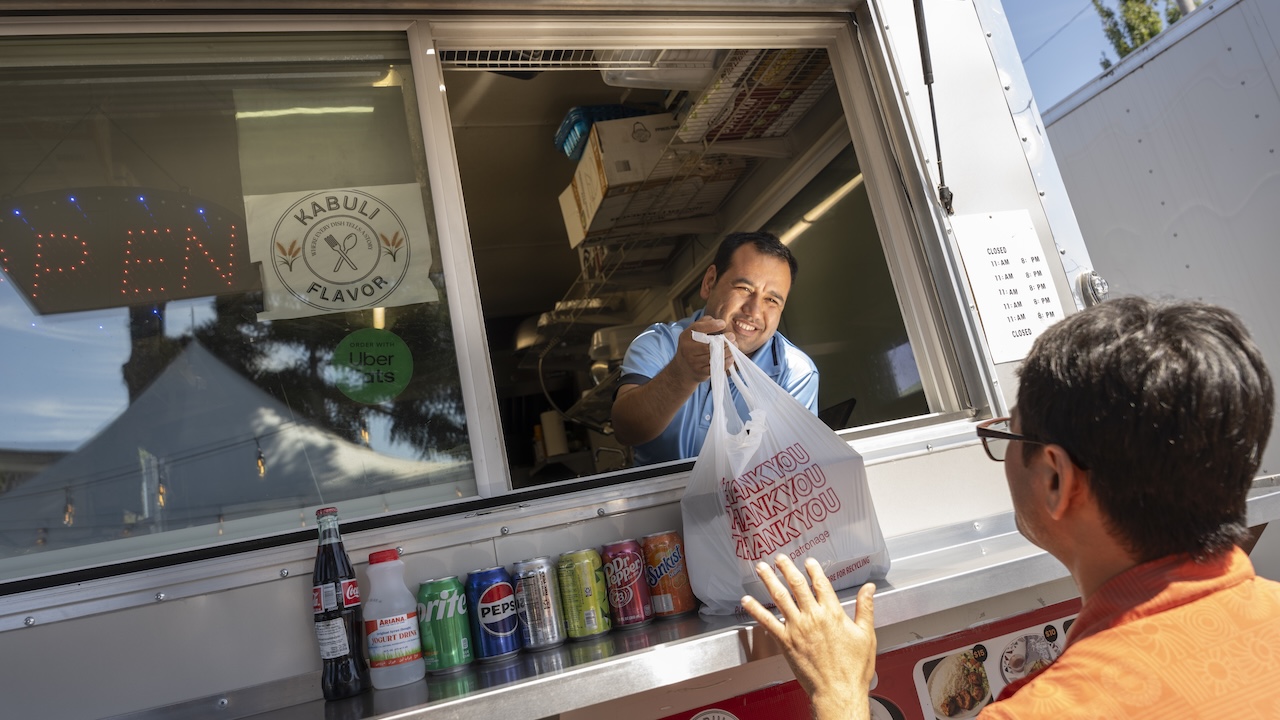
On Saturday mornings, before Salem had a grocery store or a food truck devoted to Afghan food, many Afghan families living in Oregon’s capital pointed their cars north every weekend.
The drive to Portland took about an hour each way, longer if traffic thickened near Wilsonville. Before the trip, families carefully scrawled their shopping lists because forgetting one ingredient—a bag of rice, a package of dried mint, fresh naan, halal meat, or the spices needed for a family dinner—could mean another week without it or another trip up Interstate 5.
Those drives became part of settling into Oregon for families rebuilding their lives after the fall of Afghanistan in August 2021. Parents planned around work schedules. Children climbed into the back seat, knowing the outing would consume much of the day. They returned with coolers and grocery bags packed tightly in the trunk. The grocery run brought more than nourishment: it was routine, memory, and home.
Today, many of those same families stay in Salem. They stop at Global Mart for their Afghan rice, tea, and fresh bread. A few minutes away, customers line up outside Kabuli Flavor, where the aroma of bolani browning on the pan mingles with the steam rising from trays of qabuli palaw. Instead of spending an afternoon on the interstate, they have time to reminisce and catch up with their neighbors.
The change feels almost ordinary now, but it was never guaranteed. Salem’s Afghan community had to rebuild more than homes after the fall of Afghanistan. It had to recreate the everyday places where people could find familiar food, share a meal, speak their own language, and see someone they know.
Two families filled that gap by building a grocery store and turning recipes learned from a mother into a food truck. Their businesses gave Salem’s growing Afghan community not just food from home, but places where home could begin to feel close again.
A bell chimes as the front door of Global Mart swings open. Inside, the store hums with the quiet rhythm of a neighborhood market. Refrigerators line one wall, and shelves are stocked with products from Afghanistan, Central Asia, and the Middle East. Twenty-pound bags of rice are stacked neatly near the freezers, and boxes of black tea sit beside shelves of dried beans, canned vegetables, and jars of honey. Bright packages of chocolates and biscuits fill baskets near the register, catching the attention of children while their parents compare different brands of rice.
A man reaches for a package of saffron before deciding to take two, and an older woman pauses in front of the bread cooler. Near the spice aisle, a young American couple studies unfamiliar labels before turning to the man behind the counter.
Mohammad Yonus Ghaznawi smiles. "What are you making?" he asks.
The couple tell him they are cooking Afghan food for the first time. He walks from behind the register and begins explaining the difference between two varieties of rice, describing which one works best for qabuli palaw. Before long, the conversation shifts to tea, then bread, then the meals he remembers from childhood. It is a conversation he has had many times.
Ghaznawi says many of his customers are Americans who come because they want to try something new. Some ask how to prepare dishes they've never tasted. Others return after discovering Afghan cuisine at a friend's dinner table or a community event.
The store gets busy in the evenings. People greet one another in Dari or Pashto before switching effortlessly to English. People come for groceries and stay for conversation.
Afghan hospitality revolves around food. Guests rarely arrive without being offered tea. Family celebrations unfold around dishes that can take hours to prepare, and even ordinary evenings often end with fruit, nuts, and conversation around the kitchen table. These traditions have survived war, displacement, and resettlement.
But in 2024, Ghaznawi and others realized Afghans in Salem risked being scattered from each other if someone didn’t bring them together over food, over Afghan culture.
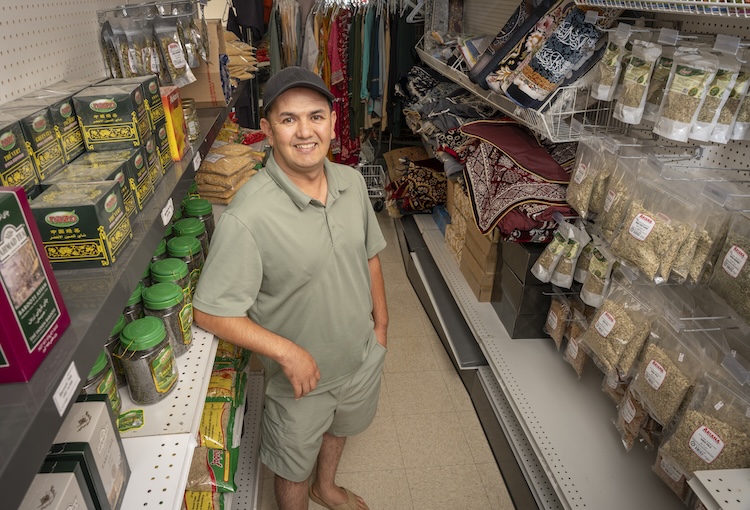
Mohammad Yonus Ghaznawi
Opening a grocery store is a difficult and risky undertaking. Ghaznawi didn’t know whether the community would support his store, but he was prepared to take the chance. It wouldn’t be his first.
Before Ghaznawi came to Salem, he worked for construction companies in Afghanistan. When work slowed, his employer cut salaries and laid off employees. He grew tired of having his income and his future depend on someone else’s decisions. He wanted control over his own livelihood, so he started a business of his own.
The gamble was substantial. With about $70,000 in grant funding and another $100,000 invested by his business, Ghaznawi built a greenhouse and chicken farm in northern Mazar-e Sharif, Afghanistan’s fourth largest city. He grew cucumbers, tomatoes, and other vegetables, and raised chickens for meat and eggs. He planned to recover his initial investment over five years.
Then came risks that no business plan could account for. Chicken farming in Afghanistan was volatile. Disease could wipe out an operation, and large, well-funded competitors had access to government contracts that gave them an advantage Ghaznawi couldn’t match. He remembers the market as competitive and unpredictable. “This was an unhealthy competition,” he says.
The business survived for about three years. Ghaznawi and his partners were beginning to find their market in 2021, when Afghanistan’s government collapsed. Ghaznawi fled to Pakistan, leaving all he had built behind. The experience changed the way he thought about his next venture.
During the eighteen months Ghaznawi spent waiting in Pakistan for the paperwork that would allow him to move to the US to be completed, he began thinking about how to build something that would not be tied to one country. He took courses on selling through Amazon, learning how to find products, work with companies, arrange shipping, and use warehouses. He imagined a business that could operate in an international market even if the place where he lived changed again.
When he arrived in Oregon, Ghaznawi initially explored selling online, but realized a warehouse would cost money without giving him a place to sell directly to customers. So he and his partners decided to open a store with an online component that could do both.
The risks were immediate. Renting a space large enough to function as both a store and warehouse meant committing to a lease and being able to cover the rent even if the business failed. Then came the licensing requirements: Ghaznawi had assumed a store license would allow them to sell whatever foods they wanted. Instead, he learned that the kind of food he sold mattered. Packaged food had one set of requirements, and meat sold by weight required another. If he wanted to bake bread, he was told he needed a special area, separate from the meat section, with its own sink. Even the products he could put on the shelves had to be identified and accounted for before he could sell them. Some licenses were still incomplete nearly a year after Global Mart opened, delaying what he could sell.
Starting a business in the US brought a different kind of uncertainty from what Ghaznawi experienced in Afghanistan. There, he worried that disease could destroy a chicken farm or that powerful competitors could squeeze him out of a market. In Oregon, the risks were easier to see but came with their own maze of rules, rent, and paperwork. He had to learn which products he could sell, which permits he needed, and how the American system worked. What carried him through was the experience of having started from nothing before. He wasn’t certain it could work, but he was willing to find out.
When we spoke for this story, Ghaznawi told me Global Mart wasn’t yet profitable. He said he and his partners hadn’t expected it to be profitable in its first two years.
“We aren’t here to make $120 [a day] from here,” he said. “Our goal is to learn the system and grow bigger.”
Initially, Ghaznawi stocked the store with with Afghan foods, dried fruits, and halal meat—goods that he believed would give the store a natural entry into Salem’s Muslim and Afghan communities. But he also wanted Global Mart to become something larger than an Afghan grocery. His goal was to bring in products people couldn’t easily find elsewhere, including items from other Asian countries. He expected Indians and Pakistanis to become some of the store’s strongest customers. Instead, Ukrainian families began coming in regularly. They like bread and tea, and bought chocolate and other sweets. Although the labels are written in different languages, many of the flavors feel familiar. He hadn’t planned for them, but he noticed what they were drawn to and adjusted his thinking about who the store could serve.
Slowly, the shelves began to reflect the community he was discovering.
Today, long-grain rice sits near lentils and dried beans. Nearby are Afghan teas, dried fruits, sweets, and spices. Refrigerators hold halal meats and dairy products. For Afghans, those ingredients can become some of the country’s most familiar dishes: Mantu, meat-filled dumplings; ashak, vegetable-filled dumplings; bolani, a thin stuffed flatbread cooked until crisp; and qabuli palaw, long-grain rice served with meat and topped with sweet carrots and raisins, a dish often associated with gatherings and celebrations.
In Afghanistan, neighborhood markets are woven into everyday life. Shopkeepers know their regular customers. A quick purchase can turn into a conversation about a friend’s graduation, a neighbor’s new baby or a family’s plans for the weekend. Ghaznawi had known that rhythm from home. He began to see it taking shape at Global Mart, too.
Customers ask whether a new shipment of sour cream has arrived or whether he plans to stock another brand of dried fruit. Parents introduce him to children born after arriving in the United States. Someone tells him about a new job. Another asks about an ingredient for a dish they are preparing for guests. Grocery bags wait beside the register while the conversations continue.
The market is becoming more than a place to buy food. It is becoming a place where people linger.
Ghaznawi pays attention to those moments. He watches which products disappear from the shelves and listens to what customers ask for. If people repeatedly request something, he looks for a way to bring it in. If a product sits untouched, he learns from that, too.
Running a business, he says, is about listening. The market evolves because its customers do.
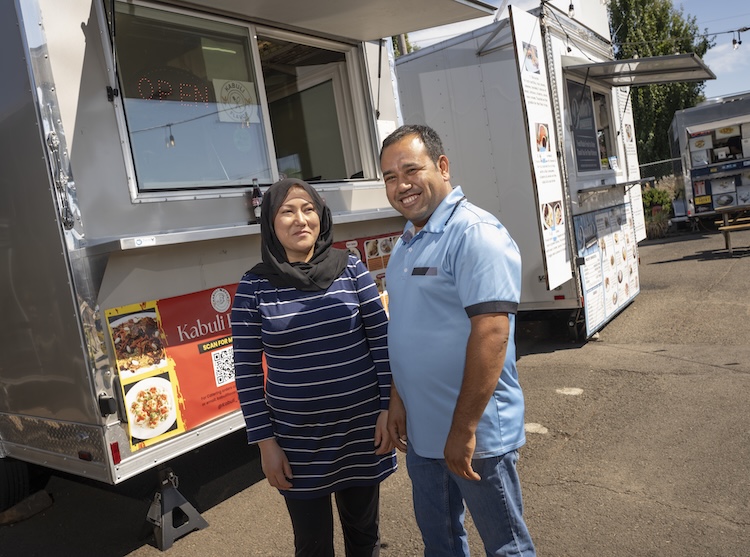
Reza and Kubra Mohammadi
As Salem's Afghan community has grown, so has its needs. Groceries are only one part of a meal. There are evenings when work runs late, when guests arrive unexpectedly, or when someone simply longs for a dish prepared the way a parent or grandparent once made it.
When Reza and Kubra Mohammadi first arrived in Salem, they were focused on the same priorities as many newly arrived refugees: learning English, finding work, and building a stable life. Owning a restaurant or a food truck wasn't part of the plan.
Like many couples starting over in a new country, they did what was necessary. Reza took delivery jobs, driving for DoorDash and Amazon Flex while the family adjusted to life in Oregon. Each day meant balancing work, language, paperwork, and the countless details that accompany resettlement.
Cooking remained something that happened at home, particularly for Kubra. She cooked the food she grew up eating: dishes made because people needed to eat, because relatives were coming over, because holidays were approaching, or because someone in the house wanted the taste of home. She wasn’t trying to create restaurant dishes, but when she cooked for community gatherings or shared meals with others, people kept asking her the same question: “Why don’t you sell this?”
At first, the suggestion seemed unrealistic. Starting a food business in a new country felt like another mountain to climb. Reza was working other jobs, and neither he nor Kubra had experience running a food business in the United States. But the question kept coming up, and the idea lingered. Eventually, they began considering what it would take to bring it to life.
Kubra had one thing they could build on, which was the food she already knew how to make. She never attended culinary school and never trained in a professional kitchen. She learned standing beside her mother, who had learned from the women before her. The recipes were carried in memory with the dough felt beneath the hands, with how rice was prepared, and with knowing when a filling was ready without measuring every ingredient.
"I learned from my mother," Kubra says simply.
In a city filled with fast-food restaurants and familiar American chains, Kubra and Reza decided they could offer something different: Kabuli Flavor would share the food Kubra already made for her family with all of Salem.
They started small, figuring out what equipment they needed, what ingredients cost, where to buy them, and how much work it would take to prepare the food and serve customers. Reza continued working other jobs while they built the business around their existing responsibilities. The food truck was not a leap into an established enterprise, but something that had to be assembled piece by piece.
When Kabuli Flavor finally began serving customers, the food itself became the introduction.
For first-time customers, Kubra often recommends qabuli palaw. It is Afghanistan’s national dish, familiar at Afghan family gatherings and celebrations. It’s the kind of dish that can sit at the center of the table and signal that guests are welcome. Bolani, mantu, and ashak offer another glimpse into the range of Afghan cooking.
Reza moves easily between the service window and the small kitchen, greeting customers one moment and helping prepare orders the next. Kubra works with the food. As with many family businesses, everyone does a little of everything. Between lunch and dinner, there are vegetables to chop, supplies to restock, equipment to clean, and preparations for the next rush.
While Kabuli Flavor has grown, Reza has continued working other jobs to support the family. The food truck has had to grow gradually, one customer at a time.
The customers are not all Afghans, and the questions they bring are different from those Ghaznawi hears at Global Mart. At the grocery store, customers ask for products and tell Ghaznawi what they want him to stock. At Kabuli Flavor, the food itself becomes the conversation: “What is this? How did you learn to make it? What is in it?”
For Kubra, one of the most meaningful signs that the food had found an audience is when customers return or bring someone else with them. A first visit can be driven by curiosity, but a second one means something has stuck.
Both Global Mart and Kabuli Flavor are still works in progress, but their days now have a rhythm.
At Global Mart, customers come through the door looking for rice, tea, bread, spices, halal meat, and other ingredients. Ghaznawi stands behind the counter, answering questions and watching the door for the next customer.
At Kabuli Flavor, the rhythm is different. The service window opens and closes, and orders are called out. Steam rises from the food as dishes are assembled. Money changes hands, customers carry their meals away, and the next order begins.
The businesses are small with ordinary routines. But for families who once drove north on Interstate 5 simply to find familiar food, those ordinary routines represent a change.
The road to Portland still stretches north, and people still make the drive for many reasons, but is it no longer the only road to a taste of home.
Global Mart is at 4865 Commercial St. SE and is open 11:00 a.m. to 8:00 p.m. daily.
Kabuli Flavor is at Beehive Station, 1510 Fabry Rd. SE, and is open 11:00 a.m. to 7:00 p.m. Tuesday–Saturday.
Comments
No comments yet.
Add a Comment