It’s spring of 1995, and I’m boarding a yellow school bus with my fellow sixth graders, setting out for a week along the Sandy River. There, we will learn about nurse logs and banana slugs, and I will have my first encounter with stinging nettle on an ill-advised but exhilarating bushwacking hike with one of our high-school-aged counselors.
Outdoor School is a right of passage for many children in Oregon. For me, that experience—loading onto a large bus headed for the Gorge, the Cascade foothills, or the coast—would turn out to be foundational, to occupy a large sense of what it meant to be me.
Until recently, when I reminisced about these adventures, I focused mostly on the destination. The days lived outdoors, apart from my family, tromping through the woods with strangers who in the course of the week became friends. Lodges that seemed lonely at first sight but came to signify shelter and company, and all around the magic of animals and plants and wind and rain. With all that to take in, I gave little thought to the journey between camp and home, to how I managed to travel there. Why would I?
Then, not so long ago, it dawned on me: All my first wilderness experiences involved a bus, or some other form of collective transit. Once-brightly painted school buses lumbering toward the rain forest in their rusty and faded yellow shells. A council-sponsored charter bus kicking up dust on the gravel road past the camp gates. Coordinated van pools full of noisy teens and long-suffering, patient adults.
These details are important because they run counter to the most popular associations we have about mobility and the outdoors, most of which involve individual vehicles. You know what I’m talking about—an SUV or truck standing alone against some grand vista, sun bouncing off shiny rims; the open convertible on an empty, winding road through rusty desert at sunset—all the stock footage that car ads are made of.
We all know those images distort reality, but they still lure us into forgetting the truth: One in three Americans doesn’t drive, which means as many as one in three people rely on other ways of getting to outdoor spaces and public lands. That number includes people with disabilities, those who haven’t earned a license and elderly folks who have had to give their licenses up, and children. It does not include those who may have a license but can’t afford a vehicle. How do these folks get to the outdoors, whether it’s the lake at a county park or a backcountry trailhead, if driving’s not an option?
Those idealized images of empty landscapes and solitary drivers continue to bolster a longstanding myth. The wildernesses of the American continents have always been populated, long before there were highways connecting them. And just who do we think built those roads? But these days, any picture of a car in the backcountry without other people is likely carefully cropped, as overcrowding at national parks and other outdoor destinations reaches new heights. The problem, though, is often as much or more about the crowds of cars as it is crowds of humans. As Mt. Rainier National Park and other high-profile locations attempt to accommodate record numbers of visitors, the key method, represented by the new timed-entry systems at high-volume parks, has not been to limit those visitors so much as to restrict the number of vehicles arriving at any given moment.
I own a car now, for the first time in my life. It has been helpful in getting to outdoor spaces with less advance planning, but I try not to rely on it, and I keep seeking out ways to get onto trails without putting myself behind the steering wheel, for the sake of my childhood self. And because when I do drive, I inevitably run into the frustrating reality of what it means to fill our wilder places with cars and roads.
This spring, on a trip to Los Angeles, I used my relative proximity as an excuse to visit Death Valley National Park. The night before, I car camped on nearby BLM land so I could get an early start. It was April, but daytime temps were already creeping up, so the next morning I made sure to reach Badwater Basin while it was still full of shadows. Before I even reached the salt flats, though, I saw a flash of orange vest. There, in the biggest national park in the lower 48, with the lowest density of visitors per acre, and at barely 7:00 a.m., I waited in a line of traffic.
There’s an obvious solution to these problems, one that many of the busier national parks have already figured out: replace cars with transit. Whether it’s Zion or Yosemite or Rocky Mountain, the constraints of both canyon and steep mountainside topography turn nonessential vehicles into obstructions. Replace twenty vehicles with a single shuttle bus holding the same number of passengers, and the obstruction nearly disappears.
It also makes more types of outdoor adventures possible. During the summer of 2023, I solo-hiked the Nüümü Poyo (also known as the John Muir Trail), starting at Tumangaya (aka Mt. Whitney) and ending in Yosemite Valley. Driving wasn’t the most obvious option for this kind of trip, given that my starting point was several hundred miles away on the opposite side of the mountain range, and I didn’t really want to leave my car abandoned at a trailhead for more than three weeks. Instead, I opted for transit, relying on a series of regional links to take me to Lone Pine, California, where to make it to the trailhead, I utilized another old-fashioned version of collective transit and caught a hitch from town partway up the mountainside. Weeks later, I stumbled into Yosemite Valley and packed onto one of the park’s many shuttles, and from there onto a bus that dropped me back on the mountain’s eastern side. One more bus link and I was at the Reno airport, heading homeward.
Relying on transit for such a long journey didn’t seem unreasonable to me, in large part because I already had plenty of experience under my belt when it came to taking buses en route to backpacking. Much of that experience came in the summer of 2021: I had just sputtered out of a five-year relationship and into the unstable moorings of a new life, returning unexpectedly to my childhood roots—both the city of Portland, and the Oregon outdoors as a site of solace. I was also car-free, which meant a return as well to the modes of travel from my youthful summer camp years. So I hauled my backpack onto buses, and found I could still get to many of those same places using public transit. I took the POINT bus out to the coast to hike a section of the Oregon Coast Trail. I found my way to the Sandy Transit Center and then on the Mt. Hood Express up to Timberline Lodge, for a weekend out on the Timberline Trail. And I even found myself not so far from Camp Arrowhead, home to many memories during my years as a scout, after taking the Gorge TransLink out of Vancouver up to Carson, Washington.
I was surprised and delighted to find out how easy it could be. And also a little sad—as a teenager, I had believed that I wouldn’t be able to continue going on outdoor adventures when I was an adult, because most people traveled to the outdoors in their personal cars, and I was not on track to own one. What would have been possible for the younger me if I had understood all the possibilities—if I had known that a life lived mostly using transit didn’t need to mean a life without overnights in the woods?
Those of us interested in both outdoor adventures and accessibility have to think beyond the glossy images of cars on canyon cliffsides, and beyond the slightly faded yet still iconic image of kids and parents piling into a station wagon for a weekend of family car camping. In 1995, our one-car family of six was about to become a no-car family of seven, after our used station wagon finally broke down for good. There wasn’t money to replace it, just like there wasn’t really money to send me to camp; that happened mostly through scholarships and scrappiness. But no matter how many boxes of Girl Scout cookies I sold, if there hadn’t been communally organized buses or vans, I wouldn’t have been able to go.
Buses made my first memories in the mountains possible, and buses would help form new memories and a new life in my mid-thirties. I wonder about what might be possible for so many others as well, if we could only break out of the stranglehold that car culture has on our collective imagination, so that the words transit and buses aren’t automatically equated with urban and cities.
There’s more at stake than any one individual’s ability to go hiking. The culturally reinforced habits of thought that link transit with urban spaces and cars with wild spaces also map onto the false dichotomies we’ve made between human culture and the natural world. These days, more Oregonians are trying to break down these manufactured distinctions, as more of us understand the extent to which the forests in Oregon that settlers claimed were “uninhabited wilderness” were in fact maintained, cared for, and lived on by the land’s Indigenous peoples since time immemorial. We’re getting clearer on how it’s not an absence of people that makes a place wild, but that wildness comes in part from how we as humans show up there, how much we let our presence be felt in the more-than-human world. What if one of the ways we begin to renew our care for the wild, to have a lighter impact while still being present, is to reduce the number of vehicles we cram into such spaces? What if part of rewilding is remembering how to migrate from village to mountaintop, not in isolation, but in community? What if the most wild way to show up in the woods is not in a 4x4 truck, but on a bus?
All those individual vehicles are also damaging to those places we talk about as “pristine”—as where “nature” is. So are the roads necessary for cars to take us there. Nature, it turns out, is usually not a fan of roads. Roads mean roadkill, i.e., death. Roads cut apart habitat in many places they serve, not as a means for mobility, but as the opposite—as a wall, or a fence. Roads and their accompanying traffic create a “moving fence,” as Ben Goldfarb calls it, drawing upon ecologist Edward Bellis in his book Crossings: How Road Ecology is Shaping the Future of Our Planet. That moving fence can mean an inability to access critical food sources, as is the case for ungulates throughout the West, or prevent the intermingling of genetic diversity necessary for a species to survive, as Goldfarb recounts has happened to various mountain lion populations. Many species simply don’t like roads; bird counts go down near them—even unpaved forest roads that are no longer in use.
Goldfarb notes it’s unlikely that we’ll move away entirely from cars to access all the places we want to go. But he agrees that transit, especially in many of the national parks, is an obvious solution to reducing our impact on both landscapes and other species. “The trouble with parks isn’t that they’re windshield wildernesses, but that there are too many windshields,” he writes. Relying on buses rather than cars reduces the number of windshields. This allows parks to continue providing access to the public while making the roads less perilous for the animals in those parks.
That’s the goal in Denali, for instance, where the park’s Vehicle Management Plan (VMP) not only limits the number of vehicles that can run on the roads each day but dictates a ten-minute gap every hour to allow for the park’s Dall sheep population to feel comfortable crossing. Any shorter and the sheep, who are incredibly sensitive to noise, won’t cross. Reducing vehicles by relying on carefully coordinated transit allows for the sheep to go on living, and human visitors to go on visiting.
There are those who might think of Denali’s tight transit schedules as restricting access, rather than as maintaining their ability to be there. But that’s not how it reads to me. I’ve never had the chance to visit Alaska, but when I read Goldfarb’s description of the park’s VMP, my desire to go increased. There would still be animals to see, in part because of the park’s practices. And I could get there—without renting a car, and all the extra expense and stress that would entail. “There’s a bus!” I thought. “How did I not know there was a bus in Denali?”
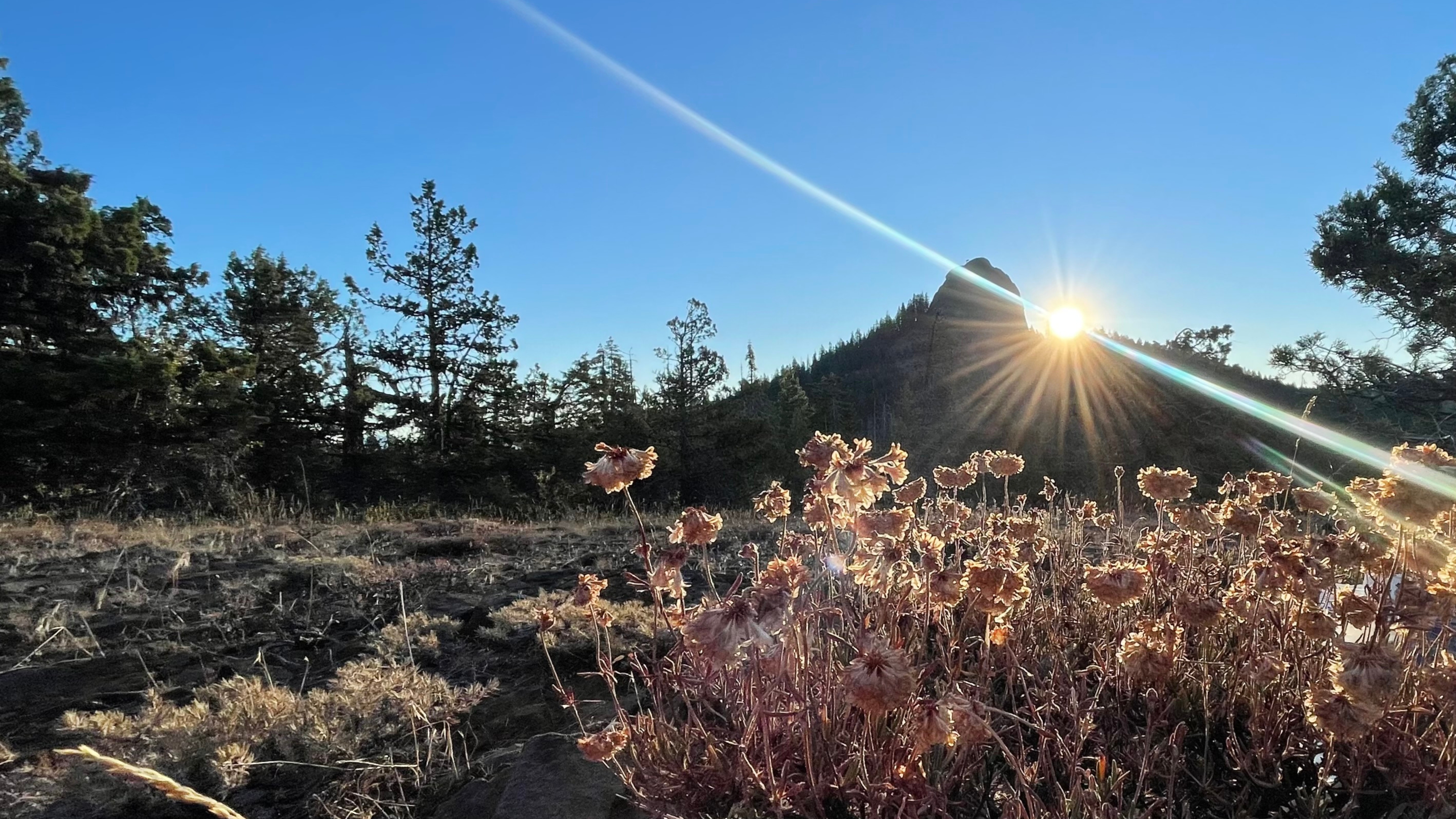
This August, I realized I had an open day in the middle of the week—the very week of the Perseid meteor showers. It seemed like a good time to try out the new transit service running in Ashland, where I live—a shuttle van from the Columbia Hotel downtown to the nearest trailhead for the Pacific Crest Trail. I booked a spot on their website, paid $5, and showed up at 10:30 the next morning. A thru-hiking couple headed southbound were already onboard as I climbed in the van, and I heard their trail news and impressions of Ashland as we drove out of town. In what felt like no time at all, we were there, and I was waving goodbye and heading toward Pilot Rock. It was barely 11:00, and in just a couple of hours I would be out in a wide expanse off the Lone Pilot trail, no other hikers around.
I picked a shady spot under a tree, kicked off my hiking shoes, and snacked and read through the afternoon. As the sky grew dark, I rolled out my bag on a groundcloth in the clearing, not bothering with my tent. The stars began to reveal themselves, satellites zipping between them on their busy way around the world. The moon would be up soon, but here, in this small gap of time, there was just enough darkness that I could witness the streaks of the meteors as they blazed past our little planet. I fell asleep not long after, sung into my dreams by crickets in the brush.
In the morning, I woke up and caught the bus home.
Meg Wade is a writer, community organizer, facilitator, and sometimes indie bookseller based in Southern Oregon. Their work in pro-democracy and climate justice movements often centers on place-based community building as well as mobility justice issues. Their writing can be found at Unsettling on Substack. They are a 2025 Oregon Humanities Community Storytelling Fellow.
Comments
No comments yet.
Add a Comment